


A B C D E F G H I J K L M N O P Q R S T U V W X Y Z
A
Application in computer science, a computer program designed to help people perform a certain type of work. An application thus differs from an operating system (which runs a computer), a utility (which performs maintenance or general-purpose chores), and a language (with which computer programs are created). Depending on the work for which it was designed, an application can manipulate text, numbers, graphics, or a combination of these elements. Some application packages offer considerable computing power by focusing on a single task, such as word processing; others, called integrated software, offer somewhat less power but include several applications, such as a word processor, a spreadsheet, and a database program.
Assembly Language in computer science, a type of low-level computer programming language in which each statement corresponds directly to a single machine instruction. Assembly languages are thus specific to a given processor. After writing an assembly language program, the programmer must use the assembler specific to the microprocessor to translate the assembly language into machine code. Assembly language provides precise control of the computer, but assembly language programs written for one type of computer must be rewritten to operate on another type. Assembly language might be used instead of a high-level language for any of three major reasons: speed, control, and preference. Programs written in assembly language usually run faster than those generated by a compiler; use of assembly language lets a programmer interact directly with the hardware (processor, memory, display, and input/output ports).
����Back to Top
BASIC, in computer science, acronym for Beginner's All-purpose Symbolic Instruction Code. A high-level programming language developed by John Kemeny and Thomas Kurtz at Dartmouth College in the mid-1960s. BASIC gained its enormous popularity mostly because of two implementations, Tiny BASIC and Microsoft BASIC, which made BASIC the first lingua franca of microcomputers. Other important implementations have been CBASIC (Compiled BASIC), Integer and Applesoft BASIC (for the Apple II), GW-BASIC (for the IBM PC), Turbo BASIC (from Borland), and Microsoft QuickBASIC. The language has changed over the years. Early versions are unstructured and interpreted. Later versions are structured and often compiled. BASIC is often taught to beginning programmers because it is easy to use and understand and because it contains the same major concepts as many other languages thought to be more difficult, such as Pascal and C.
Benchmark, in relation to computers, a type of test used to measure hardware or software performance. Benchmark tests for hardware use programs that test the capabilities of the equipment�for example, the speed at which a microprocessor can execute instructions or handle floating-point numbers. Benchmark tests for software determine the efficiency, accuracy, or speed of a program in performing a particular task, such as recalculating data in a spreadsheet. The same data is used with each program tested, so the resulting scores can be compared to see which programs perform well, and in what areas. The design of fair benchmarks is something of an art because various combinations of hardware and software can exhibit widely variable performance under different conditions. Often, after a benchmark has become a standard, developers try to optimize a product to run that benchmark faster than similar products run it in order to enhance sales.
BIOS, in computer science, acronym for basic input/output system, a set of routines that work closely with the computer hardware to support the transfer of information between elements of the system, such as memory, disks, and the monitor. On IBM and compatible computers, the BIOS, or ROM BIOS, is built into the machine's read-only memory (ROM). Although critical to performance, the BIOS is invisible to computer users. The BIOS can, however, be accessed by programmers.
Bit, in computer science, short for binary digit; either 1 or 0 in the binary number system (see NUMBER SYSTEMS). In computer processing and storage, a bit is the smallest unit of information handled by a computer and is represented physically by an element such as a single pulse sent through a circuit or a small spot on a magnetic disk capable of storing either a 1 or a 0. Considered singly, bits convey little information a human would consider meaningful. In groups of eight, however, bits become the familiar bytes used to represent all types of information, including the letters of the alphabet and the digits 0 through 9.
Buffer (computer science), in computer science, an intermediate repository of data�a reserved portion of memory in which data is temporarily held pending an opportunity to complete its transfer to or from a storage device or another location in memory. Some devices, such as printers or the adapters supporting them, commonly have their own buffers.
Bus (computer), in computer science, a set of hardware lines-wires-used for data transfer among the components of a computer system. A bus is essentially a shared highway that connects different parts of the system-including the microprocessor, disk-drive controller, memory, and input/output ports-and enables them to transfer information. Usually supervised by the microprocessor, the bus is, in computers such as the Apple Macintosh and IBM and compatible models, specialized for carrying different types of information. One group of wires (actually, traces on a printed circuit board), for example, carries data; another carries the addresses (locations) where specific information can be found; yet another carries control signals to ensure that the different parts of the system use their shared highway without conflict. Buses are characterized by the number of bits they can transfer at a single time. A computer with an 8-bit data bus, for example, transfers 8 bits of data at a time, and one with a 16-bit data bus transfers 16 bits at a time. Because the bus is integral to internal data transfer and yet computer users often need to add extra components to the system, most microcomputer buses allow for expansion through one or more expansion slots (connectors for add-on circuit boards). Such boards, when they are added, make an electrical connection to the bus and effectively become part of the system.
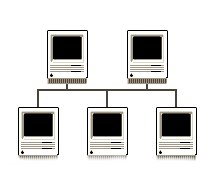
Bus Network, in computer science, a topology (configuration) for a local area network in which all nodes are connected to a main communications line (bus). On a bus network, each node monitors activity on the line. Messages are detected by all nodes but are accepted only by the node(s) to which they are addressed. Because a bus network relies on a common data "highway," a malfunctioning node simply ceases to communicate; it doesn't disrupt operation as it might on a ring network, in which messages are passed from one node to the next. To avoid collisions that occur when two or more nodes try to use the line at the same time, bus networks commonly rely on collision detection or Token Passing to regulate traffic.See Picture
Byte, in computer science, a unit of information consisting of 8 bits; in computer processing and storage, the equivalent of a single character, such as a letter, a numeral, or a punctuation mark. Because a byte represents only a small amount of information, amounts of computer memory and storage are usually given in kilobytes (1024 bytes) or megabytes (1,048,576 bytes).
����Back to Top
C++, in computer science, an object-oriented version of the C programming language, developed by Bjarne Stroustrup in the early 1980s at Bell Laboratories and adopted by a number of vendors, including Apple Computer, Sun Microsystems, Borland International, and Microsoft Corporation.
CAI in computer science, acronym for computer-aided (or computer-assisted) instruction, a type of educational program designed to serve as a teaching tool. CAI programs use tutorials, drills, and question-and-answer sessions to present a topic and to test the student's comprehension. CAI programs are excellent aids for presenting factual material and for allowing students to pace their learning speed. Subjects and complexity range from beginning arithmetic to advanced mathematics, science, history, computer studies, and specialized topics. CAI is one of a plethora of terms, most with overlapping meanings, related to the use of computers in teaching; others include computer-assisted learning, computer-augmented learning, computer-based learning,computer-based training, and computer-managed instruction.
Compiler in computer science, in the most general sense, any computer program that transforms one set of symbols into another by following a set of syntactical and semantical rules; in the most common sense, a program that translates all the source code of a program written in a high-level language into object code prior to execution of the program. Object code is executable machine code or a variation of machine code.
Computer electronic device that can receive a set of instructions, or program, and then carry out this program by performing calculations on numerical data or by compiling and correlating other forms of information.
Computer Family in computer science, a term commonly used to indicate a group of computers that are built around the same microprocessor or around a series of related microprocessors and that share significant design features. For example, the Apple Macintosh computers, from the original Macintosh to the Macintosh II, represent a family designed by Apple around the Motorola 68000, 68020, and 68030 microprocessors. Similarly, the IBM PC computers and the �second-generation� PS/2 models can be considered the IBM PC family of computers, all built by IBM around the Intel iAPx86 series of microprocessors. Depending on point of view, however, a computer family can also be considered as encompassing any machines that share the same microprocessor. In this sense, the IBM models and compatible machines built by other manufacturers can be considered part of a larger grouping, the iAPx86 family of computers. Currently, members of different microcomputer
families are not particularly compatible (able to use the same operating system and application programs).
Computer Graphics the generation of graphs, tables, and static or moving images by computer systems, usually for display on cathode-ray tubes. The complexity of the graphic material depends on the software program being used and on the sophistication of the computer memory. Vector tubes produce line images. Raster-scan tubes use an electron beam that sweeps repeatedly across a screen consisting of a grid of dots, called pixels, each of which may be varied in brightness and color. Programs that employ fractal algorithms can develop very lifelike graphics. Computer graphics, familiar through popular video games, are widely used in science and industry. In motion pictures, highly sophisticated computer graphics are used in the creation of special effects.
Computer Language an artificial language that specifies instructions to be executed on a computer. The term covers a wide spectrum, from binary-coded machine language to high-level languages.
Computer Program a set of instructions in some computer language, intended to be executed on a computer to perform a useful task. The term usually implies a self-contained entity, as opposed to a routine or a library.
����Back to Top
Database, any collection of data organized for storage in a computer memory and designed for easy access by authorized users. The data may be in the form of text, numbers, or encoded graphics. Since their first, experimental appearance in the 1950s, databases have become so important in industrial societies that they can be found in almost every field of information. Government, military, and industrial databases are often highly restricted, and professional databases are usually of limited interest. A wide range of commercial, governmental, and nonprofit databases are available to the general public, however, and may be used by anyone who owns or has access to the equipment that they require.
Small databases were first developed or funded by the U.S. government for agency or professional use. In the 1960s, some databases became commercially available, but their use was funneled through a few so-called research centers that collected
information inquiries and handled them in batches. On-line databases�that is, databases available to anyone who could link up to them by computer�first appeared in the 1970s. For the home user, the equipment required includes a computer terminal, a telephone, and a modem, which enables the terminal and the database (usually some type of search-service system) to intercommunicate. (Modified television sets can also be equipped to receive some specifically designed database services.) The user simply dials the number of the service, provides a password code for identification and billing, and types in questions to a chosen database on the terminal's keyboard. The data received may either be displayed on a terminal screen or printed out.
����Back to Top
EPROM, in computer science, acronym for erasable programmable read-only memory. Also called reprogrammable read-only memory (RPROM). EPROMs are nonvolatile memory chips that are programmed after they are manufactured. EPROMs are a good way for hardware vendors to put variable or constantly changing code into a prototype system when the cost of producing many PROM chips would be prohibitive. EPROMs differ from PROMs in that they can be erased, generally by removing a protective cover from the top of the chip package and exposing the semiconductor material to ultraviolet light, and can be reprogrammed after having been erased. Although EPROMs are more expensive than PROMs, they can be more cost-effective in the long run if many changes are needed.
����Back to Top
File, in computer science, a complete, named collection of information, such as a program, a set of data used by a program, or a user-created document. A file is the basic unit of storage that enables a computer to distinguish one set of information from another. A file might or might not be stored in human-readable form, but it is still the �glue� that binds a conglomeration of instructions, numbers, words, or images into a coherent unit that a user can retrieve, change, delete, save, or send to an output device.
File Server, in computer science, a file-storage device on a local area network that is accessible to all users on the network. Unlike a disk server, which appears to the user as a remote disk drive, a file server is a sophisticated device that not only stores files but manages them and maintains order as network users request files and make changes to them. To deal with the tasks of handling multiple�sometimes simultaneous�requests for files, a file server contains a processor and controlling software as well as a disk drive for storage. On local area networks, a file server is often a computer with a large hard disk that is dedicated only to the task of managing shared files.
File Sharing, in computer science, the use of computer files on networks, where files are stored on a central computer or a shared server and are requested, reviewed, and modified by more than one individual. When a file is used with different programs or different computers, file sharing can require conversion to a mutually acceptable format. When a single file is shared by many people, access can be regulated through such means as password protection, security clearances, or file locking to prohibit changes to a file by more than one person at a time.
Flowchart, sequential diagram employed in many fields to show the stepwise procedures used in performing a task, as in manufacturing, or solving a problem, as in an algorithm. Flowcharts are commonly used in the designing of computer programs.
FORTRAN, in computer science, acronym for FORmula TRANslation. The first high-level computer language (developed 1954-58 by Jim Backus) and the progenitor of many key high-level concepts, such as variables, expressions, statements, iterative and conditional statements, separately compiled subroutines, and formatted input/output. FORTRAN is a compiled, structured language. The name indicates its scientific and engineering roots; FORTRAN is still used heavily in those fields, although the language itself has been expanded and improved vastly over the last 35 years to become a language that is useful in any field.
����Back to Top
Graphical User Interface (GUI), in computer science, a type of display format that enables the user to choose commands, start programs, and see lists of files and other options by pointing to pictorial representations (icons) and lists of menu items on the screen. Choices can generally be activated either with the keyboard or with a mouse. Graphical user interfaces are used on the Apple Macintosh and by such programs as Microsoft Windows and the OS/2 Presentation Manager.
Graphics Mode, on computers such as the IBM PC, the display mode in which lines and characters on the screen are drawn pixel by pixel. Because graphics mode creates images from individual dots on the screen, programs have more flexibility in creating images than they do in the opposite display mode, text (or character) mode. Thus, the computer is able to display a mouse pointer as an arrowhead or other shape rather than as a blinking square or rectangle, and it can display character attributes, such as boldface and italics, as they will appear in print rather than using conventions such as highlighting, underlining, or alternate colors.
����Back to Top
Hardware in computer science, the physical components of a computer system, including any peripheral equipment such as printers, modems, and mice.
High-Level Language in computer science, a computer language that provides a certain level of abstraction from the underlying machine language through the use of declarations, control statements, and other syntactical structures. In practice, the term comprises every computer language above assembly language.
����Back to Top
Input/Output (I/O), in computer science, two of the three activities (input, processing, and output) that characterize a computer. Input/output refers to the complementary tasks of gathering data for the microprocessor to work with and making the results available to the user through a device such as the display, disk drive, or printer. The keyboard and the mouse are input devices that make information available to the computer; the display and printer are output devices with which the computer makes its results available to the user. A disk drive is both an input and an output device because it can either provide stored information or store the data after processing.
ISA, abbreviation for Industry Standard Architecture. In computer science, an unofficial designation for the bus design of the IBM PC/XT, which allows various adapters (ADAPTER) to be added to the system by means of inserting plug-in cards into expansion slots. Originally introduced with an 8-bit data path, ISA was expanded in 1984, when IBM introduced the PC/AT, to include a 16-bit data path. Commonly, ISA refers to the expansion slots themselves; such slots are called 8-bit slots or 16-bit slots. A 16-bit slot actually consists of two separate expansion slots mounted end-to-end so that a single 16-bit card plugs into both slots. An 8-bit expansion card can be inserted and used in a 16-bit slot (it occupies only one of the two slots), but a 16-bit expansion card cannot be used in an 8-bit slot.
����Back to Top
Java (computer), in computer science, object-oriented programming language introduced in 1995 by Sun Microsystems, Inc. Java facilitates the distribution of both data and small applications programs, called applets, over the Internet. Java applications do not interact directly with a computer's central processing unit (CPU) or operating system and are therefore platform independent, meaning that they can run on any type of personal computer, workstation, or mainframe computer. This cross-platform capability, referred to as "write once, run everywhere," has caught the attention of many software developers and users. With Java, software developers can write applications that will run on otherwise incompatible operating systems such as Windows, the Macintosh operating system, OS/2, or UNIX.
To use a Java applet on the World Wide Web (WWW)-the system of software and protocols that allows multimedia documents to be viewed on the Internet-a user must have a Java-compatible browser, such as Navigator from Netscape Communications Corporation, Internet Explorer from Microsoft Corporation, or HotJava from Sun Microsystems. A browser is a software program that allows the user to view text, photographs, graphics, illustrations, and animations on the WWW. Java applets achieve platform independence through the use of a virtual machine, a special program within the browser software that interprets the bytecode-the code that the applet is written in-for the computer's CPU. The virtual machine is able to translate the platform-independent bytecode into the platform-dependent machine code that a specific computer's CPU understands.
Applications written in Java are usually embedded in Web pages, or documents, and can be run by clicking on them with a mouse. When an applet is run from a Web page, a copy of the application program is sent to the user's computer over the Internet and stored in the computer's main memory. The advantage of this method is that once an applet has been downloaded, it can be interacted with in real time by the user. This is in contrast to other programming languages used to write Web documents and interactive programs, in which the document or program is run from the server computer. The problem with running software from a server is that it generally cannot be run in real time due to limitations in network or modembandwidth-the amount of data that can be transmitted in a certain amount of time.
Java grew out of a research project at Sun Microsystems in the early 1990s that focused on controlling different consumer electronics devices using the same software. The original version of Java, called Oak, needed to be simple enough to function with the modest microprocessors found in such consumer devices. Following the introduction of the National Center for Supercomputing Applications' (NCSA) Mosaic browser in 1993, Oak was recast by Sun Microsystems developers. In 1994 Sun Microsystems released a Java-compatible Internet browser, called HotJava, that was designed to read and execute Java applets on the WWW. Netscape Communications licensed Java from Sun Microsystems in November 1995, and its Navigator 3.0 browser supports Java applications. Microsoft also licensed Java, in 1996, for its Internet Explorer 3.0 browser. Microsoft developed a programming language, called Visual J++, to integrate Java, through its ActiveX technology, with its browser. Visual J++ is optimized for the Windows operating system. Various other WWW browsers are also capable of supporting Java applications and applets.
JavaSoft, a division of Sun Microsystems with responsibility for Java and its business development, has created JavaOS, a compact operating system for use on its own JavaStation network computers, now in development, as well as, possibly, in cellular telephones and pagers.
Joystick, in computer science, a popular pointing device, used mostly for playing computer games but used for other tasks as well. A joystick usually has a square or rectangular plastic base to which is attached a vertical stem. Control buttons are located on the base and sometimes on top of the stem. The stem can be moved omnidirectionally to control the movement of an object on the screen. The buttons activate various software features, generally producing on-screen events. A joystick is usually a relative pointing device, moving an object on the screen when the stem is moved from the center and stopping the movement when the stem is released. In industrial control applications, the joystick can also be an absolute pointing device, with each position of the stem mapped to a specific on-screen location.
����Back to Top
Keyboard, in computer technology, a device for entering information into a computer. A keyboard uses a key arrangement resembling that on an ordinary typewriter, with the addition of keys for specialized functions. Touching a key generates a unique electronic signal to which the computer is designed to respond.
Kilobyte, abbreviated KB, K, or Kbyte. One thousand twenty-four bytes.
����Back to Top
Low-Level Language in computer science, a computer programming language that is machine-dependent and/or that offers few control instructions and data types. Each statement in a program written in a low-level language usually corresponds to one machine instruction. Assembly language is considered a low-level language.
����Back to Top
Machine Code in computer science, the ultimate result of the compilation of assembly language or any high-level language such as C or Pascal: sequences of 1's and 0's that are loaded and executed by a microprocessor. Machine code, also known as machine language, is the only language computers �understand�; all other programming languages represent ways of structuring human language so that humans can get computers to perform specific tasks. A compiler translates programs encoded in a high-level language into machine code.
Memory (computer), in computer science, circuitry that allows information to be stored and retrieved. In the most general sense, memory can refer to external systems such as disk drives or tape drives; in common usage, it refers only to the fast semiconductor storage (RAM) directly connected to the processor.
Modem, device that converts between analog and digital signals. Digital signals, which are used by computers, are made up of separate units, usually represented by a series of 1's and 0's. Analog signals vary continuously; an example of an analog signal is a sound wave. Modems are often used to enable computers to communicate with each other across telephone lines. A modem converts the digital signals of the sending computer to analog signals that can be transmitted through telephone lines. When the signal reaches its destination, another modem reconstructs the original digital signal, which is processed by the receiving computer. If both modems can transmit data to each other simultaneously, the modems are operating in full duplex mode; if only one modem can transmit at a time, the modems are operating in half duplex mode.
To convert a digital signal to an analog one, the modem generates a carrier wave and modulates it according to the digital signal. The kind of modulation used depends on the application and the speed of operation for which the modem is designed. For example, many high-speed modems use a combination of amplitude modulation, where the amplitude of the carrier wave is changed to encode the digital information, and phase modulation, where the phase of the carrier wave is changed to encode the digital information. The process of receiving the analog signal and converting it back to a digital signal is called demodulation. The word �modem� is a contraction of its two basic functions: modulation and demodulation.
����Back to Top
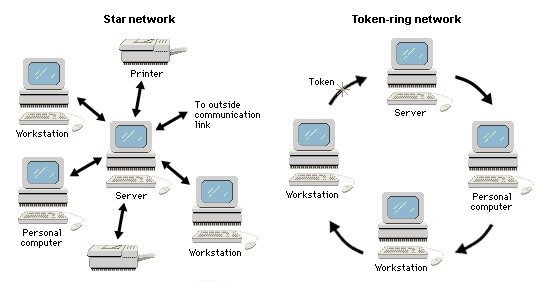
Network, in computer science, techniques, physical connections, and computer programs used to link two or more computers. Network users are able to share files, printers, and other resources; send electronic messages; and run programs on other computers.A network has three layers of components: application software, network software, and network hardware. Application software consists of computer programs that interface with network users and permit the sharing of information, such as files, graphics, and video, and resources, such as printers and disks. One type of application software is called client-server. Client computers send requests for information or requests to use resources to other computers, called servers, that control data and applications. Another type of application software is called peer-to-peer. In a peer-to-peer network, computers send messages and requests directly to one another without a server intermediary.See Picture
����Back to Top
Object Code in computer science, the code, generated by a compiler or an assembler, that was translated from the source code of a program. The term most commonly refers to machine code that can be directly executed by the system's central processing unit (CPU), but it can also be assembly language source code or a variation of machine code.
Object-Oriented Programming (OOP), in computer science, type of high-level computer language that uses self-contained, modular instruction sets for defining and manipulating aspects of a computer program. These discrete, pre-defined instruction sets are called objects and may be used to define variables, data structures, and procedures for executing data operations. In OOP, objects have built-in rules for communicating with one another. They can also be manipulated or combined in various ways to modify existing programs and to create entirely new ones from pieces of other programs.
Operating System, abbreviated OS; sometimes called the executive. In computer science, the software responsible for controlling the allocation and usage of hardware resources such as memory; central processing unit (CPU) time, disk space, and peripheral devices. The operating system is the foundation on which applications, such as word-processing and spreadsheet programs, are built. Popular operating systems include MS-DOS, Windows-NT, the Macintosh OS, OS/2, and UNIX.
����Back to Top
Program in computer science, synonymous with software; a sequence of instructions that can be executed by a computer. The term can refer to the original source code or to the executable (machine language) version. The term program implies a degree of completeness; that is, a source code program comprises all statements and files necessary for complete interpretation or compilation, and an executable program can be loaded into a given environment and executed independently of other programs.
����Back to Top
QWERTY Keyboard, in computer science, a keyboard layout named for the six leftmost characters in the top row of alphabetic characters on most keyboards�the standard layout of most typewriters and computer keyboards. An alternative layout, the Dvorak keyboard, is considered more efficient, but the QWERTY keyboard has the advantage of familiarity. In addition, it is by far the more widespread of the two.
����Back to Top
RAM, in computer science, acronym for random access memory. Semiconductor-based memory that can be read and written by the microprocessor or other hardware devices. The storage locations can be accessed in any order. Note that the various types of ROM memory are capable of random access. The term RAM, however, is generally understood to refer to volatile memory, which can be written as well as read.
ROM, acronym for read-only memory. In computer science, semiconductor-based memory that contains instructions or data that can be read but not modified. To create a ROM chip, the designer supplies a semiconductor manufacturer with the instructions or data to be stored; the manufacturer then produces one or more chips containing those instructions or data. Because creating ROM chips involves a manufacturing process, it is economically viable only if the ROM chips are produced in large quantities; experimental designs or small volumes are best handled using PROM or EPROM. In general usage, the term ROM often means any read-only device, including PROM and EPROM.
����Back to Top
Software (computer) computer programs; instructions that cause the hardware�the machines�to do work. Software as a whole can be divided into a number of categories based on the types of work done by programs. The two primary software categories are operating systems (system software), which control the workings of the computer, and application software, which addresses the multitude of tasks for which people use computers. System software thus handles such essential, but often invisible, chores as maintaining disk files and managing the screen, whereas application software performs word processing, database management, and the like. Two additional categories that are neither system nor application software, although they contain elements of both, are network software, which enables groups of computers to communicate, and language software, which provides programmers with the tools they need to write programs.
Source Code in computer science, human-readable program statements written in a high-level or assembly language, as opposed to object code, which is derived from the source code and designed to be machine-readable.
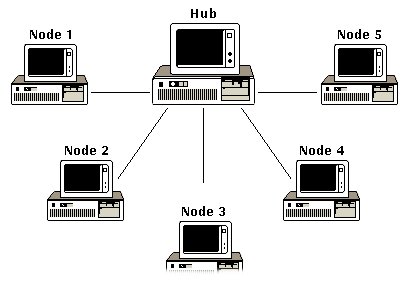
Star Network,A star network consists of several nodes connected to a central hub in a star-shaped configuration. Messages from individual nodes pass directly to the hub, which determines any further routing.See Picture
����Back to Top
Token Passing, in computer science, a method of controlling access on local area networks through the use of a special signal, called a token, that determines which station is allowed to transmit. The token, which is actually a short message, is passed from station to station around the network. Only the station with the token has the right to transmit information. If a station receives the token and has no information to transmit, it passes the token to the next station in line. Token passing is one means of ensuring that multiple stations do not transmit at the same time.
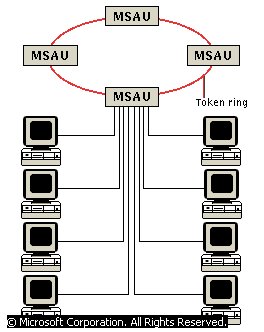
Token Ring network, Developed by IBM, the Token Ring network combines elements of ring and star networks in a configuration consisting of a ring that connects multistation access units (MSAUs). The ring regulates traffic via a passed token. Only the node receiving the token has access to transmitted messages. The MSAUs operate similarly to a star network configuration in that many nodes are connected to one hub.See Picture
����Back to Top
UNIX, in computer science, a powerful multiuser, multitasking operating system. Considered a very powerful operating system, UNIX is written in the C language and can be installed on virtually any computer.
UNIX was originally developed by Ken Thompson and Dennis Ritchie at AT&T Bell Laboratories in 1969 for use on minicomputers. In the early 1970s, many universities, research institutions, and companies began to expand on and improve UNIX. These efforts resulted in two main versions: BSD UNIX, a version developed at the University of California at Berkeley, and System V, developed by AT&T and its collaborators.
Many companies developed and marketed their own versions of UNIX in subsequent years. Variations of UNIX include AIX, a version of UNIX adapted by IBM to run on RISC-based workstations; A/UX, a graphical version for the Apple Macintosh; XENIX OS, developed by Microsoft Corporation for 16-bit microprocessors; SunOS, adapted and distributed by Sun Microsystems, Inc.; Mach, a UNIX-compatible operating system for the NeXT computer; and Linux, developed by Swedish computer engineer Linus Torvalds with collaborators worldwide.
����Back to Top
Virtual Disk, in computer science, commonly called a RAM disk, Random access memory (RAM) used as a disk drive. Because the computer does not need to wait for the hardware to respond, reading and writing to such a �disk� can vastly improve performance. However, because a virtual disk exists only in memory, its contents must be copied to a physical disk or the data will be lost. The exception is a virtual disk on battery-backed RAM, which is RAM that has its own battery; when the power to the computer is turned off, that battery ensures that the contents of RAM are left intact. Ultralight laptops often use battery-backed RAM as a virtual disk because such storage consumes less power than a hard disk.
����Back to Top
Wildcard Character, in computer science, a keyboard character that can be used to represent one or many characters; usually encountered with operating systems as a means of specifying more than one file by name. In MS-DOS, for example, the question mark (?) wildcard character can be used to represent any single character, and the asterisk (*) can be used to represent any number of characters. Thus, ?OOK.DOC would refer to BOOK.DOC, COOK.DOC, LOOK.DOC, and so on; *.DOC would refer to any filename ending in the extension .DOC; and *.* would refer to any filename and any extension�in other words, to all files on the specified disk or in a specified directory.
Word Processor, in computer science, an application program for manipulating text-based documents; the electronic equivalent of paper, pen, typewriter, eraser, and most likely, dictionary and thesaurus. Word processors run the gamut from simple through complex, but all ease the tasks associated with editing documents (deleting, inserting, rewording, and so on). Depending on the program and the equipment in use, word processors can display documents either in text mode, using highlighting, underlining, or color to represent italics, boldfacing, and other such formatting, or in graphics mode, wherein formatting and, sometimes, a variety of fonts appear on the screen as they will on the printed page. All word processors offer at least limited facilities for document formatting, such as font changes, page layout, paragraph indention, and the like. Some word processors can also check spelling, find synonyms, incorporate graphics created with another
program, correctly align mathematical formulas, create and print form letters, perform calculations, display documents in multiple on-screen windows, and enable users to record macros that simplify difficult or repetitive operations. See also OFFICE SYSTEMS.
Workstation, in computer science, in general, a combination of input, output, and computing hardware that can be used for work by an individual. More often, however, the term refers to a powerful stand-alone computer of the sort used in computer-aided design and other applications requiring a high-end, usually expensive, machine ($10,000 to $100,000) with considerable calculating or graphics capability. Sometimes, workstation is also used to refer to a microcomputer or terminal connected to a network.
WORM (computer drive), acronym for �write once, read many.� In computer science, a type of optical disc that can be read and reread but cannot be altered after it has been recorded. WORMs are high-capacity storage devices. Because they cannot be erased and rerecorded, they are suited to storing archives and other large bodies of unchanging information.
Worm (computer program), in computer science, a program that propagates itself across computers, usually by spawning copies of itself in each computer's memory. A worm might duplicate itself in one computer so often that it causes the computer to crash. Sometimes written in separate �segments,� a worm is introduced surreptitiously into a host system either for �fun� or with intent to damage or destroy information. The term comes from a science-fiction novel and has generally been superseded by the term virus.
WYSIWYG, in computer science, an acronym for �What you see is what you get.� A display method that shows documents and graphic characters on the screen as they will appear when printed, WYSIWYG attempts to duplicate print output as closely as possible but is not always exact. Some programs, for example, can display italics, boldface, and graphic characters on the screen, but only in a predetermined type size. Other programs, particularly on computers such as the Apple Macintosh, can display fonts, font sizes, and graphical images that closely approximate those in the printed version. Regardless of a program's capabilities, however, WYSIWYG requires display hardware capable of operating in graphics mode rather than in text mode.
����Back to Top
XModem, in computer science, a file-transfer protocol used in asynchronous communications. Developed in 1977 by Ward Christensen, XModem is widely available as public-domain software and in numerous communications programs. XModem transfers information in blocks of 128 bytes. It assigns each transmitted frame a sequential block number, which is used to report errors or duplications in transmission. A 1-byte checksum (sum of the data bytes) is included in each block to check for errors in transmitted data.
����Back to Top
YModem, in computer science, a variation of the XModem file-transfer protocol that includes the following enhancements: the ability to transfer information in 1-kilobyte (1024-byte) blocks; the ability to send multiple files (batch-file transmission); cyclical redundancy checking; and the ability to abort transfer by transmitting two CAN (cancel) characters in a row.
����Back to Top
Z80, in computer science, an 8-bit microprocessor from Zilog, a company founded by former Intel engineers. The Z80 has a 16-bit address bus, yielding 64 kilobytes of addressable memory, and an 8-bit data bus. A descendant of the Intel 8080, it was the favorite processor in the days of the CP/M operating system. One of the most popular computers of the day, the Radio Shack TRS-80, is based on this chip.
A B C D E F G H I J K L M N O P Q R S T U V W X Y Z