Copyright Page
Oxford University Press
Oxford New YorkAthens Auckland Bangkok Bogota Bombay Buenos Aires
Calcutta Cape Town Dar es Salaam Delhi Florence Hong Kong
Istanbul Karachi Kuala Lumpur Madras Madrid Melbourne
Mexico City Nairobi Paris Singapore Taipei Tokyo Toronto
and associated companies in
Berlin Ibadan
Copyright © 1997 by Oxford University Press, Inc.
Published by Oxford University Press, Inc.198 Madison Avenue, New York. New York 10016
Oxford is a registered trademark of Oxford University Press
All rights reserved. No part of this publication may be reproduced.
stored in a retrieval system, or transmitted, in any form or by any means,
electronic, mechanical, photocopying, recording, or otherwise.
without the prior permission of Oxford University Press.
Library of Congress Cataloging-in-Publication Data
Snygg, John.
Clifford algebra : a computational tool for physicists / John Snygg.
p. cm. Includes bibliographical references and index.
ISBN 0-19-509824-2
1. Clifford algebras. 2. Mathematical physics. I. Title.
QC2O.7.C55S64 1997 530.1'5257-dc2O 96-6890
1 3 5 7 9 8 6 4 2
Printed in the United States of America
on acid-free paper
Back to the top
Dedication
To my wife, Virginia
Back to the top
Contents
Back to the topIntroductionMuch of Clifford algebra is quite simple minded. If this fact were generally recognized, Clifford algebra would be more widely used as a computational tool. Entire books have been written on the calculus of manifolds. However, one does not need to master the contents of such a book before one is able to use different coordinate systems to solve problems. Similarly much of the material usually covered in books on Clifford algebra is unnecessary for a very broad spectrum of applications. The applications discussed in this book range from special relativity and the rotating top at one end of this spectrum to general relativity and Dirac�s equation for the electron at the other end. In Chapter 9, we present an elementary derivation of the Kerr metric which is the basis for the mathematics of black holes. In Chapter 10, we present a second derivation of the Kerr metric. This second derivation is more sophisticated but it is also more straightforward than the derivation presented in Chapter 9. The math prerequisites for this book are the usual undergraduate sequence of courses in calculus plus one course in linear algebra. The physics prerequisites for most of the book correspond to that covered by an undergraduate physics major. However, a few applications discussed in the book may require some physics usually covered in the first year of graduate school. Clifford algebra has become a virtual necessity for the study of some areas of physics and its use is expanding in other areas. Some physicists have been using Clifford algebra without realizing it. In quantum electrodynamics, it has been discovered that many algebraic manipulations involving Dirac matrices can be carried out most efficiently without reference to any particular matrix representation. This is Clifford algebra. In Klein-Kaluza theories and dimensional renormalization theories, one must deal with spaces of dimensions other than the four used in Dirac�s equation In such situations one can no longer use the usual 4 x 4 matrix representations of Dirac matrices and if one wishes to consider spaces of arbitrary dimension, one is forced to avoid reference to any particular representation This requires Clifford algebra. Clifford algebra is now being applied in a very conscious and explicit manner in the formulation of superstring theories. Thus Clifford algebra has become an indispensable tool for those at the cutting edge of theoretical investigations. Vector calculus has long been regarded as a universal language of physicists. In recent years there have been those who have strongly recom�mended that all serious physicists become conversant with differential forms. However Clifford algebra encompasses both of these areas of mathematics along with tensor calculus.
Another formalism that has been effectively used and promoted by Roger Penrose and others is that of spinors. It is interesting to note that in the appendix of their book, Spinors and Space-Time, Vol. 2 (1986, pp. 440-464), Penrose and Rindler use the structure of Clifford algebra to generalize the notion of spinors that has been used for 4-dimensional spaces with
The structure of differential forms and tangent vectors is embedded in the structure of Clifford algebra with only slight modifications. Thus advanced readers who already have some mastery of differential forms should find the content of much of this book to be familiar territory.
Actually, in the context of Clifford algebra, the formalism of differential forms and tangent vectors can be substantially simplified. In the usual formulation,
In the usual formalism, the tangent vector
One important feature of this book is a substantial discussion of Fock-Jvanenko 2-vectors (Fock and Ivanenko 1929; Fock 1929). These 2-vectors were introduced by Vladimir Fock and Dimitrii Ivanenko to make Dirac�s equation for the electron compatible with the dictates of general relativity. Using these 2-vectors, denoted by

In this context, the
It has been said that gravitational fields are not Yang-Mills fields but it is interesting to note that 
where
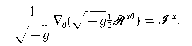
This is equivalent to 
where the
I have found that the Fock-Ivanenko 2-vectors can be used to expedite the computation of both the Schwarzschild and the Kerr metric. These computations are carried out in this text. Different readers of this book will have different interests. Some will be interested in some applications but not in others. Some readers may wish to read the mathematical portions and omit some or even most of the applications. This is generally possible. Several sections of the book are unnecessary for the understanding of the succeeding contents of the book. These sections have been designated with asterisks in the table of contents. | ||||||||||||||||||||||||||||||||||||||||||||||||||||||||||||||||||||||||||||||||||||||||||||||||||||||||||||||||||||||||||||||||||||||||||||||||||||||||||||||||||||||||||||||||||||||||||||||||||||||||||||||||||||||||||||
 signature to spaces of arbitrary dimension.
 are presented as coordinate bases of dual spaces. The distinction between these spaces is necessary when no metric is given. However, for most physical applications, one needs to introduce a non-singular metric which generates an isomorphism between these spaces. Spaces that are isomorphic are essentially identical. In the formalism of differential forms as usually presented, one does not take advantage of this fact. Even in the presence of a metric, unnecessary distinctions are main�tained. This creates a multitude of products, mappings, and spaces which require a considerable amount of bookkeeping in the notation.
 is treated as the image of the differential form
 under an isomorphic mapping. In the structure of Clifford algebra, the analogous relation becomes a simple equality:
 This simple difference in the two formalisms enables one to carry out computational manipulations in Clifford algebra which would either be awkward or illegal in the usual formalism of differential forms. All products that appear in Clifford algebra can be readily grasped by anyone familiar with matrix multiplication.
 Dirac�s equation becomes
 may be regarded as components of a gauge field.
 is the curvature 2-form. Furthermore, using the formalism of this text, a slightly generalized version of Einstein�s field equations can be cast in the form of a Yang-Mills equation. Namely
 are components of the Ricci tensor and the
 are components of the energy-momentum tensor. This form of Einstein�s field equations admits the possibility of a nonzero cosmological constant.
Back to the top
| Home | Clifford Algebra | Keywords | Copyright | Dedication |
| Contents | Introduction | Listings | Reviews | Errata |