| We're up early at this quiet hotel, and wait for the dining room to open for
breakfast. Well, there's just one table set for two people, and we quickly figure out
we're the only guests! Our hosts tell us that they're heading off today for holiday
themselves. We hop an early train -- it's a local -- for Trier. From the guidebook we
sensed that it had some potential, so we decided yesterday to spend the time we needed here. Also, we had no reservations for the evening, so we're living dangerously!. |
| |
|
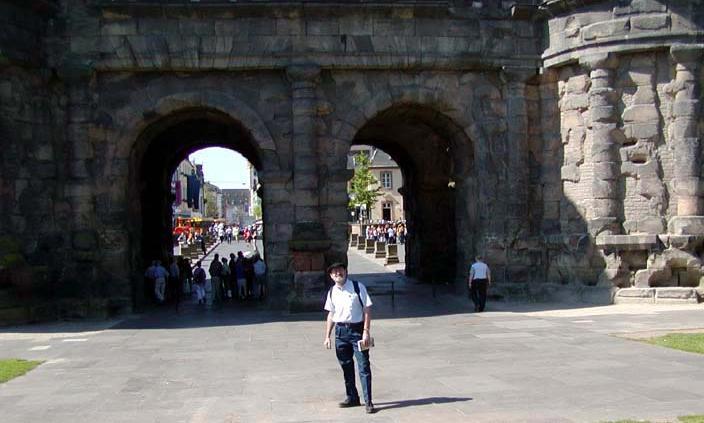
| After a long, hot ninety minute train ride, we arrive, stash our bags, and head north
for Porta Nigra and the tourist info office. The Porta Nigra (black gate) is a remnant of
the old Roman (4th century) walled city -- quite a sight 16 centuries later.
|
| |
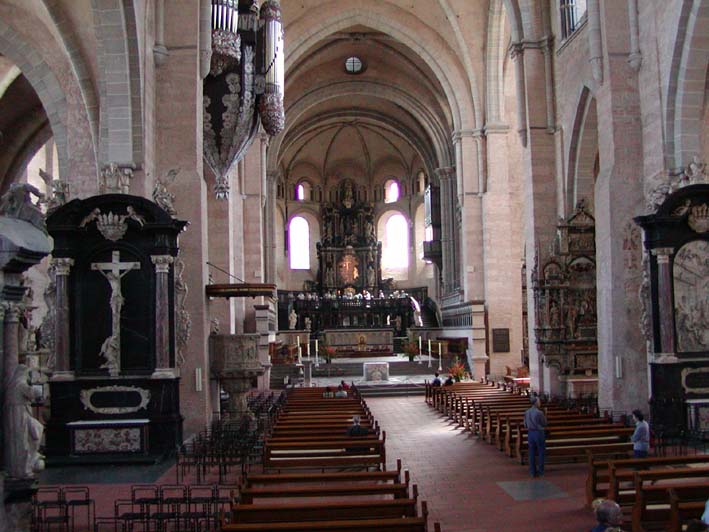
| We then hike through the market square and come to two churches side-by-side.
We enter the older one (cathedral/dom) first, also dating back to Roman times, and are
astonished at the size and splendor!
|
|
| |
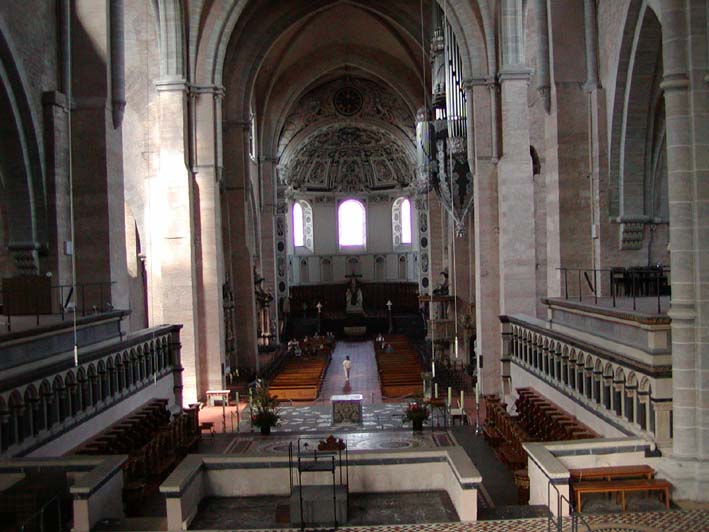
| With obvious changes in architectural style, this had been enlarged many times
during the last 16 centuries, but it was in great shape -- big and bright -- with some
beautiful altars and a neat choir area surrounded by marquetry on the walls and incredible
carvings on the domed ceiling. Behind the main altar, behind gilt-edged glass lay the relic
that was its medieval treasure -- the robe of Jesus, secured by Constantine's mother Helena
during her trip to the Holy Land in the fourth century.
|
| |
|
| |
| With so much to see, we spend more time there than expected, and get an organ
concert that was a little disconcerting -- we couldn't figure out where the organist was!
What a pleasant surprise this cathedral was!
|
| Next door was an early Gothic church, in subdued light from its stained glass
(and so no pictures!), arranged for services in the round because its nave was
so short.
|
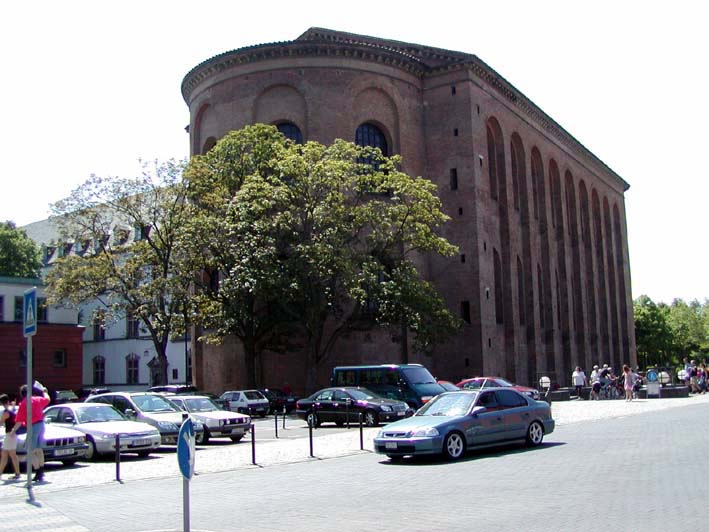
| After these two surprises, we went to the old Roman palace, now an unadorned
evangelical church. It's quite a large building (about 100m long, 30m wide and 30m high)
with brick walls, large windows and a wooden roof (recent, of course). Clearly, the
Romans built things to stand a long time!
|
|
| |
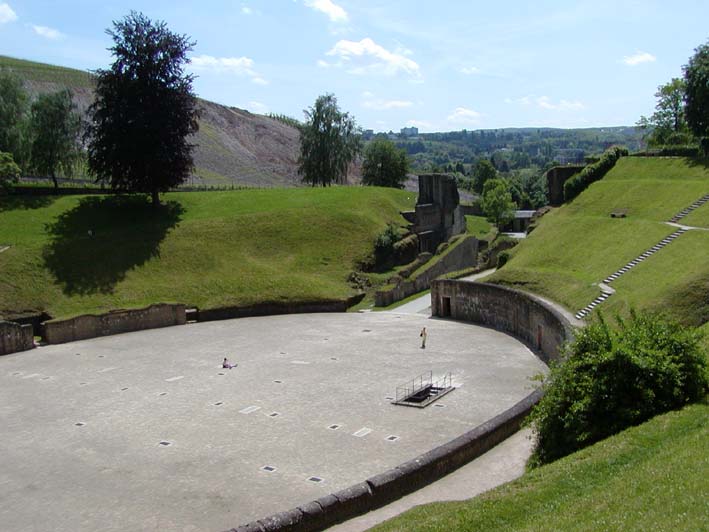
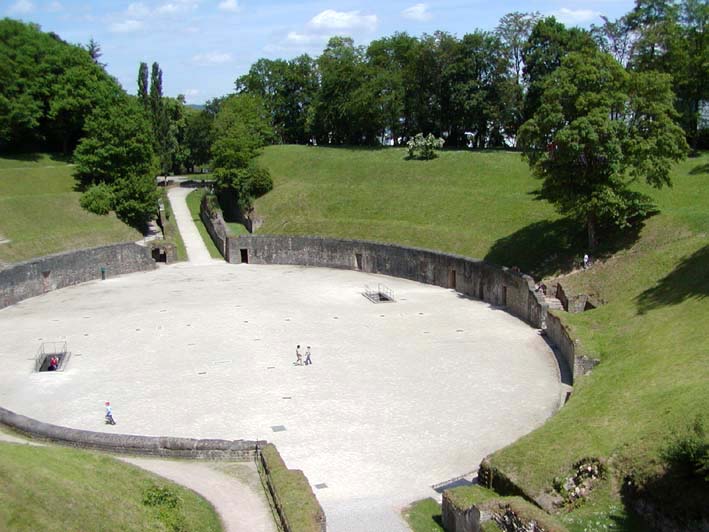
| We skipped the museum and remains of the Roman baths to head for the amphitheatre.
The walk was longer than we expected, and made longer by the sun and rising temperatures,
but well worth it, as we find a large amphitheatre -- it seemed to be more designed for
gladiators than for plays -- and enormous! Even today it could hold thousands of spectators
with great views.
|
|
|
| |
|
Follow this link for more pictures of Trier |
| |
| Tired, hot, thirsty, and hungry (not a good combination!) we take the bus back to the
train station and try to figure out what to do. With the railpass we chose to use this
morning, we could go anywhere in France & Germany. Since we were going to Paris the next day
anyway (and after toying with a stop in Rheims), we decided to try for Paris. After
checking the train schedule, we called our Paris hotel and found they had a room for us
to arrive a day early (an adventure in itself -- the first phone didn't work, the second
wouldn't take our credit card, so we ended up calling MCI (in the US!) and using our home
account to call back to France (expensive!). John was relieved to hear the person at the
hotel responding in English). After some Mediterranean lunch (delicious!), retrieving
our bags, and getting some baguettes and rolls for dinner on the road, we took the train
to Saarbrucken, changing to a TGV to Metz and Paris (and avoiding Luxemburg). We had an
interesting political conversation with a man waiting for his daughter on the same train.
After much worrying by John (who misread the train schedule), we call the hotel from the
station in Paris, and ask them to wait for us. (Victory -- a successful phone call in a
foreign language!) The sleepy night clerk has a key for us, and after some room repair,
we clean our hot, tired bodies and crash. We're in Paris!
|
| |
|