|
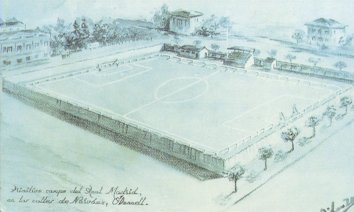 Between its foundation and 1912, Madrid Foot-Ball Club (it wasn't crowned "Real"
until 1920) played its home games in a number of pitches of greater or lesser
category, most notably the Hipódromo, where the first Spanish Cups were played
(including the club's first ever trophy in 1904). In 1912 the club moved to the O'Donnell field.
Madrid's first fenced-off pitch. The inaugural match took place on 31st October,
between Madrid and Sporting Irún, and finished scoreless. Eleven years later,
the club moved again, this time to the Ciudad Lineal stadium, with a grass
instead of earth pitch and a capacity of some 8,000 fans. La official opening
took place on 29th April 1923, in the presence of Their Royal Highnesses and of
Prince Juan, father of the present King. Real beat Real Unión two-nil, both
goals scored by José María Ubeda.
Between its foundation and 1912, Madrid Foot-Ball Club (it wasn't crowned "Real"
until 1920) played its home games in a number of pitches of greater or lesser
category, most notably the Hipódromo, where the first Spanish Cups were played
(including the club's first ever trophy in 1904). In 1912 the club moved to the O'Donnell field.
Madrid's first fenced-off pitch. The inaugural match took place on 31st October,
between Madrid and Sporting Irún, and finished scoreless. Eleven years later,
the club moved again, this time to the Ciudad Lineal stadium, with a grass
instead of earth pitch and a capacity of some 8,000 fans. La official opening
took place on 29th April 1923, in the presence of Their Royal Highnesses and of
Prince Juan, father of the present King. Real beat Real Unión two-nil, both
goals scored by José María Ubeda.
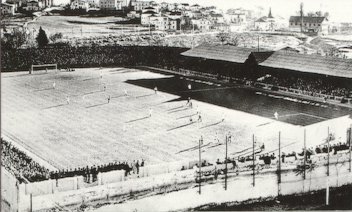 Scarcely 12 months later, on May 17th 1924, Real Madrid inaugurated another new
stadium, Chamartín, the first to belong wholly to the club. The opening game saw
Real beat the then English FA Cup holders, Newcstle United by 3 goals to two.
This stadium, which eventually held up to 22,500 fans, was where Real won its
first league titles. Santiago Bernabéu, who was elected club president in 1943,
had by then decided that the ground was unsatisfactory for a club which he
intended to make the greatest in the world.
Scarcely 12 months later, on May 17th 1924, Real Madrid inaugurated another new
stadium, Chamartín, the first to belong wholly to the club. The opening game saw
Real beat the then English FA Cup holders, Newcstle United by 3 goals to two.
This stadium, which eventually held up to 22,500 fans, was where Real won its
first league titles. Santiago Bernabéu, who was elected club president in 1943,
had by then decided that the ground was unsatisfactory for a club which he
intended to make the greatest in the world.
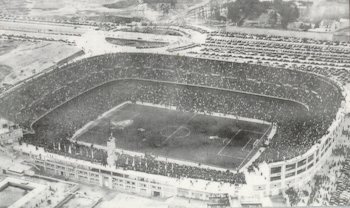 Hence, in 1944, construction began on a new stadium, originally named "La
Castellana", but renamed on January 4th 1955 after the president himself.
Hence, in 1944, construction began on a new stadium, originally named "La
Castellana", but renamed on January 4th 1955 after the president himself.
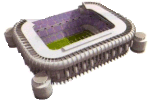
The ground was inaugurated on December 14th 1947, when Real Madrid played against the Portuguese side Os Belenenses, winning the game 3-1. Sabino Barinaga scored the first goal in the new stadium. The initial ground capacity was 75,432.
In 1953, due to enormous demand from the fans, the stadium was extended with a third amphitheatre (known as the "henhouse"). During Real's golden period, in the 1950s and 1960s, when the club conquered the European Cup six times, the ground held crowds of up to 120,000, mostly standing, supporting their team. On the international scene, Spain won its only official title so far in the Bernabéu, beating the U.S.S.R. in the final of the European Nations Championship in 1964.
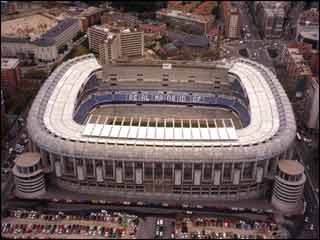 In the early 1980s, the ground saw its first major refurbishment to bring it up
to the standard necessary to become a World Cup venue. The façade and access to
the ground was modernised, and a cover was added, decreasing the capacity to
about 90,000.
In the early 1980s, the ground saw its first major refurbishment to bring it up
to the standard necessary to become a World Cup venue. The façade and access to
the ground was modernised, and a cover was added, decreasing the capacity to
about 90,000.
The distinctive access towers were added during further work carried out in 1992, and which took 18 months to complete. Once again, the capacity increased above 100,000, to 106,500.
However, according to recent Spanish legislation and new UEFA rules, from the 1998/99 season, all stadia had to be all-seater. Real Madrid was one of the few Spanish unable to complete all the necessary alterations in time. Although UEFA granted the club a 2 year extension to make these changes, the stadium capacity was reduced to 75,000.
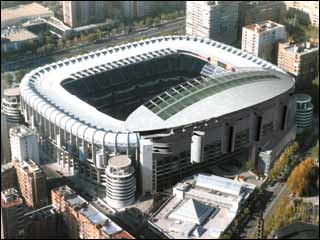 Several longer term solutions have been proposed, including the contruction of an
brand new stadium at about 5 kilometres from the Bernabéu. However, many fans are opposed to leaving the
current location. In November 2000, president Florentino Pérez unveiled his new
refurbishment project, which will add between 5,000 and 10,000 seats to the
stadium, a new events hall and, finally, a club museum which befits the history
of Real Madrid. It is expected that work will conclude around 2005.
Several longer term solutions have been proposed, including the contruction of an
brand new stadium at about 5 kilometres from the Bernabéu. However, many fans are opposed to leaving the
current location. In November 2000, president Florentino Pérez unveiled his new
refurbishment project, which will add between 5,000 and 10,000 seats to the
stadium, a new events hall and, finally, a club museum which befits the history
of Real Madrid. It is expected that work will conclude around 2005.
Back to the Real Madrid home page.