| The Colegio de Santa Isabel Story |
You cannot tell the story of the Colegio de Sta. Isabel without mentioning the man whose vision in bringing educational reforms for the advancement of Christian civilization is matched only by his own fervor and energy.
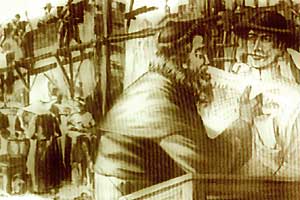 |
With much zeal and perseverance, Fray Francisco Gainza, O.P., the Bishop of Nueva Caceres, presented his plans for the establishment of a Colegio-Beaterio for girls in his diocese to Queen Isabela II of Spain.The Queen was pleased and as a token of her support presented Mons. Gainza with a relic of St. Elizabeth of Hungary under whose patronage the College will be placed.
|
On November 5, 1867 a Royal Decree was passed authorizing the establishment of Colegio de Santa Isabel de Nueva Caceres. Armed with the decree. Mons. Gainza left Spain in the company of six Daughters of Charity for the Philippines. They arrived in Manila on April 2, 1868 and immediately proceeded to Pasacao landing there at midnight two days later amid a warm welcome by a great crowd.
The following morning they left Pamplona aboard colorful barotos, thus forming a colorful parade until they reached Camaligan. From there, they proceeded to Naga, thus the Sisters of Charity first set foot in the town of Naga on Palm Sunday April 5, 1868. It was a significant day because the school soon to be established will have its crosses to bear, its shares of difficulties but later to emerge glorious and triumphant.
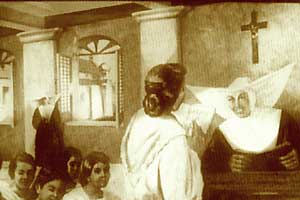
The Colegio de Sta. Isabel was formally inaugurated and opened on April 12, 1868 at the convent of the Naga Cathedral now Naga Parochial School. It was called Colegio de
Sta. Isabel in order to put it under the protection of the Queen- Saint Elizabeth of Hungary whose charities on earth had made her a saint in heaven. Future generations will remember a bountiful queen of that name-Queen Isabela II of Spain who had generously sanctioned its
opening.
 |
On July 19, 1869, the construction of the school
began. Father Antonio
Santonja, C.M. and Acting Rector of the Diocesan Seminary merits special mention here for his support to
Mons. Gainza in facilitating the construction of the college. The college was inaugurated September 18, 1875, coinciding with the Peñafrancia Fiesta.
|
Elevated to the category of "Escuela Normal de Maestras" by virtue of Royal Decree signed by King Amadeo I of Saboya on January 11, 1872, it became the first Normal School for Girls in the Philippines.
The Philippine Revolution ended Spanish sovereignty in the Philippines suspending the authorization to operate the Normal School. This was a trying time for the College. Peace was restored during the American Regime which brought in a new system of education. The Department of Instruction authorized the reopening of the Primary Course on January 15, 1913. The intermediate and college levels soon followed. With the new organization enrolment grew and better times came. In March 1940, the Junior Normal saw its first set of graduates. In the same year, the Alumni association was organized.
On December 8, 1841, Pearl Harbor was bombed- the Unites States and Japan were at war. In December 12, the Japanese landed in Legaspi, students were sent home-the College suspended classes. The Japanese took over Naga, while many residents fled to the mountains, The Sisters remained in the College campus.
In May of 1942, the Colegio was reopened offering completion courses. Nipponggo was added to the curriculum the following school year. While the Secondary Department for Boys was opened at the request of Bishop Pedro
Santos, it did not take long for the Japanese to order the Sisters to vacate the College.
On the last day of August, classes were moved back to the convent of the Naga Cathedral. In March 1945, amid the sirens wailing and planes roaring overhead, bombs fell in Naga leaving the College in ruins while the whole of Naga was ablaze.
After the war, the school was reopened this time within the walls of Ateneo de Naga. |
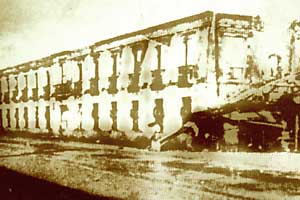 |
Sixty students marched at the first post-liberation graduation on January 12, 1946. Soon after, the reconstruction of the Colegio de Sta. Isabel began. After nine months at the Ateneo, the Sisters moved back to the College. Slowly, the school replenished its lost treasures.
A far cry from the very first graduation of eleven students 131 years ago, the Colegio de
Santa Isabel has again triumphed over the imposition of time. In the course of its existence, it has meet both foul and fair weather. It has had its days of glory and its days of gloom-through it all, the Colegio de
Santa Isabel has proved its mettle many times over. Countless sacrifices have been done as it marched through the years-gaining prestige and renown nationwide. It is still marching on-and we say-Onward, Forward dear College!
(Source: 2000 CSIAA Souvenir Program)
Home | 61st Alumni Homecoming | 2001 Jubilarians | Batch '61
|