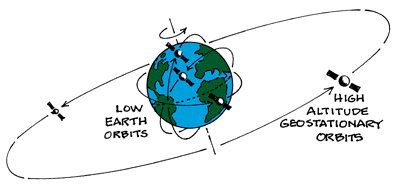
There are two main types of orbits which satellites use to circle the earth, these include polar and geostationary orbits. A polar orbit travels over the North and South poles, and is several hundred miles to several thousand miles above the earth. The satellite travels much faster than the earth, and circles it almost fourteen times each day. As the earth is turing more slowly than the satellite, the satellite gets a different view every revoluton, and it takes a few days to cover the whole planet.
A geostationary orbit is almost the antitheisis of the polar orbit, in that it is a high-altitude orbit, in which the satellite's revolution speed is the same as that of the earth. The satellite turns eastward along the EQUATOR. It stays above the same point all the time, and is approximately 22,237 miles above the earth. At that distace, the satelltie can view a huge portion of the earth, and this area is called its' "footprint." Due to that fact they require no tracking and downlink signal. This explains the usage of satellite systems for our televisons, in that they recieve a signal from a particular geostationary satellite, so we do not have to keep adjusting the position of our satellties to recieve the signal.
There is also an Asynchronous Orbit, which observation satellites typically use. They are 300 to 600 miles from the earth, and are used for tasks such as photogrpahy. They are also used for mapping, ice and sand movement, locating environmental situatuions such as hurricanes, locating mineral deposits, and finding crop problems. Orbits up to 12,000 miles are referred to as Asynchronous orbits.
The space shuttle is actally a manned satellite, and it often has the responsibilty to fix unmanned satellites, and building future space stations such as the ISS or, the INTERNATIONAL SPACE STATION. |