
Firewall Technical White Paper

Internet Security

The "information superhighway" is a marvelous vehicle for accessing and publishing information in a timely manner. The Internet provides a computuer communication path that now spans over 300 countries and has an estimated 50 million users. With this explosive growth in recent years, has come many issues concerned with computer and data security.

Not everyone on the Internet is your friend. Malicious users known as "hackers" are using very sophisticated tools for gaining unauthorized access to computer systems. Often times, using these systems to attack others in the attempt at covering their tracks.

All of the information on or traveling through a system is insecure, once it has been compromised. Communication between other systems on the same network can also be monitored using "sniffer" programs. A program called a "Trojan Horse" can be installed that can trap and log user passwords. There are many other sneaky ways to break-in, steal information, and destroy or tamper with data.

The Computer Emergency Response Team (CERT) is an organization tasked with the responsibility of researching computer security related incidents and working with the appropriate manufacturers to fix vulnerabilities. They are also an excellent resource for gathering information and keeping up-to-date with issues pertaining to network security.

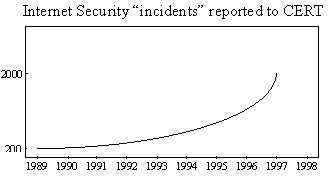
"The information he provided includes recent trends: the increasing damage caused by intrusions, more knowledgeable intruders, increased use of automated attack tools, and a 2000% increase in computer incidents handled by the CERT Coordination Center since its establishment in 1988."

-- Computer Emergency Response Team

What is a Firewall?

The term "firewall" has been used for many years to describe a system that protects a computer network and the computers on them from various types of attack. There are many ways to implement a firewall, each with specific advantages and disadvantages, so it is impossible to describe exaclty what a firewall is. It is accepted however, that the primary goal of a firewall is to implement a desired security policy; controlling access in both directions through the firewall, and to protect the firewall itself from compromise.

A firewall is a controlled access point between security domains, usually with different levels of trust. It can be a highly effective tool in implementing a network security policy if it is configured and maintained correctly.

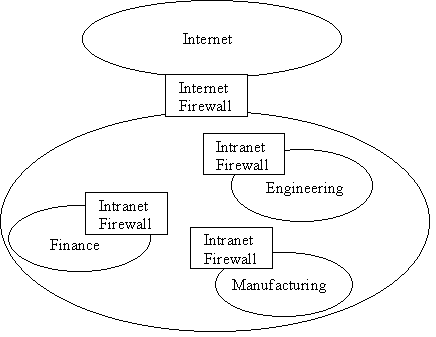
An "intranet firewall" creates security domains within an organization. Possibly between finance, payroll, engineering, or other department with sensitive data. Intranet firewalls typically have a slightly more permissive security policy since it is not the front line of defense to the Internet, but have the requirement to run at LAN speeds that are much higher than typical WAN speeds.


Security Policy

A security policy is a well thought out plan and in-depth knowledge of your particular network. It is knowledge of what exactly you are trying to protect against, and the points of vulnerability. Security policies vary from site to site; some are very restrictive while others are relatively open.

Security is a compromise between the investment in resources and the risk of failure. Not everyone needs Fort Knox security; nobody can affort it. A detailed security policy takes into consideration what is being protected, what the associated risk is, what equipemnt and manpower are required to secure it effectively.

A lock on your front door can help to keep out burglars, however, a determined intruder will look for the easiest way in. An open window or doggie door are the next targets. If the contents are valuable enough, the expense of an alarm will be easily justified.

Computers with classified, life-threatening, or other highly sensitive data should not be connected to the Internet under any circumstances. No firewall can provide perfect and guaranteed security, and no compromise in security can be acceptable.

Ęgis, when properly configured, provides very effective security for commercial and educational networks. The embedded operating system was designed to be the most secure, easy to use firewall available on the market today.

A complete security policy will reveal the areas of vulnerability and the appropriate equipment or actions to be taken to secure them. For additional information on defining and implementing a network security policy, please refer to the references listed.

Types of Attacks

Intrusion:
There are many ways to gain unauthorized access to a system. Operating system vulnerabilities, telnet highjacking, and cracked or guessed passwords are some of the more common. Once access is attained, the user can send impostered email, tamper with data, or use the system privledges to attack another system.

Information Theft and Tampering:
Data theft and tampering do not always require that the system be compromised. There have been many bugs with FTP servers that allow attackers to download password files or upload trojan horses.

Denial of Service:
Any attack that keeps the intended user from being able to use the services provided by their servers is considered a denial of service attack. There are many types of denial of service attacks, and unfortunately are very difficult to defend against. "mail bombs" are one example in which an attacker repeatedly sends large mail files in the attempt at filling the servers disk filesystem thus preventing legitimate mail from being received.

Types of Attackers

Joyrider:
Not all attacks on computer systems are malicious. Joyriders are just looking for fun or for "bragging rights." Your system may be broken into just because it was easy, or to use the computer as a platform to attack others. It may be difficult to detect intrusion on a system that is used for this purpose. If the log files are modified, and if everything appears to be working, you may never know.

Vandals:
A vandal is malicious. They break in to delete files or crash computer systems either because they don't like you, or because they enjoy destroying things. If a vandal breaks into your computer, you will know about it right away. Vandals may also steal secrets and post them to public bulitin boards.

Spies:
Spies are out to get secret information. It may be difficult to detect break-ins by spies since they will probably leave no trace if they get what they are looking for.

Host Security

In the early days of networked computers, host security provided individual protection of computer systems. Good passwords and controlled user accounts was sufficient. Each computer was responsible for its own security. Bugs in operating systems from various vendors makes it extremely difficult to obtain an effective security policy over a large number of systems today.

Network Security

Systems outside of a security domain should not even be able to make connections to computers within. It is often the case where outbound connectivity is allowed. Firewalls provide the mechinism to restrict access inbound while allowing access outbound. Host security is relaxed due to the control provided.

Host security is still very important within a security domain. The Internet firewall cannot protect against internally launched attacks. Intranet firewalls create separate security domains within an organization, thereby controlling access between departments.


Types of Firewalls

All firewalls currently belong to one of three basic types: packet filtering, proxy server, and stateful packet inspection. All of these types are sometimes used together in assembling a site's Internet security system.

Packet Filter

Packet filters, called "access control lists", or access lists for short, on Internet routers provide a rudimentary form of security. Filters are configured to discard packets with particular attributes such as:

Packet filtering routers are not dynamic or stateful, which means that their filtering criteria does not change based on packets that have passed recently, or based on which side of the firewall the connection was initiated from. Forwarding decisions are made based only on field values from the specific packet in question, which is not sufficient to distinguish between welcome and unwelcome packets.

For useful sorts of filtering, access lists tend to be lengthy, quite complex and error-prone.

Although performance is not usually a problem in modern implementations, lengthy access lists can degrade throughput and increase latency. Since state is not kept in a packet filtering router, every packet through must be checked against the same access lists.

Packet filters can be very effective in completely blocking specific types of traffic, and for this reason are sometimes part of an overall firewall system. For example, telnet can easily be blocked by applying a filter to block TCP port 23 (telnet). The difficulty and complexity arises when the filtered protocol is allowed to some hosts, or for more complex protocols that specify return data ports dynamically.

Proxy Server

A proxy server acts as an intermediary between a client and a server, and is typically implemented as an application running in conjunction with a general-purpose operating system. Clients on the protected network must be specially modified to communicate with the proxy.

A proxy server does not forward packets directly; rather, it acts as an endpoint for client connections from the protected net, and establishes independent connections to the ultimate destinations requested by the clients. The proxy server copies data in both directions to and from the client connection.

Although proxy servers offer more complete filtering than simple packet filters, they suffer several disadvantages:

First, clients on the protected network must be specially modified to implement the proxying protocol. This complicates the configuration and adds considerable network administration. Since they are application specific, only applications that have proxies will work.

Second, because proxy servers operate with a general-purpose operating system, they are vulnerable to whatever security problems that OS might have.

Finally, an OS-based system introduces significant procesing overhead, meaning that throughput degrades as the number of proxied connections goes up. Performance becomes a significant problem at link speeds now in common use for Internet connections.

Proxy severs introduce a lot of latency since two separate TCP connections must be established before any data can be transferred. New connections suffer a from a high connection setup time due to the "process" nature of a proxy. Each connection requires a separate process.

Stateful Packet Inspection

Stateful packet inspection combines the best aspects of the packet filter and proxy methods above, without their attendant problems. A stateful device performs fundamentally as a packet filter, yet it tracks the state of connections made through it. Such tracking enables the device to reject packets that are not associated with existing connections initiated from the protected network. Rejected packets are dropped and a security log message is generated.

Stateful devices offer the sophisticated decision-making capabilities of proxy servers, yet operate much faster because they use a minimal implementation with no OS processing overhead.

Because stateful packet inspection is transparent, special proxy applications are not required. This reduces the load on the firewall and improves performance when the connection is destined for an internal host, since the firewall will not be involved. This is not the case when an application is configured to use a proxy server.

Evolution of the Internet and Firewall Security

Firewall technology is has been constantly changing to meet the latest demands. Originally, host security was all that was needed. Packet filtering provided the first implementation of network security as the threat from the Internet increased. Proxy servers were developed a few years later, providing more comprehensive filtering, when additional security was required. Stateful packet inspection, the latest advancement in firewall technology, provides the enhanced security of proxy servers, yet operates with much greater efficiency, resulting in better response times and throughput capacities.

Performance

Security is job #1! Absolutely, the purpose of having a firewall cannot be diminished in order to gain speed. However, secure, high-performance firewalls are required to remove the bottleneak when using high speed Internet connections. UUCP, 56K, 256K connections were the norm not that long ago. Today, T1 and T3 links are commonplace.

Performance is being driven by the latest Internet applications. Older applications like telnet and ftp are not as sensitive to long delays and lower throughput. There are fewer, long lived connections for a firewall to contend with.

The World-Wide-Web makes possible the generation of enormous amounts of traffic at the click of a mouse. This increased load is difficult for proxy servers to handle because of their inherent system overhead. Multimedia applications are beginning to appear and also present problems for older technology.

Platforms

Firewalls can be built on embedded systems, including packet filtering routers, or on a workstation running a general purpose operating system like UNIX or Windows NT.

"The biggest single reason that a firewall is likely to be more secure is simply that it is not a general-purpose host."

Firewalls and Internet Security
--William Cheswick & Steven Bellovin

General purpose operating systems when used as the foundation for an Internet firewall are challenged with a difficult task: to provide a secure environment when installed as a firewall and to provide multiple services to client systems in a open environment when acting as a server. On an open system, dozens of files need to be modified and meticulously maintained to ensure a proper level of security. The OS also needs to be free from any CERT advisory bugs. This process is called "hardening" of the OS.

Another problem with general purpose operating systems is their size and complexity. All software has bugs. Large programs are more difficult to secure simply because of their complexity. A firewall with bugs is likely to have security holes.

A firewall is only as secure as its hardening. If an intruder finds a weakness in your firewall system and compromises its security, the entire network is at risk, and the application level firewall becomes useless.

Ęgis is an application-specific device designed from the ground up to be secure. It is not hindered with the requirement to run a spreadsheet, database, or word processor. There is no underlying general-purpose operating system, or the risks inherent in complex OS-based systems.

There is no Application Programming Interface (API) to allow the execution of user programs, which means that it is completely invulnerable to viruses. Attacks on firewalls that attempt to read password files, or change system files that affect permissions are not possible; there are none. It is also invulnerable to "trojan horse" attacks that are common on systems with disk filesystems.

Out of the box, Ęgis has a secure configuration. General purpose operating systems are quite the opposite. All services are allowed, and the user has to explicitly close everything up.

"One system administrator complained that he had reloaded his systems multiple times, and he was still being attacked. It turned out that, although he knew about CERT advisories and vendor security bulletins, he'd never bothered installing them. For example, CERT advisory CA-93:16 was posted to the net in November of 1993; it advised the UNIX community about a problem with most versions of Sendmail. Vendors had cooperated by providing replacement programs, and the advisory contained a replacement for the /bin/csh program used in the Mprog line of the sendmail.cf file. A year and a half later, CERT still gets calls from sites that are broken into using this old Sendmail vulnerability."

-- Ed DeHart
CERT Technical Advisor


Ęgis Implementation and Security Policy

Ęgis is a stateful packet inspection firewall running on a specially designed kernel. There is no underlying operating system and there are no unnecessary network services running.

Stateful packet inspection is implemented by building a table that describes all connections through. Information stored in the connection table include the source and destination IP address, TCP or UDP port numbers, and the TCP sequence numbers. The first packet through creates the connection entry. All ubsequent packets are verified as being part of a valid connection, and the connection statistics are updated before forwarding the packet.

Ęgis Interfaces & De-Militarized Zone (DMZ)
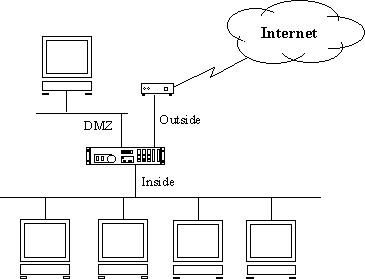
All Ęgis firewalls include three 10/100 autoselecting Ethernet interfaces. The outside interface is for connecting to the Internet or other untrusted network. The inside interface is for the protected clients and servers. The DMZ interface is for publicly accessible servers or servers where external access is required. The DMZ provides controlled access from untrusted hosts by network service (destination port) without requiring that the server exist on the outside or inside interface.

Access Lists

New outbound connections are allowed unless denied in the access lists. Access lists are a user-configured table of permissions relating to connections initiated from the protected (inside) network. Access lists are checked only when a connection is being established.

Access List parameters include:

Note that access lists have little to do with security; it is a way to restrict inside users from accessing certain outside locations or services.

Exceptions

New inbound connections are denied unless allowed in the exception list. The exception list is a user-configured table of permissions relating to connections initiated from the external (Internet-side) interface. Normally this list contains only a few entries, for services such as inbound SMTP. Connectionless protocol services such as archie, DNS, and RealAudio (tm) may also be configured (see "UDP", below). Exceptions are checked only when a connection is being established.

Exception List parameters include:

Traps

All inbound packets on the external interface are checked against the Trap List. A trap is a packet attribute or connection state that is deemed threatening. Individual traps can be enabled or disabled by configuring the Trap Table, but statistics that count the number of occurrences are always enabled. If a match is found, the packet is dropped and logged according to the action configured in the corresponding Trap Table entry.

Possible traps include certain IP options (source route, record route), TCP flag combinations, various ICMP types, etc.

Connection Termination

When a connection is terminated by either endpoint, its entry in the connection table is removed. Connection terminations are logged. The log data include source and destination IP addresses and port numbers, as well as byte counts and connection duration.

Internally Initiated FTP

The File Transfer Protocol (FTP) requires special handling. When an internal client connects to an external FTP server, a control connection is established using TCP. However, file transfers occur over separate data connections that are negotiated via the control connection. These data connections are initiated by the FTP server to an arbitrary port number on the client (although they usually originate from a well-known source port number on the server).

It would be unsafe to permit inbound access for connections to arbitrary port numbers from a fixed source port, although this is exactly what plain packet filter systems do, because the source port number is easily spoofed.

Instead, Ęgis scans outbound FTP control packets looking for FTP "PORT" commands, which specify parameters for the server-to-client data connection. A temporary inbound connection table entry is created to permit the return data connection and the entry is deleted as soon as the data transfer is complete.

User Datagram Protocol (UDP)

UDP is a connectionless protocol that also requires special handling. Unlike TCP datagram headers, UDP datagram headers do not correspond to specific protocol states, and do not indicate whether they contain requests or responses.

Ęgis secures UDP applications by tracking outbound (assumed) requests and allowing responses from the same server on the same port numbers for a programmable time interval. Once the pseudo-connection is opened, it remains open until an inactivity timer expires. Repeated UDP packets on the pseudo-connection that originate on the internal (protected) network will continue to restart the timer.

Access lists may be used to block any or all UDP applications.

Logging

Ęgis offers extensive logging capabilities that create permanent records of activity and of all violations of the configured security policy. Logging is done over the network to a remote host via syslog, or via the Windows95 firewall-monitoring utility.

Ęgis is implemented on a specially-designed kernel; there is no underlying general-purpose operating system. Unnecessary network services are not present, and packets sent to such services on Ęgis will be discarded and logged.

Management Access Control

Management filters may be configured to control access to the firewall itself (Figure 1). Ęgis may be isolated from any direct access, or may be set up to allow any of Telnet, HTTP, or WinGUI protocol access from specific hosts or subnets. The default state is to deny all network access, except ICMP echo.

It is strongly recommended that you allow Telnet and HTTP access only from hosts that you trust and only on the inside interface. Ęgis is password protected, but unauthorized users will not even receive a login prompt if management filters are configured to restrict access. Allowing ICMP echo from both interfaces is not a security risk, but is very useful in troubleshooting.


Other Resources

Networking Fundamentals Technical White Paper, and
Network Address Translation Technical White Paper
Meridian Network Systems, Inc.
http://www.meridiansystems.com

Firewalls and Internet Security - Repelling the Willy Hacker, by
William R. Cheswick and Steven M. Bellovin,
ISBN 0-201-63357-4, Addison Wesley

Building Internet Firewalls, by
Brent Chapman and Elizabeth D. Zwicky
ISBN 1-56592-124-0, O'Reilly & Associates, Inc.

Internet Firewalls and Network Security, by
Karanjit Siyan, Ph.D.
ISBN 1-56205-437-6, New Riders Publishing

Computer Emergency Response Team (CERT)
An online library of computer security related advisories. You can also receive advisories as they are announced by subscribing to the mailing list. To do so, send e-mail to [email protected] with "subscribe" in the header. A security checklist is available via anonymous FTP from info.cert.org:/pub/tech_tips/security_info

Firewalls Mailing List
A discussion group focused on the topic of Internet firewalls and Internet security. This mailing list has a very high volume of articles. Only recommended for those with serious interest. To subscribe, send e-mail to [email protected] with;

subscribe firewalls <your-email>

Replace <your-email> with your real email address.

A FAQ (Frequently Asked Questions) is available via anonymous FTP from ftp.greatcircle.com/pub/firewalls/FAQ


 Back To Archives.                  Back To Main Page.

Hosted by www.Geocities.ws

1