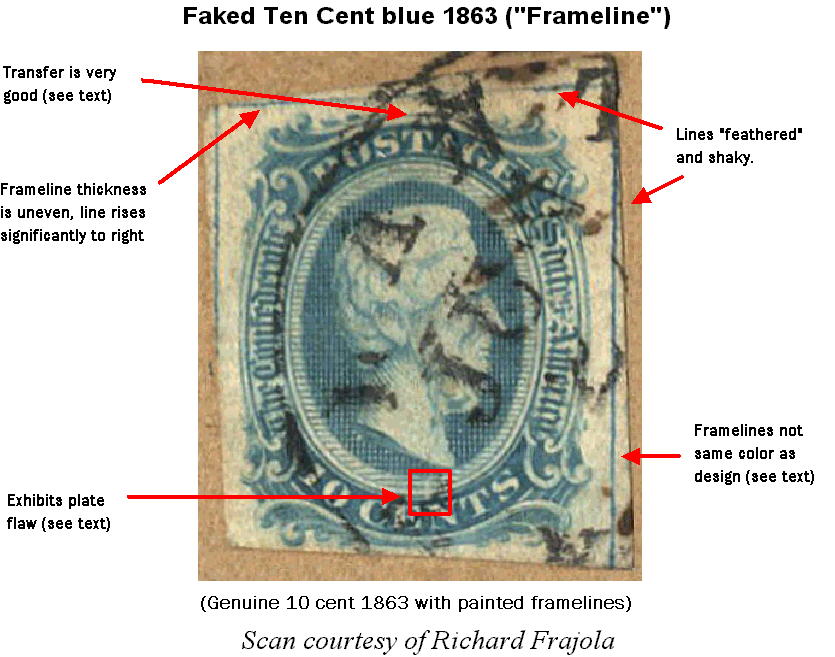
Detecting Fakes of CSA #10The best method of detecting fakes of this stamp is by examining the color of the lines and comparing to the color of the stamp. This will usually expose the fake immediately. However, scanners typically do not capture the true color of stamps well, and color also depends on the computer monitor in use. Because of this, that method is seldom very dependable when looking at scans. If the lines are obviously a different color, you should assume that the item is fake. If the colors appear to match, other characteristics should be used to evaluate the stamp. Firstly, the quality of the lines should be examined. They should be straight and smooth, of fairly even thickness and not significantly inclined. If the lines are shaky or wavy, the lines have been painted by hand (as in the stamp above). On the plate that produced the #10, lines were applied by drawing an engraver's burin along a straightedge. There were places where the lines may be slightly thicker due to repositioning the straightedge and restarting the burin, but the lines should still be straight. If the lines appear to be good, it is still possible that they were applied with a colored pencil and ruler. Without the stamp in hand it is very difficult to further examine the framelines. There are other general characteristics which, while not definitive tests, are present on enough examples of this stamp that they can be used to further evaluate from a scan. Again, these characteristics are NOT definitive, only clues from a statistical viewpoint. Examine the quality of the design at top and bottom. This stamp was the first use of the makeshift transfer press, which did not perform well. Consequently, a large number of these stamps show short transfers at the top, bottom or both. Some of the plate positions were recut to complete the design. Look for such recuts in the outside oval area and in the corner ornaments on both sides at top and bottom. Look for the plate flaw above the "N" of "CENTS". It is thought that the transfer was damaged during the making of this plate. Consequently, some stamps do not exhibit the flaw, some have been recut to fix the flaw, and some exhibit the flaw. If the transfer appears to be complete, with no recut lines and the flaw is present above the "N", the stamp is at least suspect and chances are fair that the stamp is a #11 with ruled lines. The stamp pictured above is on cover and was part of a large collection formed by a very prominent collector of CSA postal history, and recently sold by a major auction company. The cover was received by Richard Frajola for authentication. His conclusion was that the stamp and cover were genuine, but that the framelines had been painted in. There was a noticeable color difference that does not show up in the scan. Thanks to Richard for providing the scan and sharing his opinion. |