 Killer Whales Living In The Wild

Description: The killer whale is an extremely robust marine mammal. The head is conical
when viewed from above and lacks a well-defined beak. The dorsal fin, which is located in the middle of the
back, is large and varies in shape. It is short and curved in adult females and young and tall and erect in
adult males. The males' dorsal fin can reach six feet in height and are highly variable is appearance. The
pectoral fins or flippers are large, broad and rounded. Male orcas usually have larger flippers than females.
The tail flukes also vary in size and shape between the sexes. There are 10-14 pairs of large conical teeth
in the jaws. Orcas use these powerful teeth to subdue their larger prey and to grasp onto the slippery
bodies of fish and other aquatic prey.
The orca or killer whale is mainly black with various white and gray markings. The white ventral zone
begins at the lower jaw and narrow beneath the all black flippers and continues to the umbilicus or belly
button and broadens around the genital area then narrows again at the base of the flukes. White also is on
the undersides of those flukes and is bordered in black. A large white, finger-shaped patch of white graces
the flanks. There is also a white oval above and behind each of the eyes. Behind the dorsal fin is a gray of
white saddle-patch that varies between populations, pod units, and individuals. Researchers often take
photos of this dorsal patch and even the eye patch to track individual killer whales.
Behavior: Killer whales are quite active and agile for their immense size. They often play
and socialize with one another by rubbing bodies. This behavior helps to reinforce the positive orca bonds
and establish a social ranking between individuals. Orcas often breach, tail slap, pec slap, spyhop, roll over
in the water, play with seaweed and feathers, and generally perform silly orca behaviors. This playfulness
has many possible meanings and seems to invoke the best reactions in humans.
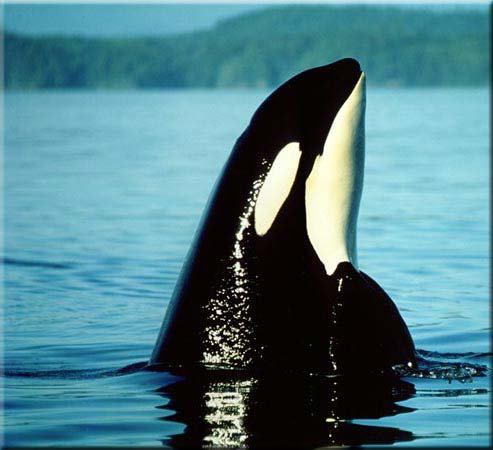
Orcas also show a variety of responses to boats. They can be curious or not seem to know they are there.
For the most part though, killer whales seem to be most interested in the humans the are watching them
for inside the boats.
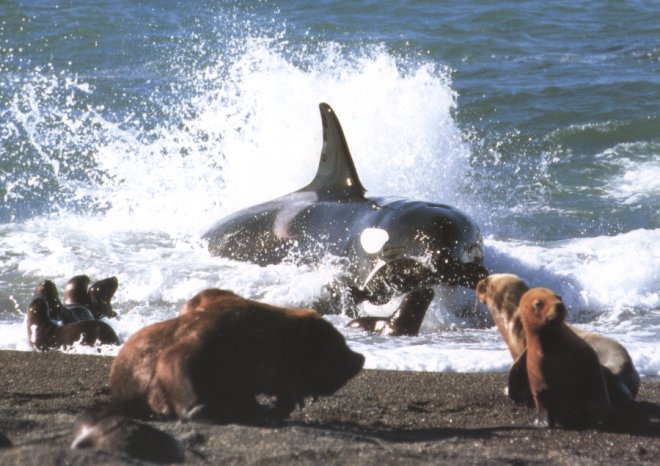 Food & Hunting: Killer whales feed on a wide variety of prey items. These range from small
schooling fish to huge oceanic baleen and toothed whales and even sharks and deer and moose. With such
a varied menu to chose from orcas are no doubt the top predator in the oceans. They are also one of the
few whales that prey on other marine mammals and sharks.
Food & Hunting: Killer whales feed on a wide variety of prey items. These range from small
schooling fish to huge oceanic baleen and toothed whales and even sharks and deer and moose. With such
a varied menu to chose from orcas are no doubt the top predator in the oceans. They are also one of the
few whales that prey on other marine mammals and sharks.
They are cooperative hunters and work together to provide food to the other pod members and young
calves. Killer whales spend many hours teaching their young to hunt and to beach themselves to catch
seal pups on the beach.
 Reproduction: Though mating has never been observed within wild populations of orca,
those in captivity have given researchers an idea of how orcas mate. It is important to note that information
gleaned from captive animals can never be accurately compared to wild killer whales. Male orcas are though
to temporarily leave their pods to seek out receptive females in other pods. Males may never met their
babies and do not help in calf-rearing.
Reproduction: Though mating has never been observed within wild populations of orca,
those in captivity have given researchers an idea of how orcas mate. It is important to note that information
gleaned from captive animals can never be accurately compared to wild killer whales. Male orcas are though
to temporarily leave their pods to seek out receptive females in other pods. Males may never met their
babies and do not help in calf-rearing.
 Females become sexually mature at eight years of age and have a gestation period of 12-14 months.
Female killer whales reproduce every five years and stop ovulating at 40 years old, but by this time they
would have brought 10 new orcas into the world. Males become sexually mature at 10-12 years old.
Females become sexually mature at eight years of age and have a gestation period of 12-14 months.
Female killer whales reproduce every five years and stop ovulating at 40 years old, but by this time they
would have brought 10 new orcas into the world. Males become sexually mature at 10-12 years old.
The calf looks very similar to the parent orca, but has a darker saddle-patch and the white areas are orange
is reddish in color. The baby is also much smaller and doesn't swim well at first. The dorsal fin and tail flukes
are soft and floppy. Young orcas grow quickly on their moms rich, thick milk and are weaned after two
years.
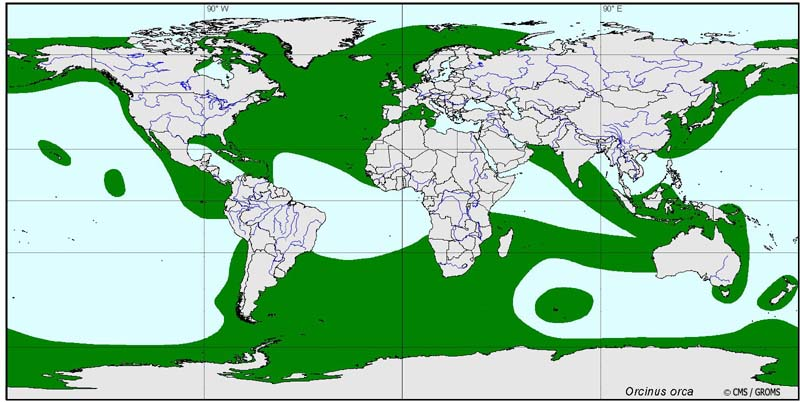 Habitat: Killer whales are by far the most widespread of the marine mammals. They live in
every ocean in the world, but are most numerous in cold water zones. They sometimes even enter large
rivers and bays. The movements of some pods are seasonal and then others remain in one area all year.
Habitat: Killer whales are by far the most widespread of the marine mammals. They live in
every ocean in the world, but are most numerous in cold water zones. They sometimes even enter large
rivers and bays. The movements of some pods are seasonal and then others remain in one area all year.
Other Facts: Orcas are the largest member of the dolphin family and the top predator in
the marine environment.
Killer whales live with their families their entire lives and only death or capture can make an orca leave that
family. They can live to be 80-90 years old. Females out live the males by ten years. Pods consist of up to
30 animals and are based on the mother/calf bond that is the center of all animals societies. Every pod has
it's own unique language or dialect.
Male orcas are usually 19-22 feet long and weigh up to 12,000 pounds. The largest male recorded was 32
feet long and weighed a hefty 22,000 pounds!
Females are about 16-19 feet in length and weight about 8,000 pounds. The largest female on record was
28 feet long and weighed in at 16,500 pounds!
Orca calves are about 7 feet long and weigh 450 pounds.
Killer whales were once feared by people and hundreds were killed. Then humans captured one and named
him Namu. Namu was the first orca used to entertain humans and thus the captivity industry was born and
mankind developed a taste for dolphin and whale attractions.