The name Tokitae means "shimmering water" in the coastal Chinook
dialect. But what lies beneath the "shimmering water" os one of the most
violent and grusome capture stories ever to be witnessed and told. This
tale of heartache and imprisonment first began in 1966 when a female orca
was harpooned while tending to her young calf. Both were intended to
become companions to Namu (the first killer whale used to entertain
humans). The mother drowned herslf and the little orphan was shipped to
Sea World, San Diego to become the first "shamu". Two years later another
attack took place. This time two whales were taken and one three-year-old
male made home at the Miami Seaquarium.
 But the violence that a young female, soon to be named Lolita, lived
through was devastating. It began on August 8, 1970. Her family was at
peace hunting the salmon that anually returned to the bay and began the
journey to their spawning grounds. Suddenly catcher boats converged on
the tranquil pod. Small aircraft dove at the terror-stricken whales,
forcing them deep into Penn Cove. The males split up from the pod and
tried to lead the hunters away from the young and females, but the capture
crews threw out nets. To those individuals that witnessed the capture
recall that the air was heavy and choked with the screams and calls of the
whales.
But the violence that a young female, soon to be named Lolita, lived
through was devastating. It began on August 8, 1970. Her family was at
peace hunting the salmon that anually returned to the bay and began the
journey to their spawning grounds. Suddenly catcher boats converged on
the tranquil pod. Small aircraft dove at the terror-stricken whales,
forcing them deep into Penn Cove. The males split up from the pod and
tried to lead the hunters away from the young and females, but the capture
crews threw out nets. To those individuals that witnessed the capture
recall that the air was heavy and choked with the screams and calls of the
whales. 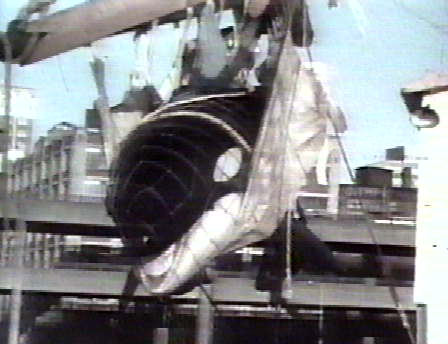
The small cove was soon filled with the thrashing of the killer
whales. Mothers placed thier own lives at risk in order to protect those
of their calves. Infants ranging from 2 to 7 years if age were quickly
separated from their mothers and prepared for extraction. A mother and four
babies died that horrid day. All drowned in the twisting nets. The four
calves were slit, filled with rocks and dumped at sea. Survivors of the
attack were sold into a life of slavery and humiliation.
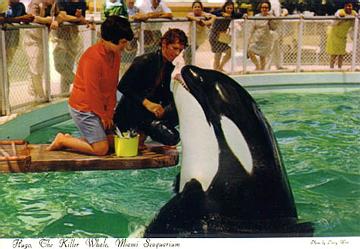
On the 14 of September, 1970, Miami Florida adopted a brand new attraction. Purchased for $6,ooo dollars and driven 3,ooo miles from home the tiny orca was moved into the tank at the Seaquarium. In the small tank Lolita was reunited with Hugo, the male captured earlier that year. But their happyness was short-lived when Hugo died of a brain anurysim. He was only 13 years old.
Now she is all alone and lonely, with only her trainers, an
inflatable plastic orca, and four captive Pacific white-sided dolphins(
whom she doesn't like) for companions. She is the only survivor of the
captures, but has a sunny disposition for a creature that has ben through
hell and lived. This lovely animal performes the various humiliating
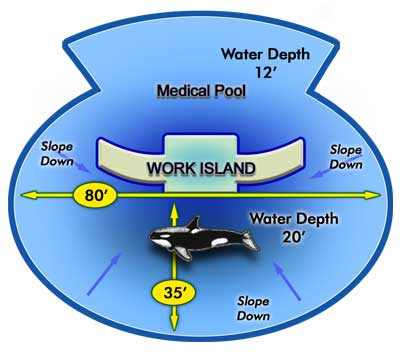
tricks twice a day, every day of the year. She lives in a very small tank
and has barely enough room to breach and swim. (the image below should
give you an idea of the tank she lives in)
Lolita is an excellent candidate for release. She is in her reproductive prime and since she was captured at the age of six, Lolita would have already learned to hunt and fend for herself. She remembers the calls of her family and knowns how to communicate with them. Also her ecolocation systems are developed and mature. If she is ever released into the wild great care would be taken to see that she does not bring any human illnesses into wild orca communities. The reintroduction Lolita would go through would be slow and steady to ensure that she is accepted into a wild pod. Aside from these factors, Lolita's owners claim they have her best interests in mind and won't release her under the ideas that she is too dependant on humans. Some animal behaviorists even claim that she could be in danger if released and might infect wild populations.
But think about this. Keiko was released and managed to do pretty well. If orcas can be taught to do tricks then they can be taught to be wild. The following addressess are for thoses who feel they can help tip the scales in favor of freeing Lolita. Please contact the man responsible for Lolita... urge him to do the right thing. Thank you.
Wometco Enterprises
Coral Gables, FL 33134
Phone: (305) 529-1400
Fax: (305) 529-1485
E-mail: Seth Grodon, Chief Public Relations Executive
[email protected]
Aurthur Hertz
The Miami Seaquarium
4400 Rickenbacker Causeway
Miami, FL 33149
Phone: (305)365-2518
Fax: (305) 365-0075
Or you can become involoved with Lolita's Legion...
the non-profit organization that is fighting to help Lolita. The link
below will take you to their home page. Everyone should learn to care for orcas
and other dolphins and whales. This site wants to spread the word to everyone
that a wild animal is not wild in a tank or cage. You don't have to
visit an aquarium to appreciate killer whales. To feel compassion for any living creature you have
to feel apprectation for them in your heart. That's were love starts....the heart.
Lolita's Legion