Since
1961 a total number if 134 wild killer whales have been kidnapped from their
pods and placed in captivity. Of these animals 110 have died. Their average
lifespan in a tank is under six years! Most die before they reach their early
twenties. In 1968, 63 pregnancies occurred in captivity, sadly, only 26 of the
captive-born calves have survived. A grand total of 49 orcas are held in 12
marine parks in five countries. 23/49 were wild- caught and 26/49 captive-born.
21 of these orcas now call Sea World their home. These performing whales
attract around 10 million people annually and provide this facility with 70% of
its income. They are essentially making money by exploiting these beautiful
animals.
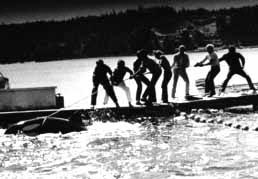
Killer whales are our helpless victims that we've plucked from their families
and from the oceans kicking and screaming. Then we have forced them to live in
small tanks in chemically treated "sea water". Humans have placed
them in artificial social groups and taught them to perform demeaning tricks that
have nothing to do with their natural behaviors and then called it
"educational". Animal welfare groups agree that captive whales and
dolphins suffer in captivity. Many orcas died from injury and infections and
premature death.
To force wild-caught orcas to perform for paying crowds the animals are often starved in holding pens in warehouses or sheds. Once the hungry animals surrender and take dead fish laced with vitamins and medications the animals are ready to be taught demeaning tricks. Trainers call this process - positive reinforcment. But it is the opposite, it is food deprivation. Once the killer whales have been taught dolphin tricks, they are moved to the main tank and placed in their "socail group". Many people working for aquariums do not know that different populations of orca have different dialects. captive orcas from different parts of the world will not understand the other prisoners and that often leads to fights.
Aggression between the captives and towards trainers has increased over the
years. Here is a short list of some of these examples from well-known marine
parks. These are actual accounts of aggresstion
towards trainers and the public by captive killer whales. (please note ... there has been no
record of a WILD orca ever attacking a human).
Miami
Seaquarium, Florida
(1970s) -
"Hugo" broke observation window, causing significant water lose and slicing
off the end of his nose.
(Unknown) - Trainer Chris Christiansen received seven stitched in his cheeks
after placing his head within the jaws of "Hugo", closing his mouth
on a mis-cue. Trainer Manny Velasco recalled both "Hugo" and
"Lolita" becoming aggressive, lunging at trainers on the platform.
Marineland
of The Pacific, California (now closed)
(1985) -
"Corky" broke observation window resulting in the loss of more than
one-third water volume in tank.
(1978) - May 2 - Trainer Jill Stratton, 27, was nearly drowned when
"Orky" suddenly pinned her to the bottom of the tank and held her
underwater for four minutes.
(Unknown) - Unidentified male trainer was seized by the leg and held at the
bottom of the pool until the man almost lost consciousness by "Orky".
Sea
World, California
(1984 & 1986)
- "Kandu V" reportedly took two female trainers in her mouth on two
separate occasions in 1984, then pinned a male trainer against a wall at Shamu
Stadium in November 1986.
(1987) - June 22 - Witnesses John Fitzrandolph and Deborah York reported
observing aggressive behavior by "Kandu V" towards "Corky"
in a complaint written to NMFS. Fitzrandolph described the event, "...the
two killer whales collided violently. In but a couple of seconds, we witnessed
blood boiling from a 2 1/2 - 3 foot gash along the lower abdomen...of the
whale."
(1989) - Sea World officials said "Kandu" had repeatedly exerted her
dominance since "Corky" was brought to the park from Marineland three
years ago.
(1989) - Sea World veterinarian Jim McBain said the whales usually emerge from
their social skirmishes with minor rake marks from rival's teeth as was the
case in previous combat between "Corky" and "Kandu".
(1989) - Joanne Webber, a former killer whale trainer injured in 1988,
described "Kandu" in court documents as, "exhibiting the extreme
characteristics of aggression when frustrated. She does occasionally bite and aggressively
rake other whales."
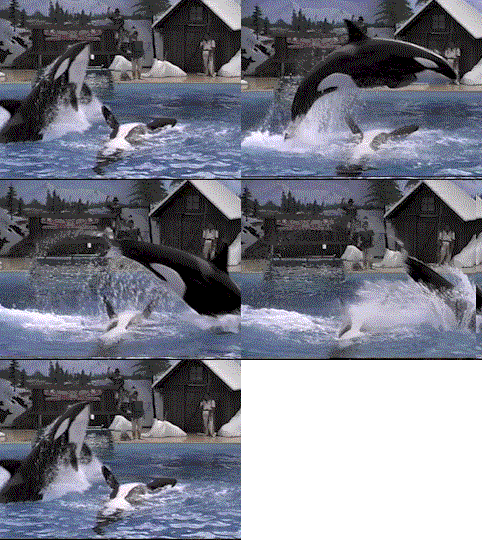
(1989) - August 21 - During an afternoon show performance, "Kandu V"
initiated aggressive behavior towards the larger orca "Corky",
opening her mouth very wide and striking "Corky" broadside. As
"Kandu" returned to the north back pool, she took her first observed
breath exhaling large amounts of blood. The impact had fractured her upper jaw
and lacerating arteries. The hemorrhage persisted for 45 minutes until death.
(1995) - July 10 - A five-year-old orca ripped a gash from his chin to his lip
exposing a six-inch strip of tissue, apparently when he ran into a tank wall or
gate. Trainers reported that the young male had been swimming quickly around
the pool with a six-year-old female, although no park officials witnessed what actually
happened.
Sea
World, Florida
(1988) -
Aggression escalated between the two male orcas "Kotar" of Icelandic
origin and "Kanduke", an older transient. Both animals reportedly
beached themselves and made crying sound repeatedly. "Kotar"
reportedly bit "Kanduke's" penis inflicting injuries sufficient to
close shows for two days. "Kotar" was transferred to Texas in 1988.
(1988) - August thru November - The following attack was described as the
"culminating incident" of repeated aggression between mother and calf
orcas. Another source described the mother as "actively pursuing the calf
aggressively and tries to get it out of the tank and pursues it on
slide-outs". "Taima" swam under her three-month old calf
"Sumar" during a summer performance, swatting the calf with her tail
and tossing the calf out of the water onto the trainer platform. The mother then
slid out and pinned the calf against the wall and began biting him. Guests were
evacuated from the show area while trainers pulled the mother into the back
pool by a harness. Sometime afterward, mother and calf were permanently
separated into different pools due to "poor parenting" and the calf
was transferred to California 7 months later.
Sea
World, Texas
(1991) - May 5 -
"Kahana" died violently from injuries resulting from a collision with
the pool wall, including multiple fractures of the mandible and skull,
lacerations exposing portions of the brain, and severe hemorrhage. Sea World
attributed the collision to a panic response caused by pain due to a 3 cm by 6
cm intestinal tumor. Following an investigation of the death, National Marine
Fisheries Service notifies Sea World that the cause of death would be recorded
as "severe trauma".
Sea
World, unknown location
(1984) - Trainer
Bud Krammes was seriously injured in an undescribed incident.
(1985) - Trainer Georgina Jones was grabbed by an orca during a performance in
San Diego.
(1987) - Numerous San Diego newspapers reported on a "white paper"
disclosing at least 14 trainer injuries of various severity while working with
orcas within a five-month period in 1987. Only a few of the incidents were
described in the media.
(1987) - September 27- Trainer Mark McHugh was bitten on the hand while feeding
an orca between shows.
(1987) - September 30 - Trainer Chris Barlow, 24, was hospitalized with minor injured
after being rammed in the stomach by an orca during a performance.
(1987) - March 4 - Trainer Jonathan Smith, 21, suffered cuts, a ruptured
kidney, and a lacerated liver after being seized by two orcas, repeatedly
dragged to the bottom of the pool and smashed against the tank during a
performance. Smith had less than one-week experience working with orcas.
(1987) - June 15 - Trainer Joanne Webber, 29, suffered a fractured neck when
one orca landed one top of her and pushed her to the bottom of the pool during
a practice session. Webber had five years experience working with orcas.
(1987) - November 21 - Trainer John Sillick, 26, suffered fractured vertebrae
(T1 - T12), a fractured femur, and a fractured pelvis after one orca breached
on top of him while riding another orca during a performance. Sillick had less
than two years experience working with orcas.
(unknown) - Secretary Annette Eckis, wearing a bikini, slid off the back of an
orca she was riding for a publicity stunt. The orca seized her leg and swam
around the tank refusing to release the screaming woman until familiar divers
entered the pool.
Vancouver
Aquarium, Canada
(1991) -
"Hyak II" died February 16, 1991 - 12 days following a fight between
the other male orca "Finna" on February 4, 1991.
(unknown) - Trainer Doug Pemberton described "Skana" as the dominant
animal in the pool. "She is capable of changing moods in minutes">
He described "Skana" and "Hyak" as "moody", and
recalled that, "Skana once showed her dislike by dragging a trainer around
the pool. Her teeth sank into his wetsuit but missed his leg."
Dispite these dangerous and often fatal attacks by captive orcas, people still
visit marine parks and oceanariums.
The captivity industry has also been arguing that captivity is best for marine mammals
and that they are loved by trainers and turists alike. Here are some of the
various points of the arguements about keeping orcas captive.
The following are a comparison between the LIES that the captivity industry promotes and the
TRUTHS they attempt to cover up.
The Crystal Orca does not -- in any way -- endorse, promote, or encourage the capture, confinment,
and display of dolphins and whales.
The facts presented to you are from (Lolita's Legion) and (Orca Network).
Fiction vs Fact
all vet info about the treatment of cetaceans comes from those in captivity
This fact is only 99% true.
How many vets are working with cetaceans in the wild?
If cetaceans were not in captivity they would not be needing treatment.
all anatomical, physiological, and pathological info comes from captive whales
and dolphins
Most information is decades of measures taken from Soviet whaling days
Info about habitat use and social lives is impossible to get from captives.
The lives of orcas are cut by 2/3 in captivity.
How much more study is needed to until we learn that
they are killed prematurly to satisfy our curiosity.
info about reproduction comes from those few in captivity
In terms of physiology and gestation, that's partly true, but in terms of social behavior
and communities captive studies are useless.
A great number of studies in the wild have taught us about their reproductive habits.
captive animals provide us with info about their sonar and echolocation systems
marine parks generally forbid outside scientists from conducting research.
Their's is all about
protecting their assets.
Many cetaceans in captivity stop using their sonar because they do not need them in small barren tanks.
if the numbers of wild populations decreased captive animals could help
reinforce depleted wild numbers
If so, then now is the time to free Lolita, but it's a dishonest promise.
Marine parks have no
intentions of releasing thier money-making whales and dolphins.
Only ONE killer whale has ever been released after being in captivity.
most people never see wild whales and dolphins, marine parks allow people to
interact with them at a lower cost than a cetacean-watching trip
In captivity, people see artificial, confined surroundings and forced behaviors, nothing
close to the social life people see in the wild.
There are MANY animals people don't see in the wild.
Is there that great a need for these creatures to be seen?
If people really want to see them, they will find a way, do we need to make them perform for people?
oceanariums give vital educational info to visitors regarding cetacean
conservation and biology
In some cases, but they routinely lie about the life span and ignor essential facts about social life.
Female orcas live to be 90 years old, but in marine parks, they still claim that orcas only live to be 35.
Information about killer whales sould be served up just as well in an IMAX theater. There is no need for a live demonstration.
people will want to conserve whales and dolphins more if they have contact with
those animals
People will want to conserve whales and dolphins if they are more educated about how they live in the wild.
If people would leave whales and dolphins alone, there would be no need to conserve.
captive whales and dolphins act as ambassadors for their wild relatives
The truth about whales and dolphins is the best ambassador.
Captivity perverts and corrupts any educational content found there.
Captive whales and dolphins serve only as entertainment.
They are part of a muti-billion dollar industry that is busy trying to make money by putting
out statments like the last one.
animal trainers and handlers are invaluable when it comes to a marine mammal in
need of human aid
There are plenty of people equally or more competent to accept the challenges of helping whales and dolphins in trouble.
Other than strandings, whales and dolphins do not need human aid. They just need to be left alone.
some whales and dolphins need to stay in captivity for their own survival
In rare cases, for a short time.
The only whales and dolphins that need to stay in captivity are those born there.
None of the others need to be there and every effort should be made to free them.
people are not interested in something until they have direct contact with it
So nobody is interested in dinosaurs?
To think that people have to have direct contact with something in order to be interested is naive
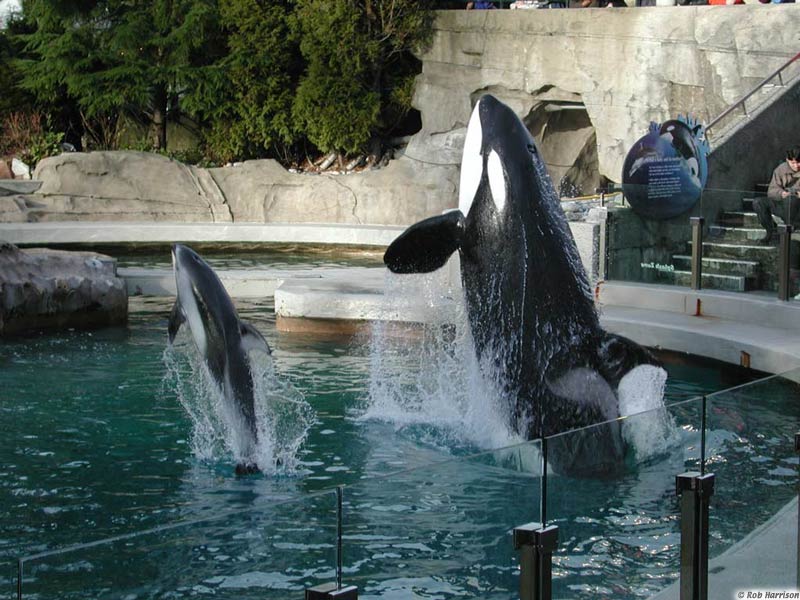 I just want all
of you to know that captivity is a death sentence for whales and dolphins.
Their lives are full of stress and in no way are they "happy" living
and performing in small barren tanks. Whales and dolphins are much more happy
being wild and free. They are more in danger of dieing in a tank than of dieing
out in the ocean. Please don't support facilities with captive whales and
dolphins. They are truely dying to entertain us.
I just want all
of you to know that captivity is a death sentence for whales and dolphins.
Their lives are full of stress and in no way are they "happy" living
and performing in small barren tanks. Whales and dolphins are much more happy
being wild and free. They are more in danger of dieing in a tank than of dieing
out in the ocean. Please don't support facilities with captive whales and
dolphins. They are truely dying to entertain us.