Deep in the Ottawa National Forest, in the middle of miles of nothing but
trees and sky,
thousands of parked cars and scores of young women and men—many barefoot,
some
bearded, others with dreadlocks—pack the two-lane road that cuts through
this remote stretch
of land. A girl leans out from the back seat of an oncoming old Chevy and
shouts to me, "Can I
get a ride, sister? These guys are drunk."
She pushes her way out of the car and the grey-haired man driving it swerves
down the road.
The woman, who says she is 25 but won't give her name, wears a maroon-colored
sarong, a
knitted cap, and duct-taped shoes. Her lip is pierced. She's heading to
the woods, she says,
to the heart of the Rainbow Family Gathering.
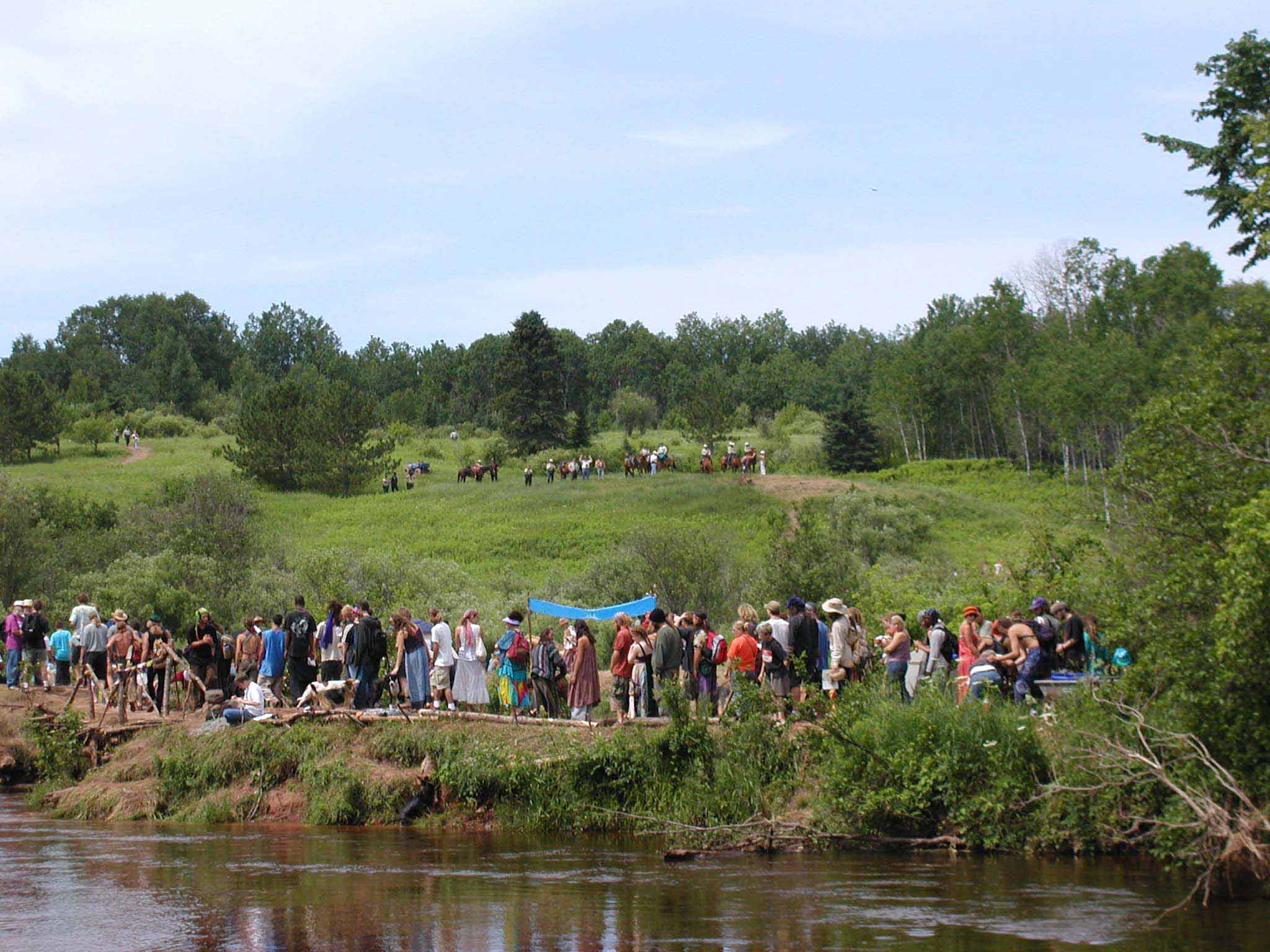
Since 1972, as many as 25,000 self-proclaimed hippies of all ages and origins
have come
together every summer for a week of sprawled-out camping and good vibrations.
This year,
fewer than 9,000 have shown up because the gathering is in such a remote
place—on
Michigan's upper peninsula near the lumbering town of Watersmeet. Nestled
in the forest on
both sides of a path about half a mile from the road, Rainbows pitch tents,
build makeshift
kitchens, go to drum circles and yoga, and smoke a lot of pot. The main
event takes place on
Independence Day, when everyone joins hands in a big circle to pray for
peace and love on
Earth.
To the despair of the U.S. Forest Service, the Rainbows always gather during
the week of July
4th, and they always gather in a national forest. The more pristine the
location, the better. This
year's site is one the Forest Service explicitly asked them— begged them,
actually—to stay
away from. It surrounds a 19th-century ghost town that contains delicate
archaeological
specimens, including dishware and the foundations of homes built beginning
in the 1800s.
The area also has a fragile water table near the ground's surface.
According to Becky Banker, a Forest Service information officer, by the
beginning of the week,
the Rainbows have already damaged some artifacts and polluted the water
with their waste.
"You can't put thousands of people in one area without there being long-term
damage,"
Banker says. "You do the math. That's a lot of shit."
The mess, and the environmental damage it causes, is part of a colorful
legal wrangle
between the Forest Service and the Rainbows, which heated up this year
with at least 27
arrests and the alleged assault of an officer when the service forcibly
closed down the ghost
town. Ignoring the closure, on July 4th a few thousand people stormed past
Forest Service
officers onto the off-limits site to pray for peace.
After every gathering, dozens of Rainbows stay behind to help forest service
officers clean up.
"We leave the land in better shape than when we find it," insists the woman
from the
Chevy—something most Rainbows sincerely believe. "Sure we may stomp on
some
vegetation," says a stoned 18-year-old guy who hasn't slept in 36 hours.
"But this public land
needs to become more public. It only takes, like, three or four months
for it to recover." Some
of the Rainbows care less about the ghost town—at a town-hall meeting in
Watersmeet, one
claimed that the town wasn't worth protecting because it had been built
by white settlers rather
than Native Americans.
Not surprisingly, the Forest Service thinks otherwise, and it also thinks
the Rainbows are
deluding themselves about the impact of the gatherings. An investigation
of last year's
gathering in Boise National Forest in Idaho found piles of uncovered waste,
vegetation
destroyed by fire pits and thousands of trampling feet, and a stream damaged
by two large
holes that were dug for a tank and a large trench to collect water. The
investigators say it could
take the area years to bounce back.
To many Rainbows, going into the woods is about "avoiding Babylon"—the
corrupt, everyday
world of 9-to-5 jobs and materialist striving. In Babylon, the woman from
the Chevy made the
mistake of marrying and having kids when she was young, and then getting
hooked on heroin
and speed (habits she has since kicked). But at the gathering, she says,
she feels like she
has "come home." She frolicked naked. She met a guy she likes. She acquired
two new body
piercings and two new tattoos, including a marijuana leaf on her lower
back.
Lots of other Rainbows feel similarly liberated when they get to the woods.
Whether they are
Hare Krishnas, anarchists, or alcoholics, almost all shun Babylon's capitalist
values—and the
confines of its government. Since the gathering is supposed to be about
kicking free, it's
particularly galling for Rainbows to discover that even deep in the woods,
they can't escape
rules and regulations.
In 1995, the Forest Service started requiring all private groups of 75
or more people who want
to camp out on forest land to apply for a permit. One adult has to sign
the application on the
group's behalf. In a one-page application, he or she has to list the location
and facilities the
group wants to use and the number of campers who plan to come. Anyone in
a group of 75 or
more who camps without a permit faces up to six months in prison and a
fine up to $5,000.
The idea behind the permit is pretty basic: The Forest Service asks someone
to sign for the
group not to hold him accountable, but so officials will know whom to communicate
with. The
agency says it's trying to accommodate large groups while protecting forest
resources and
staying on top of health and safety concerns. Groups are denied permission
to use places
that could be damaged by big gatherings and are steered toward sites seen
as better
alternatives. The permit requirement gives the Forest Service an idea of
how many officers it
should send out to monitor a gathering.
All big groups who want to use the national forests—including Burning Man,
which holds a big
fire festival in Nevada that's just as countercultural as the Rainbow Family
Gathering—sign up
for government permits. All groups, that is, except for the Rainbows, who
think the permit
requirement is unconstitutional. They say that it violates their First
Amendment right to
assemble freely, and that it unfairly calls for one person to speak for
thousands of others.
The Rainbows are emphatic: They have no leaders and no organization. And
they won't be
boxed in to becoming a legal entity the way Burning Man or the Boy Scouts
are. "The Rainbow
Gathering is a spiritual concept like God," says Barry Adams, one of the
original founders, who
goes by the name Plunker. "No one would ask God to be liable for national
forest land. Plus,
no one can be a designated agent for a motley crew of unaffiliated individuals
and unaffiliated
groups."
Plunker's argument has gotten him nowhere. When he made it in U.S. District
Court in
Montana in 2000, the judge sentenced Adams to three months in prison plus
a $500 fine for
attending that year's gathering in southwestern Montana, which didn't have
a permit.
In fact, over the past eight years, eight or so cases involving Rainbows
have gone to court, and
the government has won all but one of them. Some judges are starting to
get annoyed by the
group's persistence. U.S. District Judge Maurice B. Cohill Jr. sentenced
three Rainbows who
participated in the 1999 gathering in Pennsylvania to three months in prison.
The judge said
that the permit requirement is constitutional because it treats all groups
alike and serves a
"significant governmental interest"—protecting the forest and ensuring
public health and
safety. Cohill concluded, "While the 'mouse that roared' syndrome sometimes
has the appeal
of tweaking the authorities on the nose, we hope that the time to stop
has finally arrived."
The Rainbows lost on appeal, too, but they plan to keep roaring. Their
small advocacy group,
People for Compassion and Understanding_//\_Free Assembly Project, is investigating
the
Forest Service's handling of gatherings, tracking Rainbow court cases,
and offering legal
support. The organization's leader, Scottie Addison, a 52-year-old from
St. Louis, is
counseling the Rainbows who got arrested this year.
Meanwhile, the Pennsylvania Three, as they're known among Rainbows, started
doing their
time in federal prisons in Oregon, Colorado, and Connecticut. "It's going
to be tough," said one
of the three, Joan Kalb (a.k.a. Joanee Freedom), a week before she headed
off. "I'm going to
have to find someone to stay at my apartment in New York to watch my two
Amazon parrots."
Megan Twohey is a writer living in Washington, D.C.