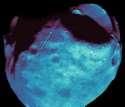
Our Moon, which has often described as a sister palnet to the Earth, is just one of more than 50 planetary satellites in the solar system. It is the sixth largest. All the planets, with the exception of Mercury and Venus, have moons revolving around them. The investigation of these satellites has been one of the mostinteresting features of the space probes in the past few years. This collage of recent photographs examines a selection of other moons and compares them with our own.
PHOBOS. 14 miles (22km) in diameter. It is shown here in a mosaic of images taken by Viking 1.
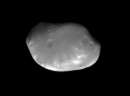
DEIMOS. 8 miles (13km) in diameter.
PHOBOS AND DEIMOS. The cratered surface of Phobos and Deimos are dark grey. Like our own Moon, they are dusted with a loose coating of pulverised rock known as the regolith.

OUR MOON. 2,160 miles (3,476km) in diameter. Since our Moon takes the same times to rotate on its axis as it does to orbit the Earth, the same hemisphere is always facing Earth. With the naked eyes it is possible to distinguish the dark, waterless seas, such as the Mare Imbrium, and the bays, such as the Sinus Roris, from the brighter highlands around them.
IO. 2,255 miles (3,632km) in diameter. Although Jupiter's IO was discovered by the Italian astronomer Galileo in 1610, little was known about it until the Voyager fly-bys in 1979. Vividly covered photographs revealed that it is the only body in the solar system, other than the Earth, known to be volcanically active today.
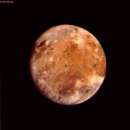
GANYMEDE. 3,276 miles (5,276km) in diameter. About 1 1/2 times the size of our moon, Jupiter's Ganymede is the largest moon in the solar system. The dark areas of its icy surface are separated by bands of younger, lighter terrain. The bright spots mark the sites of craters.
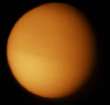
TITAN. 3,200 miles (5,150km) in diameter. Saturn's largest satellite is similar in many ways to the inner, or terrestrial, planets. For example, it has a rocky core and atmosphere (though with a pressure 1.5 times greater than the Earth's). It's surface features are hidden by orange clouds that are fringed by layers of blue haze.
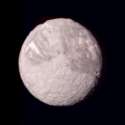
MIRANDA. 300 miles (480km) in diameter.
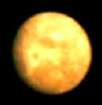
OBERON. 1,000 miles (1,600km) in diameter.
OBERON AND MIRANDA. Even more surprising than the discovery of Uranus's new moons by Voyager 2 were the pictures taken of its five known moons, Oberon, Titania, Umbriel, Ariel and Miranda. The last turn out to be a geological oddity. In this part-image taken by Voyager 2, Miranda is clearly misshapen, gouged by craters and valleys and riven by great faults and jagged ridges. Miranda is 20 times smaller than the Earth, but some of its cliffs are 3 miles (5km) tall - over 3 times higher than the walls of Amarica's Grand Canyon.