| Mel Gibson |
The Passion of Christ - Mel Gibson movie * * *
Official web site 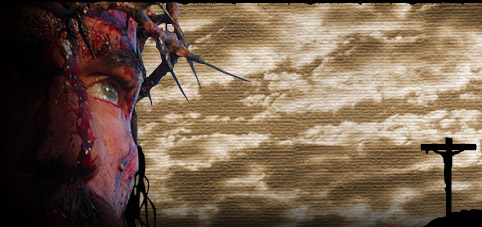
While crucifixion film wins praise, —
'Passion' also inflames
By Richard Ostling, The Associated Press
NEW YORK - It wasn't backed by a major studio and it won't even appear in theaters until Ash Wednesday, a full two months after Christmas. Yet Mel Gibson's engrossing epic ``The Passion of the Christ'' is already among the most-debated films of recent times and a major religious flash point.
Private viewings by select audiences in recent months - often including conservative clergy - have won the movie heartfelt praise.
The Rev. Billy Graham professed he was profoundly moved by Gibson's somber depiction of the last 12 hours of Jesus' life. An aide to Pope John Paul II said the pontiff felt the film accurately ``shows how it was'' as Jesus went
through anguish in the Garden of Gethsemane, arrest, trial, torture and crucifixion on Golgotha.
Gibson said that ``Passion'' is indeed an attempt to capture what really happened, but also a personal _expression of faith.
``I had to make this film; I couldn't not make it,'' he said.
Some Jewish groups, however, have expressed outrage about the portrayal of Jews, fearing that the movie might spark anti-Semitism. Some Christian scholars have joined their complaint.
A recent viewing of the film's nearly final cut showed why people are reacting so dramatically.
It is not just that the passion was filmed, although the story has long been a delicate subject between Jews and Christians, and among Christians themselves. It's the elaborate rendering of Christ in agony that is at the core of the reactions. Gibson's vision is intensely violent.
The depiction is close enough to the literal Gospel accounts to
upset liberals, yet with imaginative additions that might trouble some biblical purists. While the film is not a collective attack upon Jews, the handling of some Jewish characters seems bound to spark still more protest.
Those who come to the movie without a strong religious background will be given plenty to ponder, and many will be sent scurrying back to the New Testament to compare the movie with the ancient Gospel texts. They'll soon discover that the Bible is far more restrained than the gory Hollywood treatment.
Scripture discreetly states that Jesus was scourged, spat upon and struck on the head. In the film, Jesus (Jim Caviezel) is savagely whipped by sadistic Roman soldiers wielding metal chains. Blood splatters and oozes. After the Nazarene is dragged away, mother Mary (Maia Morgenstern, daughter of a Holocaust survivor) stoically mops up the sacred blood from the pavement.
On Golgotha, Mary's face and robe
are smeared with blood as she kisses Jesus' feet and cradles his corpse. In one nonbiblical, gruesome touch, a bird pecks out the eyes of the bad thief crucified with Christ - nature's retribution for mocking Jesus.
Gibson, who directed, funded and co-scripted the film, explained in e-mail responses to questions that in those scenes, ``I tried to make it as realistic as possible. I wanted the audience to feel like they were really there. ...''
Yet the actor-director, often identified as a traditionalist Catholic, acknowledged that the film is ``hugely personal. I saw other film versions and I couldn't understand them; I couldn't believe them.''
What drove him to create this version was a spiritual crisis about 13 years ago. ``I came to a difficult point in my life and meditating on Christ's sufferings, on his passion, got me through it,'' he said.
``Once I started meditating on the passion, really going deep
into it in my own mind and heart, then I began to understand it, to believe: That's the version I put on film.''
Who was responsible for Jesus' death? The film's answer is everyone - in accord with the biblical teaching that Jesus died because of the sins of each individual ever born.
The movie says this from the very start, citing the traditional belief that the prophet Isaiah foretold redemption through the cross (``he was wounded for our transgressions'').
In flashbacks, Jesus himself says ``no man has greater love than this, that he lay down his life for his friends'' and, at the Last Supper, ``This is my blood, given for you and many for the forgiveness of sins.''
As for the culprits directly involved in the crucifixion, the film features a shrouded, androgynous Satan, who is eerily omnipresent. Judas fulfills his customary betrayal and hangs himself. Pilate orders the unjust execution and Roman troops
gladly carry it out.
But what about the Jews?
Liberal scholars interpret Jesus as a political martyr, whereas the Gospels, and ``Passion,'' say the Jewish authorities judged him guilty of blasphemy for claiming to be the Messiah and Son of God and led their followers in urging execution.
While the script doesn't imply collective guilt for Jews as a people, there are villainous details that go beyond the Bible.
However, there are also elements that might assuage some Jewish objections to the movie.
All those on Jesus' side were also Jewish, of course. Gibson's script in Aramaic and Hebrew (with English subtitles) underscores Jesus' Semitic setting.
Gibson plans to add scenes before release to underscore Jesus' teachings about love and forgiveness. In the end, he believes, his creation will be faithful to the Gospels.
``The movie is about faith, hope, love and forgiveness," he said. "If it
stirs those things up in people, it will be a success.''
|