 |
| The following tells how Prestonpans got it's name and a brief telling of our early works........ |
| Towards the end of the 11th century a pirate name Aldhamer was caught up in a hurricane and was swept round Gullane Point into the Firth of Forth where his boat was wrecked on the rocks along the shore here. Finding it impossible to to get back home, the shipwrecked mariners decided to remain where they had been driven by the hurricane. They formed a settlement and called it 'Aldhamer' in honour of their chieftain. That story was passed down from father to son over the centuries. |
| Prestonpans Name |
 |
| One thing is certain that when the monks came down from Newbattle in 1184 and settled in the disctrict they found the hamlets of Aldhamer to be occupied by villagers. It soon became known as Aldhammer. Shortly after they named it Prieststown. With salt being manufactured there it became Salt Prieststown. This was later reduced to Salt Preston. In time the Salt was dropped and the Pans added. Hence Prestonpans. |
 |
| During the earliest years of the 13th century coal was discovered and excavated by the monks. It is said that from Seaton along the coast of Pinkie Burn and from Winton to Inveresk was originally Tranent or Winton territory. In 1184 De Quincy, landlord of these lands, granted the monks of Newbattle lands whereon they formed a grange. he also gave seven acres of meadow where to feed their sheep and also allowed them to take peats out of Tranent Peatries. |
| These Meadows stretched from Dolphinstone on the west along by Bankton, Meadowmill and along Seaton on the east coast. It is believed the monks discovered coal while taking peat from the Peatries. A charted was applied in 1210 enabling them to excavate the black diamonds as they were known. It was the earliest spot in the kingdom where caol was dug from the earth. The charter of Newcastle-upon-Tyne of 1234 making the monks the first to excavate coal. |
| The manufacture of salt, like the digging of coal, began at a very early period in this locality. The monks from Newbattle were granted a footing at Preston from De Quincy in 1184. By 1198 they were busily engaged in making salt. Two centuries earlier there were ten salt works belonging to the town capable of producing between 800 to 900 bushels of salt per week. |
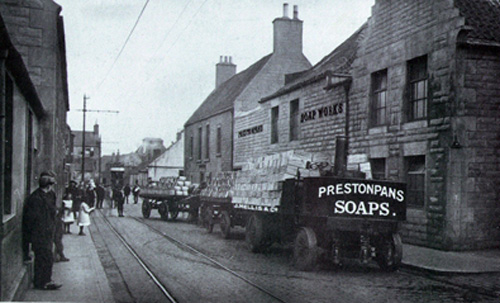
| Prestonpans at one time had 16 breweries flourishing but they have all closed down. The oldest belonging to the Fowler family was built in 1720. The Fowlers obtained it in 1756 and was in production until the 1960's. Famous for it's wee heavy and good ales it enjoyed large fame in Scotland. The soap works here were situated in the high street extending south to Kirk Street. They were owned by Messrs James Mellis + Co. The output was 90,000lbs per annum. |
 |
| Coal and Salt works |