 |
| In 1745, a battle took place at the southside of Prestonpans which to this day is honoured...... |
| The Battle of Prestonpans |
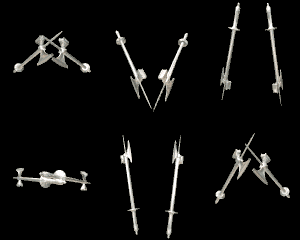
| Hanoverian General Cope landed at Dunbar on September 17th, 1745, and along with approximately 2,500 troops marched toward Edinburgh. With forces somewhat equal in number to the Jacobites, Cope decided to make a stand at Prestonpans and wait for Prince Charles Edward Stuart, who he knew would inevitably march to meet him in battle. The Hanoverian defensive position was thought to be ideal, with two walls to their right, a bog on their left, the sea behind and a deeper moat-like ditch in front of them. In addition to Cope's numerous well armed foor soldiers and dragoons were six 1 1/2 pounder galloper guns and six small mortars. Considering the Highlanders "poor" weapons (Mismatched guns, broadswords, Lochaber axes, Pitchforks...) and their lack of artillery, the English Commander was quiet confident. |
 |
| The Jacobites came within sight of Cope's men by mid-afternoon, September 20 and paused to reconoiter their offense and survey the area. O'Sullivan sent a contingent to the Tranent Churchyard, at the village's northwestern extremity. Without delay they were observed by Cope's men, who used two 1 1/2 pounder guns to bombard them, wounding some. At this point Donald Cameron of Lochiel, XIX Captain and Chief of Clan Cameron, became enraged that his men were being risked so, and asked O'Sullivan's rival, Lord George Murray to withdraw them. Over O'Sullivan's protests the Camerons were removed by Murray, who, acting on information he had received, decided that the Jacobite attack must come from the east, not west. |
| Murray's decision, contrary to Prince Charles plans, came about from information he had received from a local gentleman, Robert Anderson. Anderson had known this area since childhood and told Murray of a hidden path through the underguarded bog which would lead the Highlanders to the plain below; by this route they will take the Hanoverians by surprise. That evening, when details of the impending attack were being finalised, a dangerous dispute took place between the Camerons and the MacDonalds. Ever since the Battle of Bannockburn, with King Robert the Bruce in 1314, the honour of fighting on the right flank had belonged to the MacDonalds; this was challenged by the Camerons. Earlier because of a similair conflict, the Clan's Chiefs had arranged to settle such disputes by drawing lots; the outcome favored the Camerons. Unfortunately, the MacDonalds fighting men erupted into near mutiny, essentially refusing to fight unless they were granted the right hand position. The situation was tactfully defused by Lochiel, who ceded the right flank to the MacDonalds if the battle didn't take place the next day, which it didn't. |
 |
| At 3AM on September 21st, the Jaconites silently mobolized their army, (which must have not been easy, since the opposing camps were a mere 400 yards appart) even leaving the horses that were possessed behind, and headed towards Anderson's hidden path. In the meanwhile, a detachment of sixty Camerons, under Clanranald, was sent to quietly seize the the enemy baggage train at Cockenzie. The Camerons easily overcame two companies of the Black Watch and forty additional infantrymen. The baggage would later prove to be of great value to the Jacobites, supplying them with 4,000 English pounds, ample weapons, and most of General Cope's personal accoutrements. The main body of the Jacobite forces weaved single file through the bog and formed their ranks in the darkness just 200 paces from the Hanoverians, who discovered their enemy's tactic had hastily swung their forces around and formed their ranks. Just after the break of dawn the attack began. |
| The left flank, consisting of the Camerons, Stewarts of Appin, The Atholl Brigadem and MacGregor's, began a silent march towards the Hanoverians cannons and Colonel Gardiners Dragoons. Under Lord Murrays aggressive command, the 800 camerons were in action long before the rest of the Highland army, firing a few shots at the enemy ordinance guard as they advanced. The guard replied with two Volleys, which did little to to impede the camerons progress. At this point Colonel Whitefoord managed to fire off somewhere between 5 - 11 shots from the heavy mortars and 11/2 pounder guns, which kolled one private and wounded an officer in Lochiels regiment. (This volley also killed Major James MacGregor, the son of the famous Rob Roy MacGregor) the artillery didn't intimidate the Camerons, it only managed to enrage them. They sounded their war cry 'Chlanna nan con thigibh a so's gheibh sibh feoil' and 'ran on with undaunted speed and were first up to the front of the enemy.' At this point the right flank also streaked into action, charging the English and enraging them in the style of combat suited to the Highlander, hand-to-hand, with targets held firm. |
 |
| 'The Victory began, as the battle had done, among the Camerons.' They carried everything before them, rushing forward past the now edserted and silent artillery to engage the dragoons. The Camerons tactic was to strike at the noses of the horses, as to get the better of their masters. This ruse wasn't very effective, since the majority of the cavalry to retreat in every which direction welll before the Highlanders were upon them. Those Hanoverians who were able to actually escape were few and far between, for it seems that the 'ideal' defensive area the General Cope had chosen had one serious shortcoming, it caged them in and allowed the Highlanders to take their rage upon them. |
| Incredibly, the action lasted only 15 minutes, ending in a total overthrow and almost entire destruction of Cope's army. the Camerons stayed in the thick of the battle during this time, engaging numerous pockets of Hanoverian foot soldiers, one of which Colonel Gardiner had attached himself to when his men fled for their lives. As he shouted 'fire on my lads, and fear nothing!!', a Cameron dealt him a 'terrible' blow to the head with his Lochaber axe, the weapon of choice for the Clan Cameron. Elsewhere, the enemy forces were being decimated. Prince Charles was galloping all over the battlefield, pleading wiearly morning, approximately 1,400 were taken prisoner, of which 900 were wounded. Only about 40 Jacobites were killed and 75 wounded. Among the dead were two Cameron officers, Lieutenant Allan Cameron of Lundavra and Ensign James Cameron, both of Lochiels regiment. |
 |
| After such a complete and easy victory Prince Charles believed that he and his Highlanders were the chance to surrender with dignity after obvious tide had been turned in battle. |
| Very few Redcoats escaped. The number has been placed somewhere between 175 and 200, with General Cope leading their way back to Berwick, where Cope was maligned as being the only General who brought first news of his own defeat. |