ALEXANDER MAY SHANNON AND
SHANNON'S SCOUTS
this information was compiled by Mike Ventura from various scources
Alexander May Shannon was born to Granville and Unity Williams Shannon in
Arkansas on the seventh of May, 1839. In 1853 at the age of fourteen, he went to
Texas. In 1861, the Civil War broke out. Alexander was living on his ranch on
the San Antonio River in Karnes County at the time, and was one of only a few in
the county who opposed secession. When Texas made the decision to join the
Confederacy, Alexander May Shannon joined the Eighth Texas Cavalry, known as
Terry's Texas Rangers, where he soon achieved the rank of Lieutenant of C
Company, later becoming its Captain. He stayed with that
unit until July of 1863, when he was assigned to command of the secret service
of the Army of Tennessee, reporting to the commanding general. In February of
1865 he was promoted to colonel. He was wounded several times in his service.
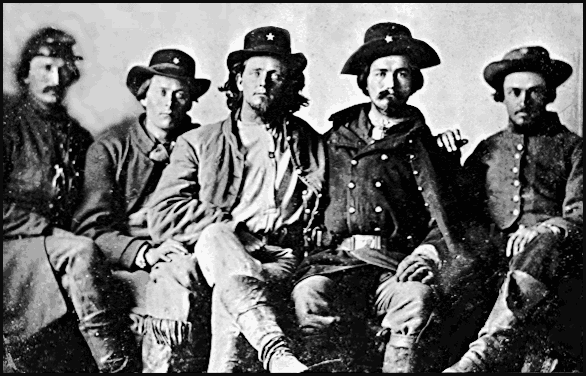
Some of Shannon's Scouts Left to Right: Peter Kenwell, Tom Burney (possibly),
Felix
Grundy Kennedy, William A. Lynch, unknown
One day in 1864 regiment Colonel Tom Harrison appointed Captain Shannon to lead
three other men, R. L. Dunman, from Chambers County, Texas, who was in Company
K, Lew Compton of Company C, and Bill Kyle of Company I, in a reconnaissance
mission behind enemy lines to report on one of Sherman's positions, a battery
that had been shelling Atlanta. Disguised by wearing Yankee uniform pants, the
four made it through enemy lines in darkness, got close enough to observe the
battery, then stole horses and made their way back to report by riding through a
cornfield to pass the Yankee pickets. According to R. L. Dunman, "The corn was
in roasting ear stage, sufficiently tall for us to keep pretty well hidden by it
from the sight of the enemy. As we walked through the corn, each man kept well
concealed behind his horse, letting him browse past the sentries until we were
safely out of sight. Then we mounted our newly acquired steeds and rode them
back to headquarters. This detail of Captain Shannon and his three picked men
was the origin of 'Shannon's Scouts.'
"On another occasion Shannon's Scouts, there were eighteen of us in this party,
ran into a brigade of Yanks." Dunman recalls, "We werequite as much surprised as
they were, but rather than let them discover our weakness in number, we began
yelling and shooting as we came, making enough noise and bedlam for several
times our number. We had approached from the rear, and they evidently thought
the entire Confederate army was after them, for they started to run and kept on
going through three miles of thick underbrush before they stopped! That was one
time when 'bluff' probably saved our hides!"
The Scouts grew in number, various details having eighteen to thirty men in
reports from various writers who served in the unit. The Scouts were never much
publicized as some other famous units, but were seasoned fighting men, whose
exploits exceeded most other single units. They spent days at a time behind
Sherman's lines, taking out foragers, pickets, scouts and light infantry and
cavalry units.
In April of 1865, Capt. A. M. Shannon of the Texas Eighth and Lieutenant Wilson
of the 11th Texas, with about 20 selected men, joined with Lieutenant H. C.
Reynolds of Company I of the 51st Alabama Regiment, known from his past work as
"fully capacitated for scout work,"and fourteen of his men, to form a " Special
Scout unit reporting only to General Wheeler. They were to operate daily in
small squads, some
remaining in camp for cases of emergency. "Their work was so successfully done,"
wrote scout veteran Edward Kennedy, "that the enmity of our foes was aroused to
where they charged us with murdering all prisoners after they had surrendered.
"Prisoners in our hands told us their officers had read out to their men such
accusatory papers, and these statements were sustained by a complaint sent in by
General Kirkpatrick on the 22nd of April, and said complaint is to be seen on
page 436 in DuBose's book, General Joseph Wheeler and the Army of Tennessee. A
prompt reply was given to General Kirkpatrick's paper, and two prisoners readily
signed
it."
"This complaint was based on work done the day before (21st) by nine members of
the scouts, five Alabama and four Texas boys. Lieutenant H. C. Reynolds in
command.
They had three engagements that day, in the first of which two (Yankees) were
killed; in the second, ten killed; one captured, and onewounded and captured,
one of his crowd escaped; third engagement, one captured, one killed, several
escaped. Total, sixteen, yet the complaint stated their loss as eighteen with
two throats cut.
"We knew nothing of such an act. Pistols were the only weapons used by the
Scouts. Several days after this correspondence General Wheeler met Kirkpatrick
to discuss the question of exchanging prisoners, as General Kirkpatrick often
arrested old citizens and dumped them in with war prisoners to tramp the road
with the horses.
Captain Shannon was one of the party accompanying General Wheeler, and just
before the discussion closed General Kirkpatrick said: 'If a member of your
scouts ever falls into my hands, I intend to have them publicly executed. They
are virtually fighting under the black flag, therefore, not entitled to the
rights of prisoners of war,'
General Wheeler replied that he would like to know if he executed anyone.
General Kirkpatrick said he would let him know, and Captain Shannon then said:
"General Kirkpatrick, you will have to capture before you can execute, and you
have never been able to do that yet; but should you, and execute, I assure you
that you will find you have paid dearly for your revenge."
Ed Kennedy of Centerville, Alabama wrote for the August 1918 Confederate
Veteran, "On 6th of May, 1865, General Wheeler ordered Captain A. M. Shannon,
commanding Wheeler's Special Scouts, to take his men across the Peedee River, in
North Carolina, do a certain work, and report as soon as possible thereafter."
The Scouts commandeered an old flat barge and crossed the river, spent the night
in the woods, then found, to their surprise, General Wheeler and two men at a
farm house. The General, with his command had gone the opposite direction than
the Scouts, and finding a ford, had swam the river, finding quarters where they
were found by the Scouts. They learned that a squad of Federals were at a
neighboring farm. Kennedy reports, "As the scouts made a move to go on, General
Wheeler said, 'We will go with you,' and rode on beside Captain Shannon, close
behind the advance guard. The Federals were soon found, and a charge made on
them resulted in a quick rout, which was rapidly pressed by the scouts. As the
chase continued, many Federals at other points along the road joined in the race
for safe quarters.
"The boys that day seemed to vie with one another so that General Wheeler might
see the essential qualifications of a man to be a member of his special scouts.
The chase was kept up until the advancing Federal forces were seen across an
open field forming a line of battle for their reception, so they hastily
retired. A published report of this little encounter stated that the Federal
loss was thirty-five in killed and wounded. As this fight went on one of the
boys called to General Wheeler to tell him something, and the quick response of
the General was: 'Don't call me 'General'; I'm Private Johnson with you boys
today."
"Captain Shannon rode a large dapple claybank stallion named Mohawk, and early
in this fight a ball passed through the upper part of his neck, and he fell in
the road. The Captain quickly transferred his saddle to a Federal horse which
had lost its rider, and he continued in the fight. On the scout's withdrawal
they passed back up the road on which they had advanced, and Mohawk was found
still lying prostrate in the road just as he fell, his head towards the enemy.
As the crowd passed by he appeared to take no notice, and several of the boys
bade him goodbye. As they moved on up the road at a lively gait for a half or
three-quarters of a mile, the rear guard heard the sound of horse's feet rapidly
approaching. They halted, expecting to receive a charge by an approaching enemy;
but it was only Mohawk coming in haste to take his place at the head of the
scouts. Captain Shannon promptly remounted him and rode him till the close of
the scout's service and probably to his home in Texas. As the members of this
scout did not want to surrender, they disbanded on the 15th of April The Alabama
boys left on the morning of the 16th, and the others probably did the same
during the day."
A writer to the Confederate Veteran Journal in the August 1897 issue recalls,
"The reunion of the survivors of Terry's Texas Rangers, which took place at
Nashville in June, calls to memory he names of a few Rangers under General Hood,
known as Shannon's Scouts, and left by him in Atlanta when he started on his
Nashville campaign in 1864. Our orders were to harass and punish the enemy at
every chance, and that duty was well performed. From the time Sherman left
Atlanta until
Johnston's surrender we killed or captured over twelve hundred Federals, and
fully half were killed, as General Joe Wheeler and many survivors of the Scouts
would testify. We also captured over one thousand horses an mules and destroyed
three hundred wagons. I recall the following members of Terry's Rangers: Capt.
A. M. Shannon, Felix Kennedy, Lon Compton, Coon Dunmon, William Kyle, C.
Barnett, Tom Burney, Sam Mavic, Emit Lynch, Bill Lynch, Carter Walker, Joe
Rogers, W. H. Smith, Dick Oliver, W. E. Moore, John Hogerty and Dick Pinkney
were of the fourth Texas; Homer Barnes, Even Walker, of
Georgia; while a few of them were of the Eleventh Texas Cavalry. Our last fight
was made after Johnson's
surrender, and we lost one of our best and bravest men when Emit Lynch was
killed not far from Chapell Hill, N.C. The Scouts at no time had over
twenty-five men for duty."
In the July 1923 issue of Confederate Veteran, Mrs. Virginia Barnes Woods, of
Montecello, Georgia, wrote: "In reading in the Veteran an article by R. L.
Dunman, one of Terry's Texas Rangers, I was reminded of the time when some of
them made my father's home their headquarters. If I remember rightly, their
names were Bill Kyle, Bill Lynch Felix Kennedy, and Captain Shannon. My brother,
Homer Barnes, was with the 4th Georgia Regiment. He was wounded and came home to
stay until he recovered, but didn't go back with his company, joining the Texas
Rangers instead, and was with them to the close of the war. Emmet Lynch was
wounded in the hand and came back to our home, and my mother dressed his wound
and he got well. Two of the boys married our Georgia girls-a Mr. Moore marrying
Mettie Allen, and a Mr. Johns capturin Emma Clark. I married a Confederate
Veteran, J. G. Woods. Perhaps some of those Texas boys are living and will
remember my father and mother's hospitality. They thought a great deal of the
Texas boys. Only my sister and I are left of the family."
Colonel Shannon was with Johnston's army in North Carolina when they got the
news of Lee's surrender.
Shannon was selected as commander of the troops to escort President Davis across
to the west side of the Mississippi River, but Davis was captured before
Shannon's company could reach him.
Colonel Alexander May Shannon
After the war Colonel Alexander May Shannon returned to his ranch on the San
Antonio River, but moved after a short while to New Orleans, where he went into
the insurance business with his former commander,
John Bell Hood. In November after that first year, he moved to Galveston to take
charge of the business' Texas division.
In 1880, Colonel Shannon became a government contractor doing jetty work along
the Texas coast, "from Louisiana to Mexico." He built projects along the coast
for ten years, including the south jetty in Galveston
Harbor, which extended about four and a half miles into the Gulf.
Alexander May Shannon became the General Manager of the Galveston and Western
Railway in 1890, and was appointed Galveston Postmaster in December 1893. He
married Miss Clara Viola Scott in 1872. They had three daughters and four sons.
Viola's father was Major William B. Scott ofAlabama, and her grandfather was
Governor Murphy of the same state.
In 1866, Colonel Shannon visited the Barrow ranch in Louisiana, where he took
notice of a large and husky type of cattle. He purchased a few of the stock,
crossed with a variety known as Brahman, the sacred oxen of India. The Colonel,
being a former rancher himself, as well as having at
one time served as stock buyer for the Confederate army, recognized the quality
of the breed. He convinced his friend J. A. McFadden of Victoria to try one of
the bulls. McFadden's son took a liking to the breed, and persevered in getting
them established as breeders in Texas. At first the ranchers of the area
resisted, but when McFadden's cross-bred stock fetched higher prices at auction,
they became won over. The breed became a mainstay of the Texas cattle industry
in the early 1900s, thanks
to the eye of Alexander M. Shannon.
Colonel Alexander May Shannon died in his home of Galveston, Texas on October
28, 1906. Some of his descendants still live in the Galveston and Houston area.
Another account of the Scouts in action was published in the March 8, 1865 issue
of the Galveston
Weekly, in the form of a letter from Enoch D. John (LETTER), a Scout himself,
which included several page from his journal. According to Mr. John, the scouts,
over about two and a half months, killed or captured 459 Yankee soldiers, and
recovered numerous slaves andseveral dozen head of various livestock from
forager's hands.
From the Galveston Weekly News, March 8, 1865 A letter from Enoch D. John to his
parents
Achievements Of The Thirty Rangers
12 Miles from Covington, Newton Co., Georgia, December 18th, 1864
Dear Parents: - I am still in the land of the living, and expect to be for some
time to come.
Gen. Hood selected from the Rangers 30 picked men, to act as his special scouts,
who were placed under the command of Captain Shannon, of Co. C, of our regiment.
I having the honor and pleasure of being one of the 30 selected for special
duty, [and] have in consequence, been absent from the command for some two
months. Since I left, several of our brave comrades have fallen, among whom are
Jno. S.Stewart, Jno. Fowler, and A. Moore, and John Ryan slightly wounded.
On the 14th of Nov., Gen. Sherman, who is in command of the Yankee army, finding
that Gen. Hood had flanked him, and that it was impossible for him to retreat
from Atlanta through Tennessee, and being nearly starved, left the 14th, (after
burning everything except the Churches,) with four corps-14th, 15th, 17th, and
20th - moved down toward Augusta with the 14th and 20th, while the 15th and 17th
went in the direction of Macon, but flanked the city and moved to Milledgeville.
The 14th and 20th, after going down the Augusta Railroad to Madison, left the
Railroad and went to Milledgeville also. The army then crossed the river and
moved toward Savannah. They will also flank that place to the coast.
When the Yankees left Atlanta, we were twelve miles below the city, on South
River. In the morning, in passing down the road, about 3 miles from camp, found
3 Yanks driving off a lady's cows. We soon scattered their brains and moved on -
crossed the R.R. in a cloud of smoke from the burning builings [sic] of the
little village of Synthiana [sic], and moved down the enemy's flank, looking for
more of the thieving rascals, but did not find any, and camped in a thicket,
within a half mile of the enemy - had potatoes and meat for supper.
I will now give you a few extracts from my diary for a few days that we were on
the lookout for some of old Abraham's children.
Nov. 18th - We started early, and near Oxford, in Newton County, we found a pen
of hogs that some Yanks had put up and gone to town for help to drive off. We
moved in towards town, but did not go far before we met nine Yanks. After a run
of some two miles, we killed three and wounded four. We then left the road,
keeping close to the route the enemy was traveling, but not meeting with any
more, we camped at a house a body of Yanks had just left.
Nov. 19th.- Up early and crossed the Alcova River and down the railroad through
Social Circle Station, then to Rutledge Station. There we found two Yanks, whom
we killed, and on down to within six miles of Madison, where we came up with the
rear guard of the army. We soon learned there were some 50 or 60 of the enemy
behind us. We took the woods to reconnoiter; moved round them and came back on
the road between them and the army; formed in line of battle. Captain Shannon
then sent them a flag of truce, demanding an unconditional surrender, telling
them we had them cut of and surrounded. They soon "caved." We took the party,
numbering 56, "in out of the weather" - our whole number being only 30. We then
armed some of the citizens with their guns and let the citizens send them off.
We then left the road and camped.
Nov. 20th.- Out again early; passed through Madison, but did not go far before
we caught six Yanks at a house. Went to the next house and caught four more. On
again, and soon came up with the wagon train, which we charged, but had to leave
it in a hurry, but brought off ten prisoners. After sending them up, took a
thicket and camped.
Nov.21st.- We followed on today and run into the rear guard and had to run out,
and after moving about until dark, we camped.
Nov.22nd- To-day we followed on and only whipped about 1,000 negroes, who were
on their way to the enemy. We camped at dark.
Nov. 23rd.- This morning we moved on through the plantations to the Oconee
River, and swam it. After riding about three miles we found twenty-five or
thirty Yankee cavalry. We charged them, and after a round or two, they ran,
after we had killed or wounded several, but in the run we ran into a whole
brigade and had to run out. We took tot he woods and camped within five miles to
Sparta, Hancock County.
Nov. 24th.- Remained in camp until 11'o clock. We then passed through Sparta out
on the Milledgeville road up some eight miles; then to the left, through Linden,
and down Buffalo creek and camped.
Nov.25th.- Moved out early and learned from citizens that a party of Yankee
cavalry were in search of us. A general desire was expressed that their wish to
find us might be gratified. We moved on about half a mile and found them, 30
strong. We pitched into them and run them three miles to their main army,
killing five and capturing five of them. We then took the woods, crossed the
creek, and found three more at a house. To kill two and capture the other was
but the work of a moment. We moved on, and when near Sandersville, we found we
were in the very heart of the Yankee army. After trying in several directions to
get out without any chance of success, we hid in the woods. The Yanks killed
hogs all around us. We lay low until after dark, when we moved out, taking care
to avoid their campfires, which were all around us; rode until nearly daylight,
and stopped at Worthing's Cross Roads, some ten miles from Sparta.
Nov. 26th.- We had just finished breakfast, when Gen. Kirkpatrick's special
scouts of 28 men came into sight. Capt. Shannon took 15 of us and charged them,
and run them about two miles, killing two and capturing two. Our horses were so
jaded we could not follow them farther; came back into the timber and camped.
Nov. 27th.- We rested in camp until 2 o'clock, when we moved out on the road to
Vining's Bridge on the Ogeechee River, and found a large force of the enemy
camped. We have nine prisoners and some thirty Yankee horses with us now. We are
in Gibson County.
Nov. 28th.- Turned out early, and when within four miles of Soursville we found
our enemies, charged the lot, killed three, captured three, and run the whole
brigade for a mile. We then turned off the left, and soon found nine Yanks,
burning some houses, cotton, and cotton gins, barns, &c.; charged them at once,
and in a very few minutes the whole lot were in kingdom come. We then moved back
and camped, satisfied with the day's sport.
Nov. 30th.- Moved out early, but did not go far before we run into an infantry
command, and taking a hasty farewell of them, went into the woods, followed by
some of their balls, which did no damage, more than an occasional dodge of the
head from Mr. Minnie's near proximity to our ears.
Dec. 1st.- Soon on the road, and traveled all day; no game; had stopped to rest
a few minutes with the remarks, such as "A bad day's work, boys." "They won't
come out to day," &c. when a dense smoke rose to our right. "Mount your horses,"
thundered Capt. Shannon, and in less time than it takes me to write, we were in
a gallop. About a mile off, we found a dwelling, barn and cotton gin in flames.
The negroes and Yanks had just left. On in a fast gallop 1 1/2 miles; another
smoke arose, off to it we went. They had left; on we went to a mill they had
just fired. "Faster, faster" every man's heart was in his throat, and every one
trying to get ahead for the first shot. We soon overhauled them to their death.
They had twenty or twenty-five negroes, and forty or fifty mules and horses, a
carriage loaded with whiskey, brandy, wine, chickens, turkeys, knives, forks,
spoons, lady's shawls and silk dresses, and a thousand other things too numerous
to mention. We took the whole, and then camped.
Dec. 2d - Out early, crossed Buckhead Creek, and found a large body of cavalry
near the mill that was burned yesterday. We took the backtrack, crossing a field
and met a squad of ten Yankees coming on our rear. We charged, killing two of
them; crossed the creek again; then crossed the Augusta and Savannah Railroad,
and camped.
Dec. 3d.- Moved on slowly, all tired, and weather bad. After riding ten miles,
we heard of a party of Yanks and cut for them; found twelve t a house. We soon
had six ready for the ditch, and six prisoners, and are now in Scriven County,
and the poorest country in the state, all pine timber. We camped five miles of
Silvania, the county seat.
Dec. 4th.- The Augusta and Savannah rivers are so close together that we cannot
play in here much longer. Crossed the Savannah at Herndon's ferry, passed
through the bottom seven miles wide and camped. We now learn we cannot cross
back until we get to Augusta. After four days traveling, reached Augusta, and
found orders for Captain Shannon to report to Gen. Hood in Middle Tennessee. We
are stopped on the road to rest, but will move on in a few days. During the last
two and a half months this scouting party have killed and captured 459 Yankees.
When Gen. Hood started his flank movement, he ordered us to stay around Atlanta,
and keep him posted as to what Sherman might do. We lay around the city day and
night; caught forage wagons; took their pickets in out of the rain; caught their
couriers between the city and river for their papers, keeping the Yanks in
constant hot water. We killed 43 and captured 102 that I know of. We are (the
scouts) now well of for clothing, the Yanks having supplied us liberally, with
clothing and funds. I am going to a dance to-morrow night near here.
"So let the whole world wag as it will, I will be gay and happy still."
I have enjoyed myself for this trip but think, sometimes, I am getting
hard-hearted. But I notice the tears of a lady always bring tears to my eyes and
the smoke and flames of a dwelling prevents the prayers of the Yankees for their
lives, even when on their knees, being heard, and steadies my nerves to kill
them all if possible. I will get more of the blue jackets yet, as I have a brace
of pistols that never snap, and a horse that is true as steel, and never
flinches.
We are all well known here and about Atlanta, and welcome guests wherever we
stop; and, as yet, none of our command has been injured.
Your affectionate son,
E.D.J.
Terry's Texas Rangers
About 2100 hours on the night of 9 March, Kilpatrick and his escort, riding
southeast on Morganton Road, were planning to halt at nearby Monroe's Crossroads
where the division's dismounted (4th) brigade was, by then, setting up camp. In
pitch darkness and heavy rain, the riders topped a small rise about 50 yards
west of the intersection with the Yadkin Road. Somehow, a sense of impending
danger communicated itself to Kilpatrick and his bodyguard, and they left the
road at a gallop, crashing into the nearby woods heading south. What had alarmed
them was the capture of part of the escort by troopers of Major General Matthew
Butler's Confederate cavalry division, which had been moving along the Yadkin
Road nearly parallel to the Federals and reached the intersection first. Butler
didn't learn until months later that his men had come within seconds of
capturing Sherman's cavalry commander. Meanwhile, Kilpatrick and his remaining
escort detoured crosslots toward their intended camp about three miles ahead, at
the intersection of the Morganton and Blue's Resin Roads.
Later that evening, after his scouts had located and observed the enemy camp,
Lieutenant General Wade Hampton, commanding the Confederate cavalry, realized
his troops might defeat the Federals if he could get his force in close
undetected. Given the rain and darkness, Hampton thought this could be done,
especially since the scouts had reported the Federals had no pickets out north
or west of their camp to watch their rear.
As he thought over his next move, Hampton considered three factors. First,
Confederate forces in Fayetteville needed time to withdraw across the Cape Fear
River and rejoin their main body further north. The Federals in his front were,
at most, two brigades, with the remainder not close enough to offer much
support. And within the confines of the federal camp was an undetermined number
of Confederate prisoners who might also be freed. Even though his own force
wasn't fully assembled, Hampton decided to attack the Federal camp at dawn.
Accordingly, in total darkness, leading their mounts and ordered not to talk
above a whisper, the Confederate troopers began moving into attack positions
north and west of the Federal camp.
The Federal force at Monroe's Crossroads consisted of two cavalry brigades, one
dismounted and one mounted -- altogether about 1,500 men.
The troopers had arrived by regiments, tired, wet and groping through the dark
woods for places to pitch tents and find shelter from the incessant rain. Their
camps ran from the Monroe house facing Blue's Resin Road, southwest about 500
yards to the sloping bank of a tiny stream called Nicholson Creek. After days of
rain, the normally lazy stream had become a swamp, narrow, but long and deep,
filling the little gully through which it flowed.
The camp of the Federal 1st Alabama Cavalry marked the farthest extent of the
bivouac and was closest to the creek. A section of the 10th Wisconsin Light
Artillery, two 3-inch ordnance rifles under Lt. Ebenezer Stetson, was posted on
a slight rise about 250 yards behind the Alabamians' camp. Meanwhile,
Kilpatrick's scouts under Captain Theo Northrup had bivouacked across Blue's
Resin Road several hundred yards east of the main Federal camp. Northrup had
been tempted by the comfortable Monroe house just south of the crossroads but
thought it too exposed, and moved his men to what he considered a less
vulnerable campsite.
As the Federals settled down for the night, Confederate scouts watched the camp.
They had orders to locate General Kilpatrick's headquarters and the Confederate
POWs. So close did they draw to the camp that four men from the 8th Texas
Cavalry actually slipped inside the perimeter and made off with several horses.
The scouts were surprised to learn that the Federals had no pickets north or
west of the crossroads where Generals Hampton and Wheeler were assembling their
men for a dawn assault.
Col. George Spencer, former commander of the 1st Alabama, now commanding the 3rd
Brigade of Kilpatrick's Division, would later say that he placed his pickets to
the east, facing Fayetteville, where he believed the greatest danger lay. A
large Confederate force under General William J. Hardee still occupied the city,
but hoped to get out before the Yankees arrived. It's likely that Kilpatrick and
Spencer talked after the general's arrival in camp, and discussed Kilpatrick's
narrow escape on the Morganton Road earlier that evening. Assuming that to have
been the case, it's difficult to believe neither of the two experienced
commanders sensed the presence of a strong enemy force in their rear.
Nevertheless, no pickets or videttes were posted north or west of theFederal
camp.
Throughout the night, more of Hampton's and Wheeler's units arrived and were
assigned positions for the attack. As these assembled at the crossroads, one of
Wheeler's divisions under Brigadier General William Y.C. Humes was posted to the
Confederate right. Its task was to hit the Federals southwest of the Monroe
house and either rout them, or keep them from coming to the aid of their
comrades around the house. Humes's men were now directly across Nicholson Creek
from the 1st Alabama, and facing about 200 yards of swamp which they would have
to cross in their assault.
Just before dawn the rain stopped and a heavy fog hung over the swamp, obscuring
the Federal camp and screening the force assembled against it. Although their
entire complement still had not arrived, the longer Generals Hampton and Wheeler
waited, the greater grew the chance of discovery. Shortly after 0530, then, the
word was passed to mount and the Confederates deployed into attack formation.
North of the Morganton Road, on the Federal right, General Butler's two brigades
would strike the Monroe house and the Yankees camped on its grounds --
including, it was hoped, General Kilpatrick. Just south of the Morganton Road
and west of the camp, behind a low rise of ground, Hampton had posted Brigadier
General William Wirt Allen's division of Wheeler's Corps which had come up in
the night. One of Allen's units was an all-Alabama brigade under Colonel James
Hagan.
Another brigade under Brigadier General George Dibrell was there as well, being
held in reserve. The assault on the west side of the Federal camp would be
led by Shannon's Scouts, who would make straight for the POW compound they
had located in their earlier reconnaissance. Meanwhile, some 300 yards further
south and west of the camp Hume's division prepared to cross the swamp along
Nicholson Creek and deal with the Federals posted there. Generals Hampton and
Wheeler had a brief last-minute conference, in which Hampton rejected his
subordinate's suggestion that the assault be made on foot. "As a cavalryman,"
said Hampton, "I prefer that this capture be made on horseback." Wheeler
acknowledged with a salute, adding, "General Hampton, all is ready for action.
Have your headquarters bugler blow the charge."
A late winter dawn in the Carolina sandhills doesn't break so much as filter
reluctantly through the brooding pines and thick ground fog. But on this cold,
sodden morning the blast of a Confederate cavalry bugle shattered the mist, and
the peace of the Yankee camp, in a barrage of sound. The brazen notes poured
forth, accompanied by General Butler's hoarse shout, "Troops from Virginia,
follow me! Forward! Charge!" Before their commander's voice had died away, the
troops north of the camp exploded from the woods and across the Morganton Road,
screaming the Rebel yell and firing as they came.
The charge struck the camp of the dismounted brigade just as the first troops
were stirring, overrunning the guards on the POW compound and setting off a
stampede for the woods southeast of the Monroe house and across Blue's Resin
Road. Those who didn't take to their heels surrendered or were shot down as they
groped for their weapons to respond. Many of the Confederate prisoners dashed in
the direction of the attacking force only to be taken by them for a Federal
counterattack coming out of the mist. Several of the escapers were shot by their
own men.
As Butler's men hacked and shot their way into the Federal camp, General Wheeler
ordered his men to charge into the compound from the west. Wheeler, too,
commenced the assault with his bugler blowing the charge -- as it turned out,
just as the Federal bugler was preparing to sound reveille. Whatever notes the
Yankee managed to play were drowned in the din of pounding hooves and yelling
men.
At about that point, Kilpatrick emerged from the Monroe house in the face of
what he later called "the most formidable cavalry charge I have ever witnessed."
Coming from a man who spared little praise for his enemies, the words amounted
to a high accolade. As the commanding general stood on the front porch clad,
some said, only in his nightshirt, two flying squads of Confederate troopers
pounded up and demanded to know the whereabouts of General Kilpatrick.
"Little Kil's" wits didn't fail him at that precarious moment. Glancing around
quickly, he saw a figure on a black horse galloping into the mist. "There he
goes," Kilpatrick replied, pointing, and the Confederates spurred their mounts
in pursuit while their intended quarry watched them go. Thus, Sherman's cavalry
commander narrowly escaped capture twice within ten hours -- at Monroe's
Crossroad's Judson Kilpatrick's personal luck was definitely in.
"By this time," writes historian Mark L. Bradley, "the fighting around the
Monroe house was a jumble of small battles at close quarters." So many men were
fighting in that confined
space that even wild or random shots hit living flesh. Those in the melee later
wrote of the individual combats they saw or were part of; desperate little
fights with no quarter asked
or given as men shot, stabbed, clubbed and clawed each another in the gray dawn
-- the last for many.
Butler's men, and the left half of Wheeler's force were now heavily engaged
around the Monroe house. Up to this point, with the exception of General
Kilpatrick's narrow escape, the Confederate attack had gone about as planned.
But on Wheeler's right, a swamp and some stubborn Unionists were about to change
that. The two brigades under Harrison and Ashby were still struggling across the
swamp in their front -- a body of water wider and deeper than originally
thought. Moreover, the two commands were attempting to cross it mounted -- a
nearly impossible feat under the circumstances if the force was to hit its
target with speed and concentration.
Behind the swamp, an equally formidable waited: the 1st Alabama Union Cavalry.
The Southern Unionists were the last of Spencer's mounted brigade to come into
camp the night before and had filed past the other units and halted along the
south bank of Nicholson Creek. Now they were alerted by the din of battle near
the Monroe house, and were in position to give a hot welcome to the Confederates
across the swamp.
The Alabama Federals, according to historian Mark Bradley, now "laid down a
heavy fire into the swamp, forcing Harrison's and Ashby's troopers to dismount
and seek cover.
"The men of the 1st Alabama Cavalry were fiercely independent
Unionists from the hilly northern region of the state who refused to
truckle to the secessionist cotton planters of the flatlands further
south. In 1862 they formed their own regiment and joined the
Union army.
For most of the war, these bluecoat Alabamians had served as
scouts, raiders and railroad guards. At the moment, however,
they were doing just what they had enlisted to do -- fight Rebels."
Fire from the Alabamians' Burnside, Spencer and Smith carbines poured into the
swamp, forcing Harrison's and Ashby's men to give up their push and turn north
to seek an easier route. As the Confederates across the creek pulled back, the
1st Alabama men turned their attention to the fighting near the Monroe house
north of their camp. The 5th Kentucky had camped on the Alabamians' right, and
now the two regiments combined forces to harry the Confederates and slow the
pace of their attack.
As the 1st and 5th poured carbine fire into the Confederate attackers, First
Lieutenant Ebenezer Stetson, commanding the brigade artillery section raced
toward his two guns. The three-inch ordinance rifles had been posted on the only
high ground in the vicinity -- a knoll so insignificant as to be almost
invisible unless an observer carefully examined the contour of the immediate
ground. Their crews had been shot down or driven off in the first assault and
now the two guns stood silent, for all intents and purposes in the possession of
hundreds of nearby Confederates who were pressing their advantage hard. Alone,
Lt. Stetson managed to load a canister round into one of the two guns. He then
raced to its rear where he single-handedly primed and fired the piece into the
mass of struggling men. The round and its accompanying blast tore a terrible
hole through the surprised Confederates. At such close range, men and horses
were torn apart by flying iron or blown for dozens of feet. Those not hit were
momentarily stunned by the sudden, unexpected discharge. Suddenly the momentum
of the fight shifted to the blue troopers who until a moment before had been
battling for their very lives.
Stetson continued to work his gun, grabbing another round and springing back to
the loader's position at its muzzle. Here both Federal and Confederate accounts
conflict as to exactly what happened. Some later recollections suggest that one
of Stetson's sergeants and some of the surviving batterymen rushed to their
lieutenant's aid and were later killed or wounded when the Confederates turned
on the guns with renewed fury. Battery after-action reports don't confirm
those accounts, however, listing one gun disabled, ten battery horses captured
and no artillerymen killed.
By now the Confederates, recovering from the shock of Stetson's first round, had
turned their fire on the Federal cannoneers while forming for a counterattack to
retake the guns. Lieutenant General Wheeler, working rapidly under fire,
gathered several elements of the Confederate force into line and ordered a
mounted charge against the Federal left. Wheeler knew that if he breached the
line and took the guns on their tiny knoll, the blue troopers would have to
abandon their camp. The Confederates came on with a rush, but the dismounted
Federals, taking cover behind the many trees that covered the area and supported
by the artillery, stopped Wheeler's men with a heavy toll. The Confederates
pulled back toward the upper part of the camp where Hampton's men still had
possession of the Monroe house and grounds.
As Wheeler's men fell back toward the Monroe house, he rallied them for a second
charge and, within minutes, they surged again toward the Federal line. But the
dis- mounted blue troopers and their breechloading carbines again devastated
the Confederates Gray troopers and their horses were shot down wholesale,
consumed by the Federal firestorm. On Wheeler¹s left Major General Butler was
forming his men for still another charge, and they came on as Wheeler¹s men
withdrew. The result was the same. Butler later reported:
"They [the Federals] had got to their artillery and, with
their carbines, made it so hot for the handful of us we
had to retire. In fact I lost sixty-two men there in five
minutes' time."
Among the casualties was Lieutenant Colonel Barrington King, commanding Cobb's
Georgia Legion, who was struck during the charge by a piece of shrapnel from one
of Stetson's guns. He bled to death within minutes.
About this time, the brigade scout company under Captain Theo Northrop galloped
up Blue's Resin Road from the swamp where he had wisely chosen to position his
men. Along with him came a number of the Federals who'd been blown loose from
their bivouac around the Monroe house by the initial Confederate charge.
Apparently thinking that these might be reinforcements, rather than part of the
force in front of them, the remaining Confederates withdrew slowly north toward
the Morganton Road.
At this point Lieutenant Generals Wheeler and Hampton conferred and agreed that
little could be gained by continuing the fight. They assumed, correctly as it
turned out, that Federal infantry was on the way to support their opponents and,
not wanting to be cut off and overwhelmed, they decided to withdraw. Posting a
rearguard while they hurriedly retrieved as many of their dead and wounded as
possible, the Confederates retired to the Morganton Road and moved off into the
piney woods toward Fayetteville. For a time the rearguard remained, then -- with
a few scattered shots to discourage pursuit -- they too withdrew.
Spencer's weary brigade remained in possession of the crossroads and its camps.
Thanks to the stubborn Unionists of the 1st Alabama Cavalry, their comrades in
the 5th Kentucky and, not least, Lt. Stetson and his guns, Kilpatrick's
reputation and his major general's commission, were safe. But it was a chastened
"Little Kil" who emerged from the fight at the Crossroads. Fearing that the
Confederates might themselves return with infantry, he anxiously pushed his
officers to finish tending the wounded and get the troops on the move. As soon
as the last casualty was seen to, the brigade rejoined the 3rd Cavalry Division
and left Monroe's Crossroads behind. But, as the saying goes, `once bit, twice
shy.' As Kilpatrick moved south he no longer marched far out on the flanks of
the army, staying much closer to the Federal infantry than had heretofore been
his wont.
Both sides claimed Monroe's Crossroads as a victory. Kilpatrick because his men
regained their camps and inflicted heavy casualties on the Confederates, and
Hampton because his men had captured over a hundred prisoners, freed all their
own men held captive by the Federals, and opened the road to Fayetteville. In
addition, the battle slowed Kilpatrick's advance and gave the Confederates
additional time to evacuate the city and cross the Cape Fear River to safety.
Kilpatrick reported his casualties as 19 killed, 68 wounded and 103 captured. He
further said of Confederate losses that his troopers buried "upward of 80
killed, including many officers," and captured 30 more. Confederate figures are
imprecise and, not surprisingly, conflict with Federal reports. Lieutenant
General Wheeler reported capturing 350 Union prisoners, and one of his
biographers puts his losses at 12 killed, 60 wounded and 10 missing. There are
no casualty figures for Butler's division, but it should be remembered that he
later estimated his casualties at 62 in just the brief fight for the guns.
Kilpatrick's lack of vigilance while far out on the flank of the main Union army
gave the Confederates a golden opportunity to inflict a stinging defeat on the
Federal cavalry. The chance was lost because the swamp along Nicholson Creek
stopped the right wing of the Confederate assault, and the fire of 1st Alabama
and the 5th Kentucky drove it back. Their action bought the time the rest of
the brigade needed to rally and drive out the attackers.
For those fortunate enough to see Monroe's Crossroads today, it's a rare chance
to examine a battlefield practically unchanged by time. Terrain, vegetation,
even weather, conditions are very, if not exactly, like those which existed in
the day of battle. The Monroe house is gone but little has been added save a
small monument. A soldier who fought there, could he return today, would find
himself on completely familiar ground... ground for all practical purposes the
same as it was on a wet March dawn 134 years ago.