WELCOME 2 CHaSKi`s ALTERNATIVE FUELS PAGE!

the AIR CAR


The petrol-driven motor vehicle has been around for more than 100 years, yet there have been few serious challenges to its dominance. As petrol prices increase around the world people are looking for new, cost-effective energy sources. We travel to France to meet the inventor of a car that runs on nothing but the air we breathe.


A shocking 60 percent of all harmful emissions in urban areas are caused by motor vehicles.


Thousands of kilometres away in the south of France a prototype is in the final stages of testing. This is a vehicle that could turn the motor industry on its head: a car that uses the fresh air we breathe as the fuel to power its engine.

The car�s creator is a Frenchman called Guy Negre. His new way of thinking has come at exactly the right time. Even the European media seem to agree, although awards and accolades have taken a long time to happen.

In 1987 Guy stopped designing Formula One engines and decided to create a car to combat pollution. It is estimated that a shocking 60 percent of harmful emissions in urban areas are from motor vehicles. The idea behind the new car was to get rid of combustion - because it�s the combustion of fuel that creates pollution. The next 14 years were spent developing the new engine, which would be lubricated by vegetable oil and powered by compressed air.

Guy�s company is based on the Cote D�Azur near Nice. He has called it MDI, which has as its logo a flower - the daisy. This no �bunny-hugging�, little backyard operation that will disappear into oblivion. MDI is already worth hundreds of millions of dollars. Within the next three years there will be plants all over the world producing cars bearing the daisy logo. Guy knows that he has a ready market. Not only is this car pollution free, it is cheap.

All this may sound like a mad utopian dream, but Guy`s invention is generating attention. At the end of last year the car made its world debut at the Auto Expo in Johannesburg. Helen Brown is the managing director of Zero Pollution Motors, the company that will produce and sell the car in South Africa. It took a trip to France for Helen to understand and believe in Guy�s invention. Like Helen, many people initially treated Guy�s invention with a great a deal of scepticism.

The secret lies in the way the compressed air is converted into energy: through a staged process. The process is then reversed and the air is decompressed in stages to create enough energy to drive the pistons and turn the engine.

Together with his son Cyril, an automotive engineer, Guy worked on developing his ideas. In 1995 they gave the engine its first test run. Guy suspected that their laughter would be probably be echoed many times over by sceptics, but he knew that his invention was worth developing. Perfecting the engine for the air car was an all-consuming process for father and son.

Guy needed to design an entire car to carry the engine. To keep air consumption down, Guy needed to keep the car as light as possible. So he simplified everything: at 35kg the engine is light enough to carry in a suitcase. The electrical system consists of only two wires and the chassis is made of aluminum.

The two-metre long tanks contain enough compressed air to last about 200km in an urban environment. To refuel, you would simply plug the engine into a normal electrical socket for about four hours. Until Guy�s vision of compressed air stations is realised, it won�t be a good idea to run out of fuel.

Years of experience as a Formula One-engine designer taught Guy to protect his creation from predatory manufacturers. Every time he perfected a part he patented it. To ensure that there was no possibility of sabotage from large corporations, Guy turned his back on traditional sources of financing. His plan was to sell a few shares in his company to small businesses. This way he managed to raise enough money to stay independent, and keep the project going.

This is not a vehicle for sports car enthusiasts. It is claimed that the car can reach a speed of 130 km/h, but at this rate the air won�t last very long. The car will be aimed at niche markets like taxis, lift clubs and small business fleets.

The car hasn�t even hit the salesrooms, yet 21 franchises have been sold to different companies around the world, including South Africa. The goal is to eventually have three hundred plants around the world. Instead of literally spending billions of dollars on one huge manufacturing plant, franchisees can build smaller, cheaper plants, which offer regional services.

Because the initial costs are comparatively low, Helen believes that her company will make this investment back within five years. It wasn�t the goal to go anti-globalisation, but simply an intelligent idea to produce cars and to produce them close to the market. To make sure �Big Brother� has no chance of sabotaging the project and to further reduce costs the middleman was bypassed - the car will be made, sold and serviced from the plant.

The first South African built air car is still two years away from being produced. But in the mean time don�t be surprised if you start hearing about air-powered buses and air-powered boats from this energetic Frenchman.


The car hasn�t even hit the salesrooms and yet Guy has managed to sell the franchises to 21 different companies around the world, including South Africa.


How the enginge works


Official Website of e.volution in South Africa


The AIR CAR: how the engine works


Guy N�gre's first prototype compressed air engine was run successfully in 1993. Applying his tremendous knowledge and skill from his Formula One engine building career he has subsequently developed three evolutions of his engine, and the latest EV4 generation produces the greatest power output yet.

In principle the technology is very similar to the internal combustion system in that compressed air is used to drive a piston in a barrel. The secret of the engine lies in the way it efficiently converts the energy stored in the tanks of compressed air.

By way of explanation, it has long been known that to compress air to high pressures a staged process should be used, compressing air to first 50 bars, then to 150 bars then three hundred and so on. This technique, commonly employed by the air and gas liquefaction industries, uses a fraction of the energy used to compress the gas in one operation. The secret of the compressed air motor is simply to reverse the process - decompress the air in stages and in so doing efficiently release energy at each point in the chain.

To compensate for the cooling effect that takes place, a thermal exchanger heats the compressed air using the warmth of external air.

This process is repeated as many times as possible to extract the maximum energy efficiency from the compressed air.

For the somewhat technically minded, the following drawing illustrates the theoretical explanation for this process.

The Isotherm, the green line, represents the ideal transformation of the compressed air: in effect, the air temperature is the same coming in and going out of the cylinder, and power is maximized.

On the contrary, the worst transformation is the Adiabatic transformation, represented by the red line. The derived power is minimal, and the air leaves the system at a very low temperature indeed.

The blue line, or polytropic curve, represents the transformation that the MDI motor realises, and the individual stages outlined above can be seen. The transformation going through the first cylinder is represented by the polytropic line (somewhere between our ideal isotherm and the adiabatic curve). The following temperature rise brings the line closer to the isotherm, and allows the second and subsequent stages to produce more power.

In other words, if we realize an adiabatic transformation no heat is exchanged between the external air and the compressed air meaning that the power produced is minimal. On the contrary, following the isotherm means a maximum exchange and the power so produced is optimised.

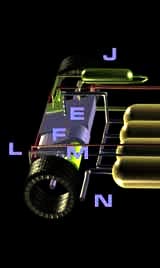
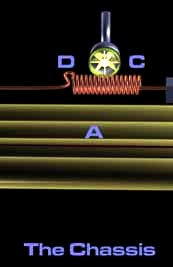
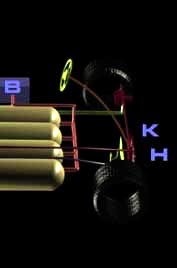
In practical terms compressed air at 300 bars is stored in the carbon fibre tanks A. The air is released through the main line firstly to an alternator B where the first stage of decompression takes place. The now cold air passes through a heat exchanger C which adds thermal energy to the air and provides a convenient opportunity for air conditioning D. The warmed compressed air now passes to the motor E. where a two more stages of decompression and re-heating take place. The motor drives the rear axle G through the transmission F. Control of engine speed is through a conventional accelerator pedal H controlling a valve within the motor.

An energy recycler J is under test which uses engine braking K to recompress air during braking into a secondary storage facility, providing additional energy for re-start and acceleration. Conventional hydraulic braking L is supplied.

The vehicle can be refilled by using the onboard compressor M or by refilling the tank at an air station at N. Ultimately the engine generates 37 Kilowatts, notwithstanding the small size of this unit. The "exhaust" leaves the engine at about zero degrees Celsius, a result of the expansion and cooling action. The exhaust is totally pure and fit to breathe.

A compressed air driven engine offers enormous benefits to the car designer. Because of its small size and weight, and the removal of a host of devices and parts not required, the designer has free reign to maximise his materials and space to provide a simple, economic platform for the vehicle.


Click here 2 fly back 2 CHaSKi`s ALTFUELS...

Click here 2 fly HOME!
HoMe


This page was created by CHaSKi on Monday, 19 February, 2001, 19:09 GMT+2=SAST.
Hosted by www.Geocities.ws

1