


Our Lady of Victories Church Weekly Bulletin

FIFTH SUNDAY AFTER PENTECOST
July 9, 2006
- C o n t e n t s
- Bulletin Articles
- 1. TODAY'S LITURGY: ON HYPOCRISY AND ANGER (from Rev. Fr. Leonard Goffine's The Church's Year)
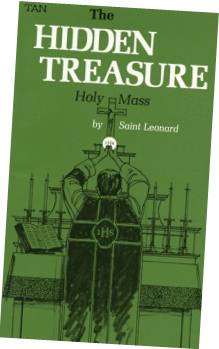
- 2. SPIRITUAL READING: THE HIDDEN TREASURE
- OLVC Section
- 1. WEEKLY ANNOUNCEMENTS
- Church Directory, Schedule of Activities and Map [new!]
- For the Missions of Asia and Vocations
- Prayer Pledges for this intentions
Bulletin Articles
TODAY'S LITURGY
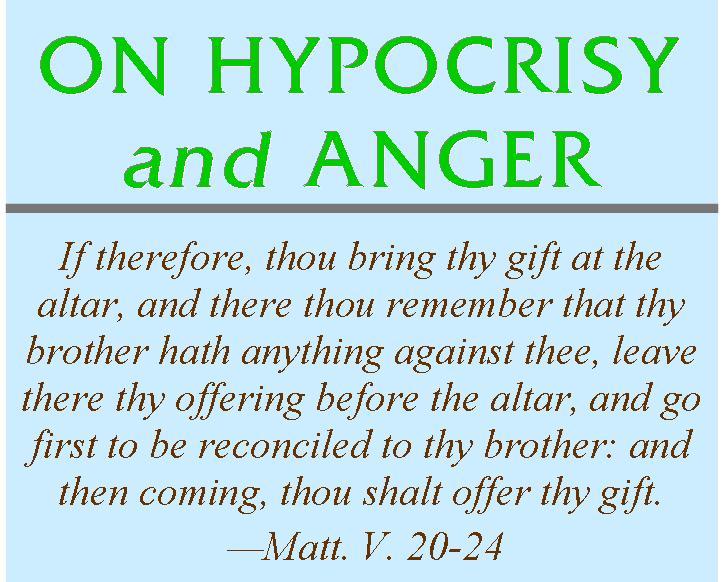
In what did the justice of the Pharisees consist?
In external works of piety, in the avoidance of such gross vices as could not be concealed, and would have brought them to shame and disgrace. But in their hearts these Pharisees cherished evil, corrupt inclinations and desires, pride, envy, avarice, and studied malice and vengeance. Jesus, therefore, called them hypocrites, whitened sepulchres, and St. John calls them a brood of vipers. True Justice consists not only in external works of piety, that is, devotional works, but especially in a pure, sincere, self?sacrificing feeling towards God and man; without this all works, however good, are only a shell without a kernel.
How are we to understand that which Christ here says of anger and abusive words?
The meaning of Christ's words are:. You have heard that murder was forbidden to your fathers in the desert, and that the murderer had to be given up to justice: but I say to you, whoever becomes angry with his neighbor, shall be in danger of divine judgment, and he who with abusive words, such as Raca, Villain, gives vent to his anger, using expressions of contempt and insult, as fool, scoundrel, profligate, wretch, is more liable to punishment. These degrees of anger are punished in different ways by God.

Is anger always sinful?
No, anger is sinful only when we wish or actually inflict some evil to the body, property, or honor of our neighbor; when we make use of such insulting and abusive words as injure his character, provoke and irritate him.
If we become angry at the vices and crimes of others, when our office or the duties of our station demand that we watch over the conduct of those under our care, to punish and correct them, (as in the case of parents, teachers, and superiors) then anger is no sin. When one through pure love of God, becomes irritated at the sins and vices of his fellowmen, like King David, or if one urged to wrong, repels the tempter with indignation, this is even a holy anger.
Thus St. Gregory Says; "It is to be understood that anger created by impatience is a very different thing from anger produced by a zeal for justice. The one is caused by vice, the other by virtue."
He, then, who becomes angry for justice' sake, commits no sin, but his conduct is holy and praiseworthy, for even our Lord was angry at those who bought and sold in the temple, (John II. 15.) Paul at the magician Elymas, (Acts XIII. 8.) and Peter at the deceit of Ananias and Saphira. (Acts V. 3.)
Anger, then, to be without sin, must proceed from true zeal for God's honor and the salvation of souls, by which we seek to prevent others from sin, and to make them better. Even in this respect, we must be careful to allow our anger no control over our reason, but to use it merely as a means of doing good, for we are often apt to take the sting of anger for holy zeal, when it is really nothing but egotism and ambition.
Why must we first be reconciled with our neighbor before bringing an offering to God, or undertaking any good work?
Because no offering or other good work can be pleasing to God, while we live in enmity, hatred, and strife with our neighbor; for by living thus we act altogether contrary to God's will. This should be remembered by all Christians, who go to confession and holy Communion, without forgiving those who have offended them, and asking pardon of those whom they have injured. These must know that instead of receiving absolution for their sins, they by an invalid confession are guilty of another sin, and eat their own judgment in holy Communion.
How should reconciliation be made with our neighbor?
With promptness, because the apostle says: Let not the sun go down upon your anger. (Eph. IV. 26.) But if the person you have offended is absent, says St. Augustine, and you cannot easily meet him, you are bound to be reconciled to him interiorly, that is, to humble yourself before God, and ask His forgiveness, making the firm resolution to be reconciled to your enemy as soon as possible. If he is accessible, go to him, and ask his forgiveness; if he has offended you, forgive him from your heart. The reconciliation should be sincere, for God sees into the heart; it should also be permanent, for if it is not lasting, it may be questioned if it was ever sincere. On account of this command of Christ to be reconciled to our enemies before bringing sacrifice, it was the custom in ancient times that the faithful gave. the kiss of peace to one another at the sacrifice of Mass, before Communion, as even to this day do the priests and deacons, by which those who are present, are admonished to love one another with holy love, and to be perfectly reconciled with their enemies, before Communion.+/p>
ASPIRATION
O GOD, strike me not with the blindness of the Pharisees that, like them, I may seek to please man by my works, and thus be deprived of eternal reward. Banish from my heart all sinful anger, and give me a holy zeal in charity that I may be anxious only for Thy honor and for the salvation of my neighbor. Grant me also that I may offend no one, and willingly forgive those who have offended me, thus practicing true Christian justice, and become agreeable to Thee.
|Back to the Table of Contents|SPIRITUAL READING: THE HIDDEN TREASURE—HOLY MASS
Chapter 1: Three Great Excellencies of the Holy Mass (cont’d)
ON THE day of the Ascension and on the day of Pentecost, there are shadowed forth the ascent of the Lord to heaven, and the coming of the Holy Spirit down to the earth; yet it is by no means true that, as each of these days comes round, the Lord again ascends to heaven, or the Holy Spirit visibly descends to earth. But the same cannot be said of the mystery of holy Mass, for in it there is made no simple representation of a bygone event, but the selfsame sacrifice is unbloodily made which, with the shedding of blood, was made upon the cross.
That same body, that same blood, that same Jesus Who then offered Himself upon Calvary, now offers Himself in the holy Mass. Opus, says the Church, opus nostrae redemptionis exercetur (second prayer for the 9th Sunday after Pentecost). Yes, exercetur; in Mass there is effected, there is continuously practised, that same sacrifice which was made upon the cross. Oh, awful, solemn, and stupendous work!
Now, tell me whether, when you enter church to hear Mass, you thoroughly well consider that you are going up as it were to Calvary, to be present at the death of the Redeemer.
If so, would you go with behavior so unsubdued, with dress so flaunting? If the Magdalene had gone to Calvary, to the foot of the cross, all dressed out, perfumed, and adorned, as when she associated with her lovers, what would have been said of her? What, then, shall be said of you who go to holy Mass as if you were going to a ball?
But what shall be said if you profane those functions of most dread sanctity with nods and becks, with tattle, with laughter, with the petty attentions of courtship, or with graver sacrileges of thought, word, or deed?
Wickedness is hideous at any time, and in any place; but sins committed during the time of Mass, and before the altar, draw down after them the curse of God. Maledictus homo qui facit opus Domini fraudulenter “Cursed is he that does the work of the Lord deceitfully” (Jer. 48:10). Think seriously upon this, while I proceed to disclose to you yet other marvels and glories of this all-precious treasure.
4. It seems to me impossible for a religious function to possess a prerogative more excellent than this of the holy sacrifice of Mass, that it is no mere copy, but one original with the sacrifice of the cross.
Still further is its eminence enhanced by having for its priest none else than God made man. In so great a sacrifice three things attract consideration: the priest who offers, the victim offered, and the majesty of him to whom the offering is made. Now observe the marvellous grandeur of holy Mass, in virtue of each of these three considerations.
The Priest Who offers is the Man-God Christ Jesus; the Victim is the Life of God; nor is it offered to any other than unto God. Re-kindle, then, your faith, and recognize the true celebrant to be not so much the human priest as the adorable person of Our Lord Jesus Christ.
(TO BE CONTINUED)
|Back to the Table of Contents|
OLVC SECTION
WEEKLY ANNOUNCEMENTS
- JULY 11 (TUES): REQUIEM MASS FOR FRIENDS AND BENEFACTORS
- —Sung Mass at 6:30 pm. Please submit names of your deceased friends and relatives whom you wish to be included in this Mass
- JULY 15 (SAT):
- N.B. No evening Mass
- —SANTO NIÑO CATECHISM—
REGISTRATION FOR CATECHISM CLASSES—Now on-going! - We encourage the parents to register their children, ages 6-18, to any of the Catechism classes which will be posted next week.
Please approach the catechists at the registration table in the veranda. For more information, speak with the catechists or Fr. Dolotina.
- CATECHISTS’ MEETING: July 15 at 4:30 pm
Note: Those who would like to help as Catechist/Assistant Catechist for this year should come to this meeting.
- CATECHISTS’ MEETING: July 15 at 4:30 pm
- —CONFIRMATIONS 2006—
- The instructions will begin today after the 9am Sung Mass—the candidates are invited to proceed to Our Lady of Victories Catholic School
- WEDDING BANNS
- Please be informed that Mr. Thomas Nathan G. Viray of Jaro, Iloilo wishes to be united in the Holy Sacrament of Matrimony with Ms. Arleen B. de Guzman of Cainta Rizal on August 11, 2006 here at Our Lady of Victories Church.
If anyone knows of any impediment that may render this matrimonial union invalid, please make it known to Fr. Joven Soliman as soon as possible.
|Back to the Table of Contents|
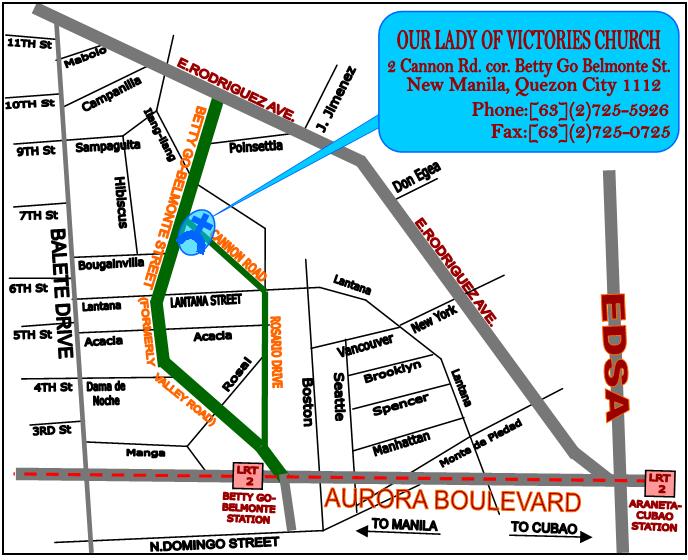
CHURCH DIRECTORY
- OUR LADY OF VICTORIES CHURCH
(UNDER THE PRIESTLY SOCIETY OF SAINT PIUS X) - Phone: 725-5926 Fax: 725-0725
E-mail: [email protected]
Resident Priests: Fr. J. Soliman (Prior), Fr. T. Onoda, Fr. Cacho, Fr. Dolotina
- WEEKLY SCHEDULE
- Sundays:
- 8:30 am-Rosary/Confessions
- 9:00 am-Sung Mass
- 10:30 am-Catechism for Adults/Confessions
- 11:00 am-Sto.Niño Catechism (children)
- 5:30 pm-Sunday Vespers
- 6:00 pm-Low Mass
- Mondays to Saturdays:
- 7:15 am-Low Mass
- 6:00 pm-Rosary
- 6:30 pm-Low Mass
- On Wednesdays
- after 6:30 pm Mass: Novena to Our Lady of Perpetual Help
- Masses are Sung on:
- 1st & 2nd Class Feasts
- Monthly Requiem-6:30 pm
- First Friday at 6:30 pm
- First Saturday at 7:15 am
- Confessions:
- Sundays: 30 minutes before the Masses
- Wed: before the evening Mass only
- Fri/Sat: before the morning and evening Masses
- Holy Hour/Benediction:
- First Friday at 5:30 pm
- All-Day Exposition and Priests' Recollection:
- every First Thursday of the month
- OTHER NOTICES
- * Except Emergencies, PHONE CALLS cannot be received from:
- 8:30 pm-8:30 am;
- 12:10-1:15 pm;
- and 5:30-8:00 pm
- *Lepanto Library Hours: (Sundays)
- 11:00-12:30 pm
- 4:30-7:30 pm
- MASS CENTERS SERVED BY OLVC
- Baguio: (new address!)
- Benguet Farmers's Cooperative,
C22 Camp Dangwa (Lower Tomay)
La Trinidad, Benguet - Freq: 1st Sunday of the month/9:00 am Mass
- Tanay, Rizal:
contact church office - Hongkong:
- freq: 2nd Sunday of the month
- Japan & Korea: contact Fr. Onoda
More info on Asian Mass Centers may be obtained from
District of Asia
 |Back to the Table of Contents|
For the Missions of Asia and Vocations