lanina.html


La Nina


Impacts of La Nina on Global Climate
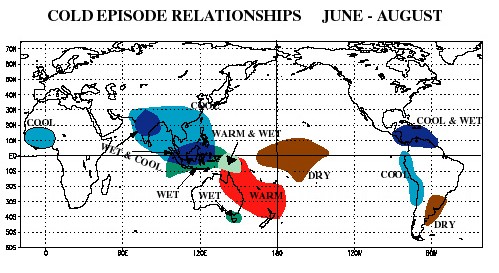
       La Nina is connected to abnormal patterns of temperature, rainfall and storms around the world. The Pacific Ocean is an important body of water. Abnormal temperatures in the Pacific Ocean can affect the whole world. La Nina causes cooling in the central and eastern part of the Pacific Ocean. Because of the uneven cooling La Nina affects global climate a lot. La Nina particularly affects rainfall. La Nina creates greater chances of severe storms. La Nina increases ocean temperature In the South eastern part of Asia (specifically Papua New Guinea and Indonesia) there is more chance of a lot of rainfall and storms. The latest La Nina was in 1998. Meteorologists believe that La Nina might have influenced the string of powerful hurricanes that hit the Atlantic coast in 1998. Meteorologists also believe that this influenced the major temperature swings in central and eastern United States. Whenever there is a La Nina the likelihood of a drought in Southeast and Southwest of the United States rises greatly. The temperatures in the Southeast of the United States get warmer than usual and in the Northeast they get colder than usual.


How Do Scientists Detect La  Nina
It is hard to detect a La Nina. Scientist use a variety of tools and methods to detect  a La Nina. They use satellites, moored buoys, drifting buoys, sea level analysis, and expandable buoys. Another tool that they use are research ships. Now with technology they can use computer models of the all the oceans in the world and computer models of the atmosphere.

What is La Nina?

    La Nina is a weather pattern that is created by unusually cold ocean temperatures.  A La Nina can happen off the coast of South America or in the eastern equilateral Pacific Ocean around Christmas time. It affects South America and Australia. During the La Nina there is lots of rain and wind. The name La Nina is Spanish for the little girl and often is referred to as a Christ Child. It can also be called El Viejo (old man), Anti Nino, anti El Nino, a cold event, or a cold episode. At least 15 La Ninas have been documented since 1904and happen in irregular intervals of about two to seven years. Sir Gilbert Thomas Walker first described the characteristics of a La Nina in1923 increasing knowledge about the phenomenon. In a La Nina the wind and air temperatures drop because cold ocean and water temperatures power a La Nina. A lot of recent La Ninas have followed an El Nino, which is the opposite of a La Nina, powered by warm ocean and water temperatures.

La Nina
By: Cristina Cornejo and Mary Hamilton

La Nina La Nina,
A name so sweet
As she cools the ocean
right below our feet.

She changes the weather,
our climate she affects,
she is so powerful
she deserves out respect.

La Nina La Nina,
You scare us so,
La Nina La Nina,
Please just go.
This is the part about La Nina enjoy!!!!!
Hosted by www.Geocities.ws

1