 Global
Consciousness Change: Indicators of an Emerging Paradigm
Global
Consciousness Change: Indicators of an Emerging Paradigm
by
Duane Elgin and Coleen LeDrew
May 1997, 40 pages
Buy
a copy.
PART
I
INDICATORS OF GLOBAL CONSCIOUSNESS CHANGE
SUMMARY
Numerous
trends indicate that the industrial era is on a collision course with
nature--from ozone depletion to climate change, rainforest
destruction, and environmental pollution. The global ecological crisis
is compounded by social, economic, and spiritual challenges that are
equally daunting. Is there a countervailing set of indicators that shows
that we humans may be waking up to our predicament? Is there a set of
trends that shows that we are beginning to consciously organize
ourselves to respond to the ecological, social, and spiritual challenges
we face?
The
objective of this inquiry was to discover whether global culture and
consciousness are significantly changing in such a way that new patterns
of values and approaches to living are emerging. To discover whether
this is so, we examined a number of the most comprehensive global and
U.S. surveys of the past decade. We organized this inquiry into five
thematic question areas:
-
Is the
global communications revolution fostering a new global
consciousness?
-
What is
the extent of humanity's global ecological awareness and concern?
-
Is there
a shift underway toward "postmodern" social values?
-
Is a new
kind of experiential or first-hand spirituality emerging?
-
Is there
a shift underway toward more sustainable ways of living?
From this
inquiry, we have concluded that a new global culture and consciousness
have taken root and are beginning to grow in the world. This represents
a shift in consciousness as distinct and momentous as that which
occurred in the transition from the agricultural era to the industrial
era roughly three hundred years ago. Because communications technologies
are a powerful force driving the emergence of this new epoch, it would
be convenient to call it the "communications era." But that
name would be ill-suited since the most distinctive feature of this
emerging era is not technological change, but a change in human
consciousness.
This change
in consciousness has two primary features. First, there is a further
awakening of our unique capacity to be self-reflective--to stand back
from the rush of life and, with greater detachment, observe the world
and its workings non-judgmentally. Second, from this more spacious
perspective, the Earth (and even the cosmos) are seen as interconnected,
living systems. Because of these two features, we are calling this
emerging change in culture and consciousness the
"reflective/living-systems" paradigm or perspective.
Because of
survey limitations, it is impossible to estimate with any accuracy the
percentage of the world's population moving toward a
reflective/living-systems way of life. In the U.S., a conservative
estimate is that 20 million people--10 percent of adults--are
consciously exploring new ways of living that seem consistent with this
paradigm. While this group is a relatively small percentage of the U.S.
population, we believe they represent an important harbinger of changes
in global culture and consciousness.
THE
EMERGING PARADIGM
In 1992,
over 1600 senior scientists, including a majority of the living Nobel
laureates in the sciences, signed and released a documented entitled Warning
to Humanity. In it, they stated powerfully the need for fresh
approaches to thinking and living. They declared that "human beings
and the natural world are on a collision course . . . that may so alter
the living world that it will be unable to sustain life in the manner
that we know." They concluded by giving the following, simple
warning to the human family:
We, the
undersigned senior members of the world's scientific community, hereby
warn all humanity of what lies ahead. A great change in our
stewardship of the earth and the life on it is required, if vast human
misery is to be avoided and our global home on this planet is not to
be irretrievably mutilated.1
Although
human societies have confronted major problems throughout history, the
challenges of our era are unique in one crucial respect--they now
embrace the entire Earth as a whole system. Never before has humanity
been on the verge of devastating the Earth's biosphere and crippling its
ecological foundations for countless generations to come. Never before
has the entire human family been required to work together to build a
sustainable and meaningful future. Never before have so many people been
called to make such sweeping changes in so little time.
Albert
Einstein observed that problems cannot be solved at the same level at
which they are created. This insight seems profoundly relevant today as
we humans need to step back and gain a whole-systems perspective if we
are to respond effectively to massive ecological problems. The
"ecological" challenges we face are not even purely physical.
Many are social and spiritual as well. It is difficult to imagine a
positive future that does not value, integrate, and balance three major
ecologies:
-
A
physical ecology that is sustainable--where we live in such a
way that present generations can meet their needs without
compromising the Earth's ability to support future generations.2
-
A
social ecology that is satisfying--where we value rich and
meaningful relationships of all kinds--in families, neighborhoods,
and communities (including the Earth-community, with all its
lifeforms).
-
A
spiritual ecology that is soulful--where we consciously
appreciate and celebrate the deep mystery and miracle of everyday
life.
To create a
future that harmoniously integrates these three ecologies, the human
family will need a new way of looking at the world--in short, a new
paradigm.
What is a
paradigm? Willis Harman gives a definition that we find very useful: A
paradigm is "the basic way of perceiving, thinking, valuing, and
doing associated with a particular vision of reality."3
A civilization's paradigm shapes how we see and understand the nature of
reality, our sense of self, and our feelings of social connection and
purpose. Paradigms shape not only our thoughts, but our very perceptions
and experience of life. When a civilization shifts from one paradigm to
another that shift goes to the very core of our lives, and represents
much more than a change of ideas.
Retired
Canadian Ambassador James George writes about the deep nature of
paradigm shifts in his book Asking for the Earth:
I have
been struggling to convey the idea of a paradigm shift intellectually.
But . . . it is not just an idea, it is an experience; and experiences
take place in the moment, in bodies with feelings. So do paradigm
shifts. They first infiltrate your mind, then they grab you in the
gut; only then do you "get it" and act.4
Civilizational
paradigms have persisted for at least centuries and usually millennia.
At the level of human civilizations, a paradigm shift is a very rare
occurrence. It has happened only a few times in human
history--specifically, during the transitions from the hunter-gatherer
era to the agricultural era, from the agricultural era to the industrial
era, and from the industrial era to the fast-emerging communications
era. Paradigms are stable and enduring ways of perceiving and relating
to the world. They persist until they generate problems that cannot be
solved; these problems then become the catalyst for triggering the shift
to the next paradigm.5 When we first enter a new
civilizational paradigm (such as moving from the agricultural era to the
industrial), we experience new freedom and creative opportunity. As we
fulfill the potential of a given paradigm, however, that paradigm
eventually becomes a constricting framework. Its partial or incomplete
nature leads to a crisis, which in turn leads to a breakthrough into the
next, more spacious paradigm. A new level of learning and creative
expression ensues.
As the
world's senior scientists have warned, the industrial era paradigm is
now generating far more problems than it is solving. The only way the
human family can understand and solve these problems is by shifting to a
larger paradigm that includes the entire Earth as a living system. Such
a transformation seems to be underway. Peter Drucker, the well-known
management expert, is just one observer who believes that the Western
world is undergoing a paradigm change:
Every few
hundred years in Western history there occurs a sharp transformation.
Within a few short decades, society--its world view, its basic values,
its social and political structures, its arts, its key
institutions--rearranges itself. And the people born then cannot even
imagine a world in which their grandparents lived and into which their
own parents were born. We are currently living through such a
transformation.6
With the
explosive growth of mass communications, a new global consciousness and
culture are emerging. Already a majority of the world's people have
access to television and are being profoundly influenced by the
communications era. The rapidly emerging "global brain" is
weaving the human family together into a new level and intensity of
relationship. The communications revolution is pervasive. The combined
power of the computer Internet, television networks, global satellite
systems, cellular telephones, fiber optics, and many more devices has
created a perceptual framework within which even those who are agrarians
or industrialists in their daily work will increasingly orient
themselves.
As pervasive
as the communications revolution is, it seems to be taking place within
a larger and deeper revolution in consciousness and culture. We are
living in a time of paradigm shift. What should we call the emerging
paradigm? In this report, we are calling it the
"reflective/living-systems" paradigm or perspective. This name
incorporates the two primary features of this perspective.
The first is
our growing capacity for self-reflection. Many times it has been
observed that where animals "know," only humans have the
capacity to "know that we know." We have the ability to
observe ourselves and our world as if from a distance. Humans can stand
back and see ourselves in the past as well as project ourselves into the
future. We are not locked in, but can reflect on our situation and make
fresh choices. When we can see our actions in the mirror of
self-reflective knowing, we become self-directing agents of our own
evolution. It is this capacity for conscious, free choice that will be
essential if humanity is to choose a path of communication and
reconciliation to create a sustainable future.
A second
hallmark of the new consciousness is its "whole-systems" or
"living-systems" view. For the last several hundred years in
Western industrial societies, a materialistic-scientific mindset has
dominated. In this view, what is "real" is the material world
as perceived by our senses and organized by our intellect. The universe
is seen as filled with lifeless matter and empty space. It is only
natural that what is important is social status and material success. By
contrast, in the emerging perspective, seemingly empty space is not
empty, but filled with immense amounts of energy. Our cosmos is seen as
a living, unified system. This new paradigm moves from a view of
separation and isolation to one of profound wholeness and
interconnection. At a fundamental level, people are viewed not as
separate beings, but as intimately involved with one another in the deep
web of life.
If
everything is intimately interconnected, then the quality and integrity
of all kinds of relationships are of paramount concern. A natural
expression of this paradigm is to bring into balance all the key
relationships in our lives--inner and outer, masculine and feminine,
personal and global, intuitive and rational, and more. This perspective
tends to bridge differences, connect people, celebrate diversity,
harmonize efforts, and look for higher common ground. A
reflective/living-systems orientation brings a unifying approach and
offers hope in a world facing deep material, social, and spiritual
fragmentation.
Table 1
presents a preliminary view of the contrasts that seem to be emerging
between the industrial/materialistic paradigm and what we are calling
the reflective/living-systems paradigm.
Books and
articles describing the possibility of a new paradigm coming into
existence have been proliferating for the past 20 years. World leaders
have spoken about the emergence of a new global perspective. Is a
reflective/living-systems paradigm developing in the world? That
question is the focus of this study.
Table
1
Contrasting Paradigms
INDUSTRIAL/
MATERIALISTIC PARADIGM |
REFLECTIVE/
LIVING-SYSTEMS PARADIGM |
| The
cosmos is made up of mostly dead matter and empty space and is not
"alive." |
Our
cosmos is a unique kind of "living organism" and, as a
whole system, is fundamentally alive. |
| We
are floating through vast reaches of empty space, and most of life
seems to lack any larger sense of meaning and purpose. |
The
entire cosmos is a unified system. Each action is woven into the
deeper ecology of the universe. Everything we do matters. |
| Consciousness--when
viewed from a reductionistic, mechanistic perspective--is a
by-product of biochemistry and is located in the brain. |
Consciousness--when
viewed from an integrative, living-systems perspective--is an
ordinary capacity that permeates the universe and provides a
reflective capability appropriate to each entity within the
universe. |
| The
goal in life is material success and social achievement. |
The
goal in life is to develop a balanced relationship between our
inner and outer lives--to live in a way that is sustainable and
compassionate. |
| The
emphasis is on conspicuous consumption. The "good life"
depends on having enough money to buy access to pleasure and avoid
discomforts. |
The
emphasis is on conscious consumption. The "good life" is
an ever-changing balance of inner and outer, material and
spiritual, personal and social, etc. |
| Identity
is largely defined by material possessions and social position. |
Our
sense of self grows through our conscious, loving, and creative
participation in life. |
| Emphasis
is on personal autonomy and mobility. |
Emphasis
is on personal growth and community. |
| The
individual is defined by his or her body and is ultimately
separate and alone. |
The
individual is both unique and an inseparable part of the larger
universe. Our being is not limited to our physical existence. |
| It
is natural that we who are living use lifeless material resources
for our own progress. |
It
is natural to respect all that exists as integral to the larger
body of life. |
| Cutthroat
competition is the norm. You compete against others to make a
killing. |
Fair
competition is the norm. You cooperate with others to earn a
living. |
| The
mass media are dominated by commercial interests and are used to
promote a high-consumption culture. |
The
mass media awaken to the challenge of sustainability and begin to
explore more workable and meaningful approaches to living. |
| Nations
adopt a "lifeboat ethic" in global relations. |
Nations
adopt a "spaceship Earth ethic" in global relations. |
| The
welfare of the whole is left to the workings of the free market or
government bureaucracies. |
Each
person takes responsibility for the well-being of the world,
enabling high levels of decentralization and freedom at the local
level, and a sustainable harmony at the global level. |
THE
INDICATORS OF CHANGE
We began by
reviewing the extensive "new-paradigm" literature (a selected
list is included as Appendix A). Next, we developed a list of the major
recurring themes that we believe indicate the emerging worldview. From
this list, we selected several dozen practical indicators that, taken
together, could potentially reveal whether a larger pattern-shift in
perceptions and values is actually occurring (these indicators are
listed in Appendix B). Using these indicators as a guide, we searched a
wide range of sources--such as Internet sites, data bases, libraries,
surveys, reports, and indexes.
It was very
difficult to find relevant information on a global scale. Few global
surveys have been done, and none have looked specifically for the
emergence of a new global consciousness. Consequently, we supplemented
limited global information with more extensive information regarding the
U.S. population. This overview report, then, is a work in progress drawn
from many different sources.
We have
grouped the findings from this inquiry into five major thematic areas.
Here, briefly, are the primary questions we asked to determine whether a
reflective/living-systems perspective is emerging in the world:
1) Global
consciousness and the communications revolution. Is a new level of
communication emerging in the world? Is the global communications
system--with its network of computers, televisions, telephones, and
satellites--becoming the social equivalent of a central nervous system?
Are we creating a paradigm-changing "global brain" for the
planet?
2) Global
ecological awareness and concern. To what extent is the population
of the Earth aware of and concerned about the health of the planet? Are
people aware that life as we know it may not be able to be sustained?
Are people willing to sacrifice economic growth for the ecological
health of the planet?
3)
Postmodern social values. Is there a shift from material values to a
concern for environmental sustainability? Is there greater tolerance for
ethnic, racial, and sexual differences? Is there a shift from
institutional authority to personal authority? Is there a conscious
shift from power to partnership in gender relations?
4)
Experiential spirituality and a new consciousness. To what extent
are people practicing some form of personal or "lay
spirituality"--for example, taking time to meditate, do yoga,
practice the "inner-game" of sports, or in other ways
exploring their personal, subjective experience? To what extent do
people view nature as a sacred and spiritual presence?
5)
Sustainable ways of living. Is there a shift toward ecological
lifestyles that integrate inner and outer aspects of living into a
balanced whole? Are there shifts in work, diet, consumption patterns,
transportation, relationships, or other areas that express a desire to
live more sustainably?
These five
themes do not cover all of the major areas of change in consciousness
and culture. For example, seismic shifts seem to be occurring in
business, medicine, the arts, science, education, and voluntary
associations--and these are not addressed adequately by this brief
overview. Although an even broader scope of inquiry is needed, the five
thematic areas selected for this initial inquiry seem to cover a
sufficiently wide scope of life to indicate whether a new pattern of
perceptions and values may be emerging in the world.
Global
Consciousness and the Communications Revolution
A foundation
of global communication and understanding already exists for the human
family. It is evident in many examples of successful, planetary-wide
cooperation:7
The world
weather system merges information from more than 100 countries every day
to provide weather information globally.
Nations
around the globe have cooperated to eradicate diseases such as smallpox,
polio, and diphtheria.
- International
civil aviation agreements assure the smooth functioning of global
air transport.
- The
international telecommunications union (ITU) allocates the
electromagnetic spectrum so that television signals, cellular
phones, and radio signals are not overwhelmed with noise.
Beyond the
basics of weather, health, aviation, and telecommunications, the human
family is being exposed to music, art, food, and ideas from different
cultures. We are beginning to develop an appreciation for the unique
tastes and qualities of different parts of the world. Globalization of
consciousness is also fostered by televised events that reach billions
of persons--for example, the Olympic games or the LiveAid rock concert
(which produced an outpouring of aid for famine victims in Africa).
Pictures of Earth from space are now common and give humanity a look at
its home from afar. Turning our gaze to the heavens with the Hubble
telescope, we can peer to the very edges of the universe. Humanity is
acquiring a realistic sense of its identity as a single species that
inhabits a small and precious planet within an immense cosmos.
The question
of questions is whether the human family will build upon a global
perspective and a history of successful communication and cooperation to
come together to create a positive future. It was our ability to
communicate that enabled humans to evolve from hunter-gatherers to the
verge of a planetary civilization. New levels and types of communication
will enable us to build a workable and meaningful future. Because many
of the world's problems are human-caused, they are fundamentally
communication problems. Because many of the world's potentials depend on
human cooperation, they are fundamentally communication challenges.
Fortunately, at the very time that we need an unprecedented capacity for
local-to-global communication, we are in the midst of a communications
revolution and have the necessary tools in abundance.
Growth in
Telecommunications
The rapid
growth of telecommunications has been a powerful engine in the
globalization of human awareness. For example:
A century
ago, it could easily take months to communicate with someone elsewhere
in the world. Today, with the international telephone system, it is
possible to connect with any one of nearly two billion persons around
the world in a matter of moments.8
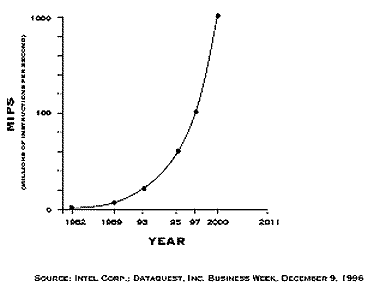
Figure 1
Growth in Computing Speeds
Source: Intel
Corp.; Dataquest, Inc. Business Week, December 9, 1996
-
Currently,
a single advanced satellite or an advanced fiber optic cable has the
capability to send the entire Encyclopedia Britannica with
all of its illustrations every three seconds.9 Future
prospects are even more breathtaking. Joseph Pelton analyzed the
emerging capabilities and concluded that, "In another quarter
of a century these are likely to be . . . systems that could send
the equivalent of the entire U.S. Library of Congress in less than
10 seconds."10
-
The
computing and communications industry "shows every sign of
continuing its breathtaking pace for at least one or two decades
more (e.g., doubling performance every one or two years), implying a
revolution in capability every five to ten years."11
This is illustrated by Figure 1, which shows the increase in the
speed of computers.
-
Worldwide,
an estimated 40 million persons were Internet users in 1996. This
number is expected to double to nearly 80 million in 1997,12
and to jump to nearly 200 million by 1999.13
-
In the
U.S., in particular, growth of the Internet has been extremely
rapid. During 1995, activity more than doubled to approximately 10
million users.14 This means that more than half of the
people using the Internet at the end of 1995 were not using it 12
months before. Personal use has been growing rapidly as two-thirds
of all users in the U.S. now tap into the Internet from home,
primarily for e-mail. A striking 41 percent of all Internet users in
the U.S. reported using e-mail on a daily basis.
The
think-tank SRI International has done research on the psychological
character of Internet users. Their results are striking. One
group--called "actualizers," who are well-educated and intent
on self-actualization--constitutes 10 percent of the U.S. adult
population but 50 percent of Internet users.15 The SRI
International research indicates that a sub-culture sympathetic to new
paradigm perspectives is having a disproportionate role in shaping the
emerging culture of the Internet. In turn, the Internet culture and
consciousness will provide an increasingly important frame of human
reference for activities around the world.
The research
firms CommerceNet and Nielsen Media Research recently described the
impact of the Internet, based on their study of users:
Our
sociological and economic structure is being rewritten, the corporate
world is dramatically realigning its strategies, and individuals are
showing a long-inhibited eagerness to explore. Nothing less. The
Internet and the countless possibilities associated with the Internet
are quickly reshaping the way we conduct business, and redefining the
way we relate to one another.16
Mark Pesce,
who has written extensively about the Internet, describes the World Wide
Web as "an innovation as important as the printing press--it may be
as important as the birth of language itself . . . in its ability to
completely refigure the structure of civilization."17
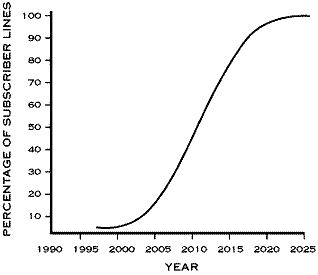
Figure 2
Fiber-Optic Lines to Subscribers in Developed Nations
Source: Bell
Northern Research
A Global
Brain for the Species
When a
planetary scope of human connection is combined with the functional
intelligence of computers, a new level of human awareness and
communication--a "global brain" or "species mind,"
so to speak--could potentially emerge. Robert Entman alludes to this
when he writes, in his introduction to a report on the future of
universal telecommunications service, that "a substantial increase
in the functional intelligence of the species seems imminent."18
Peter Russell describes the emergence of the global brain as follows:
"Billions of messages continually shuttle back and forth, in an
ever-growing web of communication, linking the billions of minds of
humanity together into a single system."19
How soon
might the global brain achieve some sort of critical mass and turn on?
An important indicator comes from a report by the Institute for
Information Studies:
The universal
global telecommunications network will serve as the main...
telecommunications conduit for economic, social, cultural, and
political exchange among the peoples of the planet Earth in the 21st
century. This network may start to come into place around the
second decade of the 21st century.20 [emphasis added]
Because
fiber-optic cable will likely be the medium of choice for high-density
routes among developed countries, the rate of its use is a meaningful
indicator of the rate at which the global brain is being wired. Figure 2
shows an estimate by Bell Northern Research for the growth of optic
fiber.21
Because a
fiber-optic infrastructure is just being established around the world,
and because computing and communications speeds are still making quantum
jumps every few years, we are probably still a decade or two from the
awakening of some form of rudimentary, but powerful, species-mind. What
might be the impact of this emergent species-mind? Pelton gives us a
glimpse of what this may mean when he describes the social impact of
global television:
Today CNN
has a global data base of information and contacts which allows it to
uplink news information from almost anywhere to anywhere in a matter of
minutes or at the least hours. In such an environment, political
repression, human rights violations, and even war are increasingly
difficult to get away with without having world opinion weighing heavily
in against the "bad guys." The thawing of the Cold War and the
destruction of the Berlin Wall are in some ways the result of
instantaneous electronic news.22
If this is a
taste of our communications future, then the emerging global brain may
be a powerful force for encouraging humanity to live more
compassionately and harmoniously. Of course, there is the danger that it
will be used not to awaken humanity to larger evolutionary
possibilities, but to focus on consumerism and escapism instead. There
is also the possibility that people will become divided into the
"communication rich" and "communication poor,"
depending on their level of access to the Internet and its growing array
of networking tools and services. That may already be happening. For
example, developed countries have 15 percent of the world's population,
but 71 percent of all telephone lines.23 Although the
telecommunications revolution is transforming life rapidly in more
developed nations, it is leaving behind a huge population in countries
whose economies are still in transition from agriculture to a more
diversified base.
Global
Ecological Awareness and Concern
A potent
indicator of a reflective/living-systems perspective is whether ordinary
people around the world are conscious of the declining environmental
health of the planet. And if they are aware, do they express a
willingness to act on their awareness?
Health of
the Planet Survey
There are
few international surveys of attitudes toward the global environment.
Perhaps the most important inquiry has been the Health of the Planet survey,
conducted in 1993 by Gallup International.24 Involving 24
nations, Gallup's survey was the largest environmental opinion poll ever
undertaken. The objective was to survey citizens in a wide range of
nations, which varied in both geographic location and levels of economic
development. The results provide an in-depth look in both rich and poor
nations at citizens' views regarding environmental issues. In writing
about the survey, its director Dr. Riley E. Dunlap concluded: "The Health
of the Planet survey demonstrates virtually world-wide citizen
awareness that our planet is indeed in poor health, and great concern
for its future well-being."25
It is often
assumed that persons living in poorer nations are so busy meeting the
challenges of everyday living that they are less concerned about
environmental problems. Dunlap found, however, that "environmental
problems are salient and important issues in both wealthy and poor
nations, and residents of poor nations express as much concern about
environmental quality as do those living in wealthy nations."26
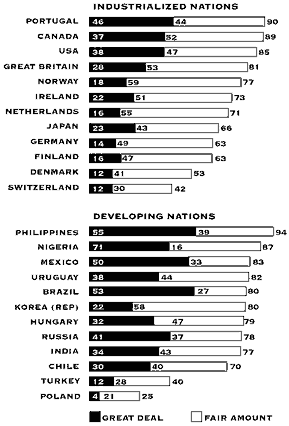
The strong concern by people in developing nations for environmental
quality may often be due to their closer contact with unhealthy water,
air, and food. Whatever the reason, people living in both industrialized
and developing nations see the health of the planet as a serious
problem. Figure 3, drawn from the Health of the Planet survey,
shows that people in both poor and wealthy nations have similar levels
of concern about the environment.27
Figure 3
Personal Concern about the Environment--
Percentage Who Say "A Great Deal" or "A Fair Amount"
Source: Gallup
International
Gallup
explored global concern about the environment by asking people how
serious they believed different problems to be--including loss of animal
and plant species, loss of rainforests, global warming, ozone depletion,
and air pollution. Concern was high across the entire range of
indicators. Figure 4 shows responses to a question about the seriousness
of the loss of species in the world.
Despite the
economic problems in many areas of the world, majorities in most of the
24 nations surveyed gave environmental protection a higher priority than
economic growth, as Figure 5 indicates. Figure 6 shows that majorities
in 11 of 12 industrialized nations and half of the developing nations
surveyed indicated a willingness to pay higher prices for such
protection.28
Figure 4
Loss of Animal and Plant Species--
How Serious Do You Personally Believe This to Be in the World? Percentage
Who Say "Very Serious" or "Somewhat Serious"
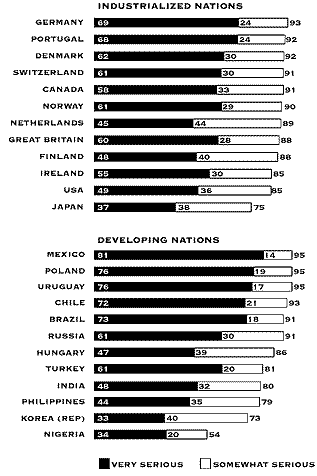
Source: Gallup
International
One finding
from the survey seems particularly promising with regard to the eventual
possibility of global reconciliation around a shared vision of a
sustainable future. When asked who is "more responsible for today's
environmental problems in the world," people from rich and poor
nations were not as polarized as they are widely assumed to be. The most
frequent response was that industrialized and developing countries are
"both equally responsible."29 There is little
evidence of the poor blaming the rich for environmental problems, or
vice versa. Instead, there tends to be widespread acceptance of mutual
responsibility.30
Figure
5
The Environment
vs. Economic Growth--
Percentage Who Choose Protecting the Environment over Economic Growth
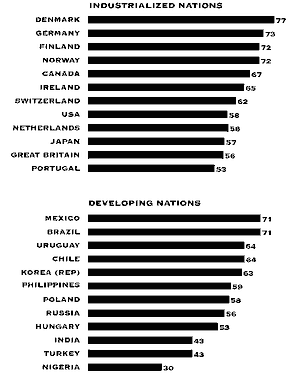
Source: Gallup
International
Figure 6
Percentage Who Say They Are Willing to Pay Higher Prices to Protect
the Environment
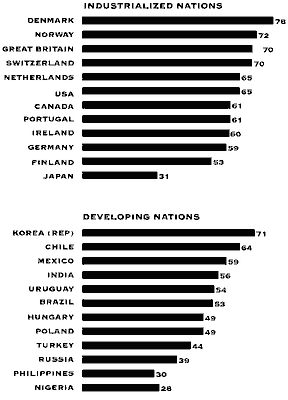
Source: Gallup
International
While the Health
of the Planet survey shows that a majority of people express strong
support for environmental protection, several indicators (such as the
annual State of the World Report from the Worldwatch Institute)
show that expressed concern is not being translated into decisive
action. There is also a question whether the Health of the Planet survey
reflects the attitudes of people in the rapidly developing economies of
Asia. In a survey in China in October 1994, for example, the Gallup
organization asked people which attitudes towards life came closest to
describing their own. Sixty-eight percent said that to "work hard
and get rich" came closest to describing their approach to life,
while only 10 percent selected "don't think about money or fame,
just live a life that suits your own taste."31 Clearly,
consumerist attitudes are flourishing in China (and elsewhere in Asia).
As has been the case in the U.S., these attitudes are likely to come
into conflict with demands for improving the environment. Although a
global consciousness seems to be awakening, it is still losing the race
with ecological decline.
Postmodern Social
Values
Another important
expression of a reflective/living-systems perspective is an interrelated set
of "postmodern" social values, such as belief in gender equality,
tolerance for others, engagement with family and community, a need for
meaningful work, concern for environmental sustainability, and the placing of
subjective well-being over material success. To see whether these social
values are becoming more prevalent, we turned to one of the most valuable
resources available for understanding world values.
The massive World
Values Survey, 1990-1991, was drawn from 43 nations, representing almost
70 percent of the world's population and covering the full range of economic
and political variation.32 Figure 7 shows the percentage of the
world's population covered by this survey.
Ronald Inglehart,
global coordinator for the World Values Survey, used a computer to
analyze mountains of data and to cluster nations according to similar value
patterns. He analyzed this unprecedented body of data on values and beliefs in
an article in the International Social Science Journal entitled
"Changing Values, Economic Development, and Political Change."
Inglehart concluded that, over the last 25 years, a major shift in values has
been occurring in a cluster of a dozen or so nations, a change that he calls
the "postmodern shift."33 This shift in values has been
growing in societies such as Sweden, the Netherlands, Denmark, Finland,
Norway, Iceland, Switzerland, Britain, Canada, and the United States. Here are
some major attributes of the postmodern shift:
Figure 7
Percentage of World's Population Covered by World Values Survey,
1990-1991
(Map of
the world not pictured)
Covered
by survey----70%
Not Covered by survey----30%
Source: Ronald
Inglehart, Modernization And Postmodernization (Forthcoming, 1997)
-
People in the
postmodern cluster of nations are losing confidence in all kinds of
hierarchical institutions, including government, business, and religion.
There is also declining trust in science and technology to solve problems,
and a general questioning of authority.
-
At the same
time that people in these nations are losing trust in traditional
institutions, they are placing more emphasis on personal authority or the
authority that comes from an inner sense of what is appropriate.
-
People feel
relatively secure materially, and tend to be more concerned with their
subjective well-being than with maximizing their material well-being. As
economic gain fades from top priority, people give much greater importance
to their desire for meaningful work and the quality of the work
experience.
-
There is a
tendency for economic growth to be subordinate to concerns for
environmental sustainability,
-
Although
postmodernism is associated with a decline in traditional religious
involvement, it is linked with a growing interest in discovering personal
meaning and purpose in life.
-
People from
these nations show a greater tolerance for ethnic, sexual, and political
differences.
-
There are new
roles for women that allow for greater self-realization.
-
This cluster
of closely correlated, postmodern values seems to characterize perhaps a
dozen nations out of the 43 analyzed. Inglehart concludes that "a
generalized shift toward postmodern values does seem to be taking
place."34 He views this shift as a rational one, calling it "a
shift in survival strategies, from maximizing economic growth to
maximizing survival and well-being through lifestyle changes."35
Awakening to
Gender Issues
A shift in social
values is also reflected in the international poll Gender and Society that the
Gallup organization conducted in 22 countries in Asia, Europe, North America,
and Latin America in 1995.36 These countries, with a combined population of
three billion people, account for a majority of the world's population. Here
are Gallup's key findings:
-
People in most
countries believe society currently favors men over women.
-
As Figure 8
shows, in most countries, majorities believe that the position of women in
their country has improved in the past five years.
-
Large
majorities in all countries say that job opportunities should be equal for
men and women.
Figure 8
In the Past Five Years,
the Position of Women Has . . .
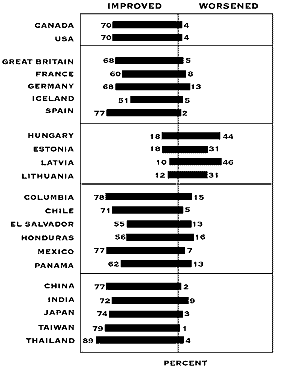
Source: Gallup
International
- As Figure 9
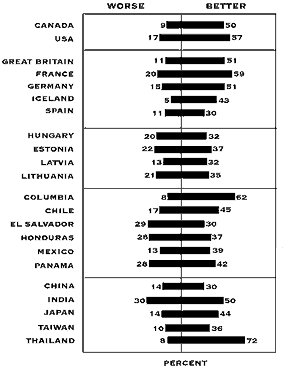
shows, in all countries surveyed but one, more people believe their
country would be governed better if more women were involved in politics.
(In El Salvador, the results were equally distributed in statistical
terms.)
While gender
discrimination still exists around the world, these findings from 22 nations
suggest there has been a widespread awakening to gender issues and concerns.
In the United
States, surveys for the National Foundation for Women Business Owners give an
indication of the growing role of women and how their priorities differ from
men's:
- Women-owned
businesses now employ one out of every four workers in the United States.
The number of firms owned by women grew 78 percent between 1987 and 1996,
nearly twice the rate of increase in the number of all U.S. firms.37
Figure 9
Effects of More Women in Political Office--
Country Would Be Governed . . .
Source: Gallup
International
- Women are
bringing a different set of priorities to their business operations. For
example, women business owners participate in volunteer activities at a
significantly higher rate than the average business owner, and their
volunteerism increases as the business grows and matures.38
Research by the
Higher Education Research Institute, which has been surveying American college
freshmen for the past 30 years, has identified another U.S. trend that
suggests women are developing new attitudes. The Institute's surveys describe
the impact of the women's movement on the educational plans and career
aspirations of college freshman women. In 1996, 67 percent of these women
aspired to advanced degrees, up from 39 percent in 1966. Entering freshman
women are now seeking graduate degrees and aspiring to careers as physicians
(or dentists) and lawyers at rates slightly higher than men.39
Growth of
Democracy
Since democracy
has deep roots in the industrial era, the spread of democracy does not, by
itself, indicate that a new paradigm is emerging. However, self-determination,
individual responsibility, and participation are strong themes in the
reflective/living-systems paradigm--making the growth of democratic forms of
government an important indicator area. Here is how the organization Freedom
House describes the current status of democratically elected governments in
the world:
Today, 3.1 billion
persons out of a world population of 5.7 billion live under democratically
elected governments. While not yet a universal standard, democracy has
deepening and widening roots in all parts of the world. . . . That 61 percent
of all countries and nearly 55 percent of the world's population live under
governments and legislatures elected in generally free and fair political
processes represents a landmark shift.40
Particularly
relevant are new processes that expand governance from representative
democracy to participatory democracy. With the telecommunications revolution,
new forms of participatory democracy are emerging. For example, in 1992, CBS
invited U.S. viewers to participate in an hour-long poll in response to
President George Bush's State of the Union speech. During the hour, CBS News
tallied more than 314,000 calls from around the nation--and turned away 24
million other callers who got busy signals.41 As the information
superhighway evolves, it will enable citizens to develop effective forms of
electronic town meetings to give feedback to elected representatives.
The broadening of
democracy has been supported by changing gender roles and expectations.
According to Gallup surveys, in the United States there has been a dramatic
increase--from 33 percent in 1975 to 61 percent in 1992--in the percentage of
people who believe the country would be governed better if more women held
political office.42
Countervailing
Trends
Although surveys
show that postmodern social values are emerging in a cluster of nations, there
are powerful countervailing trends that also need to be acknowledged. In
particular, economic disparities are growing throughout the world. The gap
between rich and poor nations, already a chasm, is growing wider rapidly.
According to the 1992 United Nations Human Development Report, "In a
world of 5 billion people, we discovered that the top billion people hold 83
percent of the world's wealth, while the bottom billion have only 1.4
percent."43 In everyday terms, among the poorest one-fifth of
the world's people, each person lives on less than the equivalent of one
dollar per day. Although a growing percentage of people in postmodern nations
may be shifting their focus from consumerism and material comfort to
sustainability and meaningful community, it is not clear if this shift will
influence the newly modernizing economies of Africa and Asia.
Another group of
trends that runs counter to postmodern values concerns the status of women
around the world. Although humanity is awakening to basic issues such as
gender equality, women still account for nearly 70 percent of the world's poor
and illiterate, and about 75 percent of all refugees.44 At the
national level, only 10 percent of the world's lawmakers are women.45
Another
countervailing trend is the continuing cultural alienation and diminished
opportunity resulting from racism. In a 1996 U.S. poll by the Washington Post,
53 percent of adults said that racism is a "big problem" in our
society, and 35 percent said it was "somewhat of a problem."46
As postmodern
values are emerging in the world, they are coming up against the stark realty
of economic inequities, violence against women, and gender and racial
discrimination. If the people of the Earth do embrace more compassionate
values, those values will surely include concern for these and many other
pressing issues, such as ending needless hunger and homelessness, attention to
those who are tortured and oppressed for their beliefs, and care for the
physically and mentally ill. How the human family meets these challenges will
be a major test of our emotional and evolutionary intelligence.
Experiential
Spirituality and a New Consciousness
Vaclav Havel,
president of Czechoslovakia, stated in a 1990 address to a joint session
of the U.S. Congress that "without a global revolution in the
sphere of human consciousness, nothing will change for the better . . .
and the catastrophe towards which this world is headed--the ecological,
social, demographic, or general breakdown of civilization--will be
unavoidable."47
Is a
revolution occurring in the sphere of human consciousness? Is a new kind
of spirituality growing? As noted earlier, a core insight from the World
Values Survey was that, around the world, people are withdrawing trust
from traditional institutions and placing greater trust in personal
empowerment. They are increasingly trusting an inner, subjective sense
of what is right and appropriate. Beyond this level of generalization,
global surveys do not exist that would reveal changes in how people
approach spirituality. We therefore focused on the U.S. experience as a
way to gain preliminary insight into what may be occurring worldwide.
Consciousness
and Spirituality Trends in the U.S.
As we looked
at changing spirituality, we thought it was important to acknowledge
core beliefs that have remained nearly unchanged over decades. For
example:
-
The
percentage of Americans who believe in God or a universal spirit was
94 percent in 1976, and 96 percent in 1994.48
-
The
percentage who believe that their soul will live after death was 75
percent in 1965, and 80 percent in 1996. 49
While
Americans still believe in God (or a universal spirit) and the
immortality of the soul, surveys show that traditional religious
institutions are no longer the engines of growth for spirituality.
Veteran pollster George Barna has explored trends in spirituality in the
U.S. for many years. He concludes his book The Index of Leading
Spiritual Indicators with this observation:
The
religious scene in America today is undergoing fundamental changes of
seismic proportions. Like almost everything in our culture today, there
is nothing sacred anymore, even in the realm of the sacred. Americans
are questioning everything about religion and faith. . . .50
What Barna
sees emerging from this spiritual upheaval is a personalized, customized
form of faith, which minimizes rules and absolutes, and bears little
resemblance to the "pure" form of any of the world's major
religions.51 The following trends suggest some of the changes
occurring in American spiritual experience:
-
A 1996 ABC
News/Washington Post poll found that 19 percent of Americans
said they have practiced meditation, and 12 percent said they had
practiced within the past year. Furthermore, 47 percent said that it
helped a lot, and 41 percent said that it helped some.53
-
The
percentage of the U.S. population who believe in telepathy
(communicating through means other than the five senses) grew from 37
percent in 1949 to 56 percent in 1996.54 This trend is
consistent with a reflective/living-systems perspective, which views
consciousness as a life-force that can extend beyond the body.
Figure 10
Percentage of U.S. Adult Population Reporting a Religious or Mystical
Experience
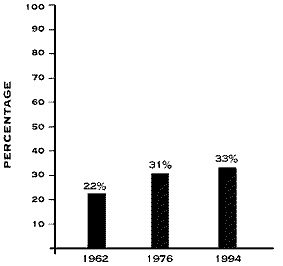
Source: Princeton
Survey Research Associates, Nov. 1994; Gallup, Aug. 1976 and Feb. 1962
- Their
spiritual experiences may be unorthodox, but Americans are reporting
an upsurge of interest in religious and spiritual matters, as Figure
11 indicates.56
- A majority
of Americans (63 percent) think the start of the millennium should be
a special time for "prayer and reflection" rather than a
time for "fun and parties" (17 percent) or both (12
percent), according to a January 1997 Yankelovich poll.57
Figure 11
U.S. Adult Population Reporting They Are More Interested in Religious
and Spiritual Matters Than They Were Five Years Ago
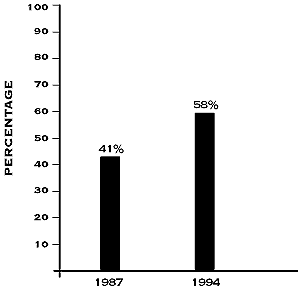
Source: ABC
News/Washington Post, May 1994; Gallup, July 1987
Viewed
together, these trends seem to show an increase in what might be called
experiential spirituality, where people are turning to their inner
experience for guidance. For many, their approach to spirituality
represents a complex and deeply personal synthesis that draws from
several of the world's wisdom traditions.58
Holistic
Health and Unconventional Therapy
Another
useful indicator of a reflective/living-systems paradigm is the use of
alternative forms of medicine that involve a significant mind-body
connection. In "Unconventional Medicine in the United States,"
a study published in 1993 in the New England Journal of Medicine,
David Eisenberg and his collaborators found that unconventional therapy
is used more often in the U.S. than previously reported: "An
estimated one in three persons in the U.S. adult population used
unconventional therapy in 1990."59 Moreover, the amount
of money spent out of pocket for unconventional therapy--such as
relaxation techniques, massage, chiropractic, lifestyle diet--was
roughly equal to the out-of-pocket costs that people paid for
conventional hospitalizations (approximately $13 billion).60
Eisenberg further estimated that Americans made more visits to providers
of unconventional therapy in 1990 than to all primary care physicians
(425 million visits compared to 388 million visits).61
Whether
measured by use or spending, unconventional modes of therapy and health
care are an integral part of the culture and economy of both Europe and
the U.S. Other indicators of this trend include:
- In
Europe, the trend for physicians to use alternative therapies is
"overwhelming," according to a recent Time magazine
article. "Out of 88,000 practicing acupuncturists [in Europe],
62,000 are medical doctors."62
- Americans
spend $165 million per year on homeopathic remedies, and the amount
is rising roughly 35 percent each year.63
- A June
1996 survey on the subject of health found that 23 percent of U.S.
citizens say they "regularly do yoga, meditation, or other
stress reducing exercises."64
- A 1996
U.S. survey found that 82 percent of the respondents believed in the
healing power of personal prayer, while only 13 percent did not. 65
Overall,
trends in spirituality and holistic health suggest that there is
movement toward a reflective/living-systems perspective. However, these
trends do not yet constitute the "global revolution in the sphere
of human consciousness" that Havel considers necessary if we are to
avoid planetary catastrophe. Psychiatrist Roger Walsh has written,
"The state of the world reflects our state of mind; our collective
crises mirror our collective consciousness."66 If this
is so, we are in a race between the awakening of a global consciousness
and ecological and social calamity.
Sustainable
Ways of Living
Are people
"walking their talk" and beginning to adopt more ecological ways
of living? Is the human family seeking to live more lightly on the Earth?
Both of the major global surveys noted in previous sections suggest that
people around the world are moving toward more sustainable ways of living.
Inglehart's analysis of the World Values Survey finds general
movement in a cluster of nations away from maximizing economic growth with
the focus instead on sustainability and well-being through lifestyle
changes. The Health of the Planet survey reveals widespread concern
for the environment, and support for giving environmental health a higher
priority than economic growth.
Another
indication of a shift toward sustainable ways of living is found in the
work of the Trends Research Institute of New York, which described
"global simplicity" as one of the top 10 trends of 1997:
The voluntary
simplicity trend that originated in the United States is now spreading
throughout the industrialized world. From Scotland to Australia and
Finland to Canada, masses of people are beginning to embrace the belief
that they can enhance the quality of their lives by cutting back on the
quantity of products they consume. Never before in the Institute's 17
years of trend tracking has a societal trend grown so quickly, spread so
broadly, and been embraced so eagerly.67
Unfortunately,
little more is known about shifts toward sustainable ways of living,
because no planetary-scale survey has been done to measure changing public
attitudes and actions. In-depth research has been done in the U.S.,
however.
Yearning
for Balance
In 1995, the
Merck Family Fund commissioned The Harwood Group, a public-issues research
firm, to study U.S. citizens' views on the issue of consumption. Their
report, Yearning for Balance, suggests that, without fanfare, a
deep change is occurring in the culture and consciousness of the United
States.68 Figure 12 gives some of the key findings.
The
Merck/Harwood Group survey found that respondents' deepest aspirations are
non-material. Asked what would make them much more satisfied with their
lives:69
Twenty-eight
percent of the survey respondents said that, in the last five years, they
had voluntarily made changes in their lives that resulted in making less
money, such as reducing work hours, changing to a lower-paying job, or
even quitting work. This is an enormous shift. Extrapolating from the
survey to the U.S. population, this suggests that, in the last five years,
more than 50 million Americans "downshifted," or made changes to
simplify their lives. The most frequent reasons given for downshifting
were:
Has it been
worth it? Eighty-seven percent of the downshifters surveyed described
themselves as happy with the change. On other questions, they were more
likely than others to say that they are happier than their parents were at
the same age, and that they are more involved in their communities.
When Questioned about "Our Culture of Materialism". . .
|
88
percent agreed that "Protecting the environment will require
most of us to make major changes in the way we live."
|
|
82
percent agreed that "Most of us buy and consume far more than
we need; it's wasteful."
|
|
91
percent agreed that "We focus too much on getting what we
want now and not enough on future generations."
|
Source:
Merck/Harwood U.S. Survey, Yearning For Balance, 1995
Overall, the
Merck/Harwood survey found that people of all backgrounds believe that
materialism, greed, and selfishness are increasingly dominating life and
are "crowding out a more meaningful set of values centered on family,
responsibility, and community."71 In summing up the
survey's findings, the Yearning for Balance report states, "People
express a strong desire for a greater sense of balance in their lives--not
to repudiate material gain, but to bring it more into proportion with the
non-material rewards of life."72
Changing
Dietary Patterns
For many
people, the reflective/living-systems paradigm involves developing a more
conscious relationship with food. Common changes in diet include eating
less meat, fat, and highly processed foods. In the U.S., there are trends
in this direction.
For example,
the demand for organic foods is increasing sharply. The Worldwatch
Institute reports in Vital Signs 1996 that "output from
organic farming is up sharply this decade; for example, in the United
States, sales of organic farm products more than doubled between 1990 and
1994."73 High demand, says Worldwatch, has brought
organics into mainstream supermarkets; 42 percent of U.S. supermarkets now
carry some organic produce.74 The Hartman Group, in a report on
Food and the Environment, found that the "green" consumer
is now in the mainstream: "A majority of American consumers are
willing to buy environmentally friendly products, and a significant
segment--23%--are eager to buy green on their own terms."75
In addition, they found that "organic foods and other foods produced
by using methods that are 'earth-sustainable', are growing by 20% per
year."76
Vegetarianism
also seems to be growing. According to a 1994 General Social Survey
by the National Opinion Research Center, 30 percent of the U.S. adult
public has "at least sometimes refused to eat meat for moral or
environmental reasons."77 A study by the National
Restaurant Association found that "about 15 percent of the nation's
15 million college students eat vegetarian on a typical day."78
Young women seem to be driving the trend toward meatless eating. Nearly
half of women college students say vegetarianism is "in,"
compared with one-third of men, according to a Roper College Track survey.79
To see if
people are acting on their beliefs, we examined the data on recycling in
the United States. A study by R.W. Beck Associates estimated that in
1994 the value of commonly recycled materials in municipal programs was
roughly $5 billion.80 As of 1995, 41 states had comprehensive
waste-management laws, and 44 had recycling or waste-reduction goals.81
A Gallup/Waste Management poll in the spring of 1995 found that:
Are people
willing to pay more for their ecological concerns? In 1971 and again in
1990, national surveys asked Americans if they would be willing to pay
15 percent more for groceries if all packaging could be recycled for use
again. Figure 13 shows the trend results.83
While there
are trends toward more sustainable ways of living--particularly in the
postmodern cluster of nations--these may be overpowered by the impact of
rapid industrialization in nations such as China and India. If these
countries, with their enormous combined population of roughly two
billion persons, embrace the "modern values" of materialism
(particularly as practiced in the U.S.), they could overwhelm trends
toward more ecological ways of living. From a global perspective, it is
too early to tell if sustainable ways of living are actually gaining
ground in the dynamic race between modern and postmodern values.
Figure 13
Percentage of Americans "Willing to Pay 15% More for Groceries If
All Packaging Could be Recycled"
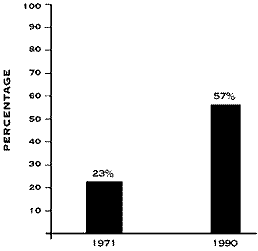
Source: Gordon S.
Black Corporation, 1990; Harris Survey, 1971
A
U.S CASE STUDY: "CULTURAL CREATIVES"
In the
preceding sections, we looked at studies that would reveal a global
shift in perspectives and values. We now turn to an in-depth survey that
explored the possibility that a change in culture and consciousness is
occurring in the United States.
Paul Ray of
American Lives, Inc., conducted this pioneering inquiry in 1995.84
His random national survey explicitly looked for a new pattern of
living, and discovered the emergence of a rapidly growing sector of the
U.S. population. He calls this group the "cultural creatives"
because, he says, these are "the ones who are coming up with most
new ideas in American culture, operating on the leading edge of cultural
change."85 According to Ray, the emergence of the
cultural creatives in the U.S. since the 1970s may represent the birth
of a new and distinctive social force that he describes as an integral
culture. A defining characteristic of integral culture, says Ray, is its
toleration for ambiguity--an ability to look beyond either/or choices
and embrace a larger whole. An integral culture is inclusive by its very
nature and will seek to include and integrate the best aspects of both
traditional and modern cultures into its postmodern expression.86
Thirty years
ago, Ray states, there were so few people in this emerging culture that
no one bothered to count them. By 1995, however, the core group of
cultural creatives had grown to represent about 10 percent of the U.S.
adult population, or roughly 20 million people. They are pioneers in
integrating different aspects of their lives. As a group, they have both
a strong inner or spiritual life and a strong outer or ecological
concern. They also have a global outlook and interest (a love of the
foreign), as well as a strong concern for local community. They enjoy
mastering new ideas, are socially concerned, and advocate "women's
issues" and ecological sustainability. They tend to be upper-middle
class, and nearly twice as many are women than are men. Ray summarizes
the distinctive values of cultural creatives using these five themes:
Ecological
sustainability, beyond environmentalism: This new culture wants to
rebuild neighborhoods and communities; is working for ecological
sustainability; views nature as sacred; wants to stop corporate
polluters; is living more simply; and is willing to pay the costs for
cleaning up the environment.
Globalism:
Two of the top values for this group are love of the foreign and
ecological sustainability.
Feminism,
relationships, family: The fact that women are a strong majority of
the cultural creatives is a major key to understanding this culture.
Ray's study also shows that women are more concerned than men are with
relationships of all kinds--from family to neighborhood and community.
Self-actualization,
spiritual practice, and alternative health care: The core cultural
creatives are building ways of living that connect inner and outer,
material and spiritual, into a meaningful whole. They have a new sense
of the sacred that brings together personal-growth psychology, spiritual
practice, and service to others. They also tend to make use of holistic
and alternative health care. Although the spirituality of the cultural
creatives is very complex and diverse, a clear value they share is being
aware or "not sleepwalking through life" (as 89 percent of the
core group in the survey said).87
Social
conscience and social optimism: Cultural creatives are conscious of
the condition of the world and are working to heal society and
themselves. With their positive approach to challenges, both personal
and ecological, they are relatively optimistic about the future.
This
emerging culture has the potential for rapid growth. Ray shows that, in
addition to the "core cultural creatives," there is another
group that he terms "green cultural creatives." The greens
constitute 13 percent of the U.S. adult population, or roughly 24
million persons. Like the core cultural creatives, they have high levels
of ecological and social concern, but give a lower priority to personal
growth, either spiritual or psychological. Says Ray, "they appear
to take their cues from the core cultural creatives and tend to be
middle class."
In summary,
a core group of roughly 10 percent of U.S. adults seems to be pioneering
a new culture; a much larger group is sympathetic with and responding to
these values. Together, these groups total roughly 24 percent of the
U.S. adult population, or 44 million persons. The presence of the green
cultural creatives means that those in the core group are not alone.
There is a large reservoir of sympathy and support from which a new
cultural paradigm can grow.
Ray's study
raises important questions about paradigm change at a global level. Is a
similar pattern-shift in priorities, perceptions, and values occurring
elsewhere? Are cultural creatives pioneering paradigm change in Latin
America, Africa, Asia, and elsewhere through the world?
CONCLUSIONS
While a
general shift in global values and perceptions seems to be underway, it
will not be possible to know with precision what is developing until
further global surveys specifically explore these changes. Despite its
limitations, we can draw several conclusions from this overview study:
Global
consciousness change and the communications revolution. A deep and
profound revolution is occurring in our ability to communicate at a
global level. In the next several decades, the communications revolution
will enable humanity to achieve a quantum increase in its functional
intelligence as a species.
Global
ecological awareness and concern. A sizable majority of the world's
people seem to be concerned about the global environment. Residents of
poorer and wealthier nations express nearly equal concern about the
health of the planet. Majorities of people around the world say that
they give environmental protection a higher priority than economic
growth and that they are willing to pay for that protection.
Postmodern
social values. Over the last 25 years, a cluster of closely
correlated, postmodern values has emerged in about a dozen
industrialized nations. This postmodern shift represents a change in
survival strategies. People are shifting their priorities. Economic
growth is no longer their main focus; instead, they are making lifestyle
changes to maximize sustainability and subjective well-being. There is
also a shift toward greater gender equality, democratic participation,
and reliance on personal rather than institutional authority.
Experiential
spirituality and a new consciousness. The World Values Survey
indicates that, in a postmodern cluster of about a dozen nations, people
are turning away from traditional religious institutions and losing
trust in hierarchical institutions in general. U.S. survey research
suggests that a significant spiritual shift may be underway as a growing
number of people seek to balance their inner exploration with a
meaningful connection to the outer world.
Sustainable
ways of living. A majority of the Earth's people seem to be aware
that the human family would benefit from living sustainably. Further
investigation is needed to see if this awareness is being translated
into new ways of living. In the United States, surveys indicate that
significant numbers of Americans are attempting to balance the material
and non-material rewards of life; changing their diets by buying organic
foods and eliminating meat; and acting on their environmental beliefs by
recycling.
Do these
trends suggest that a new pattern of global values and perceptions is
emerging? Considered individually, they are more suggestive than
conclusive--and rightly so. Individual trends cannot reveal a larger
pattern. When they are considered together, however, we believe that
these trends do reveal that an overall pattern-shift in global values
and perceptions is occurring. A new global paradigm is emerging.
What
fraction of the world's population is involved in this paradigm shift?
Given survey limitations, it is impossible to answer this at a global
level. For the United States, we have Paul Ray's conservative estimate
that 10 percent of the adult population seems to be pioneering what we
are calling a reflective/living-systems paradigm and culture. While only
this small fraction of the U.S. population appears to be wholeheartedly
engaged in the process of paradigm change at present, we believe that
this group is at the leading edge of a broader wave of global cultural
change.
Although the
trends we have examined suggest that a reflective/living-systems
paradigm is emerging in the world, we cannot conclude this report
without reiterating that other paradigms and many countervailing forces
are at work as well. Materialism and consumerism threaten the ecological
health of our planet. Poverty and discrimination may overwhelm
compassionate intentions. Although there is a profound communications
revolution underway, much of what is being communicated is shallow and
short-sighted. These are turbulent times. It is not clear which forces
will ultimately prevail, and in which direction they will lead.
Nevertheless, we believe that, as ecological necessity converges with
communications opportunity, the reflective/living-systems paradigm is
likely to grow in relevance and importance.
IMPLICATIONS
OF THE EMERGING PARADIGM
In this
section, we turn to a more personal assessment of the emerging
reflective/living-systems paradigm. Although they are speculative, we
draw seven major conclusions from this inquiry.
First, we
find it remarkable that humanity can now engage in a conversation about
paradigm shifts. Until recently, we did not have the language and
concepts to discuss changing paradigms. Now, we are becoming conscious
of the mindset that we share as a society. When bumperstickers can
proclaim "Question the Dominant Paradigm," we believe that the
popular culture has begun to wake up to the possibility of new ways of
looking at the world.
Our second
major conclusion is that, although different perceptual frameworks are
in evidence around the Earth, it seems plausible that, by midway through
the twenty-first century, a majority of humanity could be living within
the reflective/living-systems paradigm. The half century or so in
between will be a time of unprecedented transitioning among different
perceptual frameworks. This process will be complex and turbulent.
Pioneering changes in living will be occurring at a time when there is
no overarching paradigm to orient human activities. The early decades of
the twenty-first century are likely to be a time of intense confusion
and conflict over which paradigm holds the greatest promise as an
aligning vision for humanity.
A third
conclusion we draw is that the human family is moving swiftly toward a
time of great reckoning. We face tests and challenges that are more
global, unyielding, and complex than anything we have encountered
before. Within the lifetimes of a majority of those alive today, the
citizens of the Earth will make choices that will have a deep and
lasting effect on the future of the planet. We are the first generation
of global citizens. The choices we make will establish an overall
mindset and approach to living with which humanity will live for
countless generations. What we do matters at this pivotal time.
Fourth,
beyond the age-old clash of cultures, there is the deeper promise of
global reconciliation within a paradigm that draws from the highest
potentials of humanity. Marc Luyckx, writing for the European
Commission, notes some of what is possible in foreign policy with a new
paradigm:
The main
problem and danger in actual foreign policy is that we are still looking
at new problems with old eyes. Changing vision or paradigm allows us to
see that the danger today is probably less the conflict between cultures
and religions, than the conflict between paradigms. In that new vision a
totally new type of dialogue is thinkable. Why not discuss with the
pre-modern cultures how to jump over modernity-secularization into the
new post-industrial age? The change of vision could represent . . . a
powerful path to peace and a new platform of dialogue between the world
cultures.88
Our fifth
conclusion is that the reflective/living-systems paradigm may be
pointing toward the emergence of what has been called an "integral
culture"--an idea that has been discussed around the world for more
than 50 years.89 In other words, if the
reflective/living-systems paradigm continues to expand and deepen, it
will grow into an integral culture. As we develop our capacity for
reflective consciousness and knowing connection, we can achieve a higher
level of integration and balance among the polarities that pull at our
lives--inner and outer, masculine and feminine, collective and
individual, and so on. With its inclusive and reconciling nature, an
integral perspective offers the hope that the human family will overcome
its many differences and work together to build a sustainable,
satisfying, and soulful future.
A sixth
conclusion we draw is that, although the world needs a shared perceptual
framework from which to build a sustainable future, this does not mean
we should seek cultural homogeneity and human uniformity. After
surveying the growth and decline of the world's civilizations, Arnold
Toynbee found a master process at work in the disintegration of
societies, which he called a "tendency towards standardization and
uniformity."90 Diversity within unity is the mark of a
growing species-civilization. As we seek global reconciliation around a
sustainable future, we need to support a broad range of cultural
diversity at the same time. Each community or region needs to be free to
develop in ways that are uniquely suited to its culture, ecology,
climate, and other characteristics.
Finally, the
reflective/living-systems paradigm is more than a new way of thinking;
it is a perspective that invites us to open to a new level of aliveness,
interconnection, and mystery in our everyday lives. In shifting
paradigms, we shift from feelings of existential isolation in a lifeless
cosmos, to experiencing profound connections in a living universe. In
trusting the hidden wholeness of life, the human family can learn to
join the inner world of our collective psyche and soul to the outer
world of civilized action.
