Palmito Ranch, Texas




The war on the South Texas border was a wild time with Union and Confederate forces clashing on the north side of the Rio Grande, Mexican Imperialists and Juaristas on the south and Indians and bandits harassing both. However, by May of 1865 things were relatively quiet. The Confederates had kept the Federals from taking control of the Mexican border and by this late stage in the game both sides realized that the outcome of the war was about to be decided elsewhere and there was no real need to continue killing each othere in South Texas. As a result, an informal truce developed with each side more less leaving the other alone. However, that all changed with the Yankee Colonel Theodore H. Barrett in command of the Union post at Brazos de Santiago. He had heard that General Lee had surrendered and knew the war was all but over, but he wanted to make a name for himself by winning one final battle that would pave the way for his entry into politics. With these ambitions in mind, and not expecting much opposition from the ragged, outnumbered Confederates in the area, he decided to break the gentleman's agreement and mount an attack.
On May 11, 1865 he sent Lt. Colonel David Branson with about 300 men of the 62nd U.S. Colored Infantry and the Unionist 2nd Texas Cavalry to attack Confederate positions on the Texas mainland. Bad weather prevented their immediate departure and in the early morning hours of the 12th they took the unoccupied White Ranch and stopped for a rest. They lost the element of surprise when Mexican troops across the river loyal to Emperor Maximilian, whom the Confederacy supported and the Union opposed, informed the Confederates of their whereabouts. After daybreak Branson woke his men and they attacked the Confederate outpost and Palmito Ranch, easily expelling the handful of Texans there. However, the Confederates were quick to respond and by 3 in the afternoon arrived in sufficient numbers to retake Palmito Ranch and force the Unionists to retreat back to the White Ranch.
Branson immediately called for help and Colonel Barrett himself came to take command of the operation, confident that he now had the opportunity for his glorious showdown and arrived on the morning of the 13th with 200 additional reinforcements from the 34th Indiana Volunteer Infantry. This combined force them marched back to take Palmito Ranch. The reoccupied the place, in typical Yankee fashion destroying all that had remained from the previous day and pressed on. However, they were under constant harassment from Confederate skirmishers the entire way. The farther they went, the worse the fighting became. Around 4 in the afternoon Colonel Barrett halted at Tulosa on the Rio Grande to camp for the night.
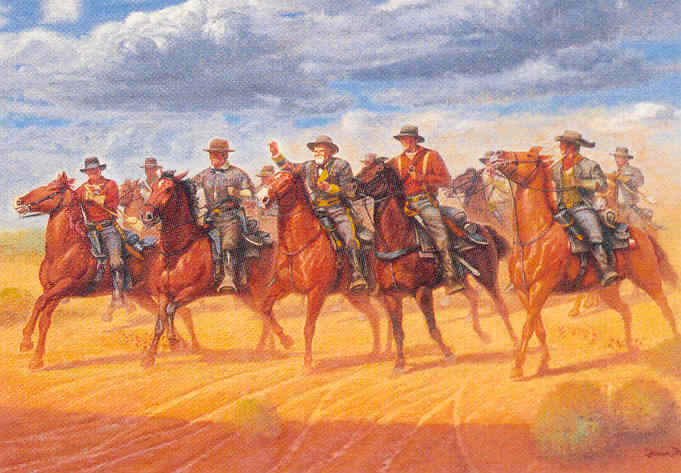
At just this time though, the hard fighting Texas Ranger Colonel John S. "RIP" Ford arrived with his Cavalry of the West and whatever forces he could scrape together to repel this latest attack. His troops were ragged and consisted largely of old men and young boys, but they were tough and determined. The Yankees formed battlelines as Colonel Ford and his Confederate Texans charged into them while his artillery shelled them from a distance. The bitter Yankees also claimed that they were occasionally fired on by Emperor Maximilian's troops across the river in Mexico, but of course this could not be proven. Eventually, the fight became too hot for the Unionists and Colonel Barrett ordered his men to retreat back to Boca Chica, his dream of fame in ruins. General James Slaughter, Confederate commander in South Texas arrived and decided to let well enough alone and allow them to go, but Colonel Ford would have none of it and continued to press the Union troops and force them to fight constant rear-guard actions during the flight to the coast.
The last battle of the Civil War was over and it was the Confederate Texans who had carried the day. It was only after questioning Union prisoners they had captured that the Texans learned that General Lee had surrendered a month before.