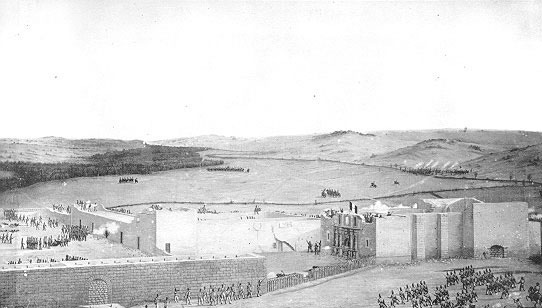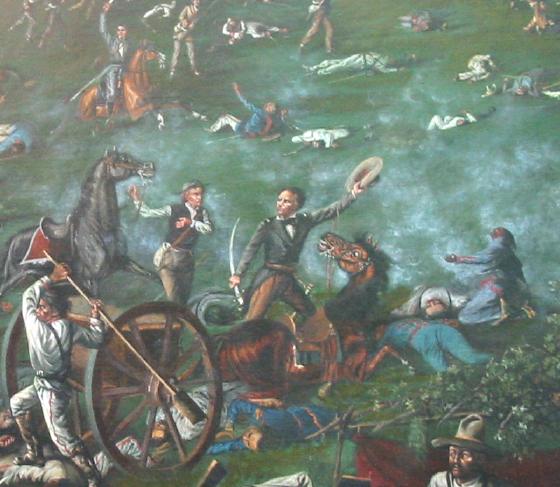
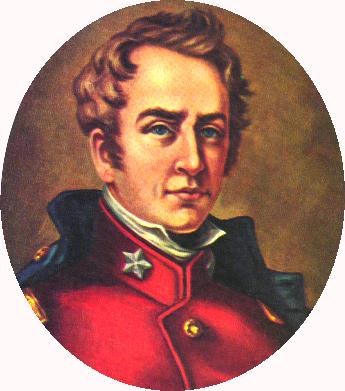
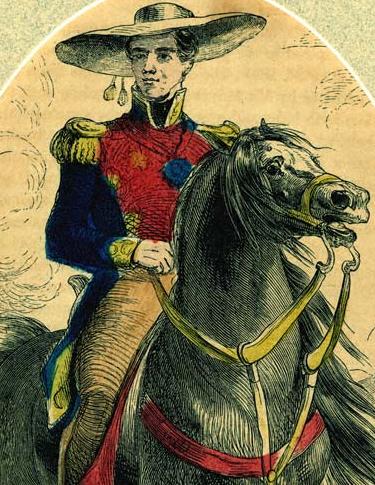
It was a cold morning in San Antonio de Bexar. The Texas Revolution was thought by the more over-confident to be over. In 1835 Texan forces had captured Goliad and forced the surrender of the large Mexican garrison in San Antonio in the war's largest battle. General Cos and his soldiers had been paroled and sent back to Mexico. But, they would soon return. In an astonishingly swift mobilization and march, the dictator of Mexico, General Antonio Lopez de Santa Anna had assembled a massive force, "The Mexican Army of Operations in Texas" and forced a rapid march north to crush the rebellion and avenge the humiliation of General Cos, Santa Anna's brother-in-law.
At 10 o'clock in the morning, standing watch in the bell tower of San Fernando Church, Texas volunteer Daniel Cloud, age 21, spotted the advance guard of Santa Anna's army, under General Joaquin Ramirez y Sesma, marching over the Alazan Hills toward the small town of 4,000. The Mexican army descending upon them was larger than the entire population of the city, roughly 5,000 soldados, with another 2,000 marching north along the coast toward Goliad. Private Cloud sounded the alarm and the Texans rushed inside the old Spanish mission known as the Alamo. The legendary names were all there: Lt. Colonel William Travis of the regulars, Colonel Jim Bowie commanding the militia and the immortal Davy Crockett of the Tennessee Volunteers.
As the Mexicans of Santa Anna occupied San Antonio, Colonel Travis dispatched riders to call for help from the surrounding Texas colonies. General Santa Anna also sent a message, to the Alamo defenders. The message was simple: the rebels must surrender at discretion, otherwise all who resisted would be put to the sword. Colonel Travis, a known war-hawk and full of bravado, answered this message with a canon shot from the 18-pdr, the largest gun in Texas and a rousing rebel cheer from the men on the walls. Santa Anna responded by raising a blood red flag over San Fernando church; it was a message everyone in the Alamo could see and understand. There would be no prisoners taken, no quarter given, this was to be a fight to the death. The Mexican batteries were brought up and the daily bombardment began. The siege of the Alamo was underway.
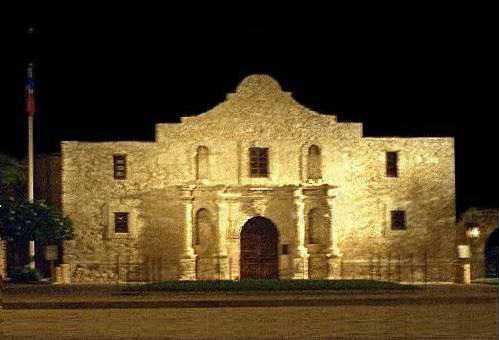
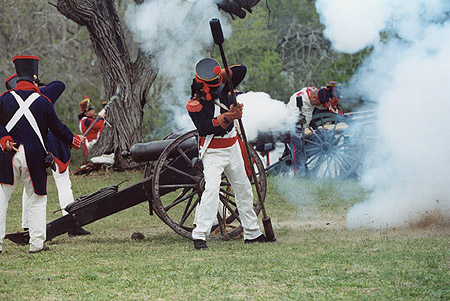
As troops of the Mexican army continued to arrive, the bombardment of the Alamo continued. Although the Alamo actually had more and larger canon than the attacking Mexicans, shortage of shot and quality powder prevented the Texans from using it to their full advantage. They also lacked the manpower to fully operate all guns with a full crew. Shots were exchanged, but the Texans had to save their ammunition for the assault they knew was coming.
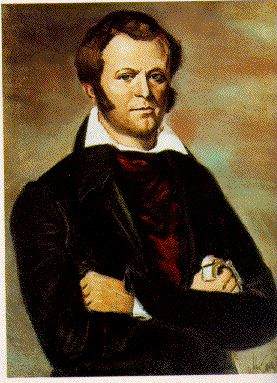
Inside the walls of the old compound, there were changes in the Texan hierarchy. Although Travis had been left in command of the post, Jim Bowie was the most popular with the volunteers who made up the vast majority of the Alamo defenders. Travis and Bowie therefore agreed to share command. However, Jim Bowie had been suffering from poor health for some time. The legendary knife-fighter was worn down by tuberculosis, pneumonia, typhoid fever and a lifetime of alcohol binges and was finally forced to hand full command over to Travis as he took to his bed to be attended by his sister-in-law. For his part, Colonel Travis wrote and dispatched one of his most famous and eloquent messages, addressed "To the People of Texas and All Americans in the World". He related the odds against his garrison, his determination to stand firm and called on his countrymen to come to the aid of the Alamo.
Outside, in Mexican-occupied San Antonio, General Santa Anna was in a romantic mood. Upon his arrival in town a lovely young senorita had caught the president's eye. When he sent an officer to obtain the girl, he ran into trouble with her devoutly Catholic mother who insisted that her daughter would not be allowed to go home with any man she was not married to. Santa Anna overcame this complication by having one of his multi-lingual young officers disguise himself as a priest and perform a mock wedding ceremony for the general. Santa Anna said he would keep the girl to entertain him during the siege, then send her back to Mexico to save her for his old age. As the day closed, Santa Anna honeymooned while the Texans endured another sleepless night under the bombardment of the Mexican guns.
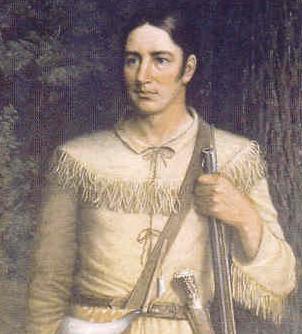
The harassing bombardment from the Mexican artillery continues, depriving the Texan forces of sleep. During the day, they are forced to work furiously to repair the damage done to their walls during the night. In charge is the Alamo's chief engineer, Major Green Jameson who has been forced to use stop-gap measures to keep the Alamo secure. Many of the walls are thick and high, but the north wall is weak and crumbling. Between the main gate and the chapel an empty space has been defended by a makeshift wooden palisade. It is the weakest point of the Alamo, but is defended by the best marksmen; Colonel Davy Crockett and his Tennessee Volunteers.
During the third day of the siege, the Mexican gunners inched their guns closer to the Alamo walls. By the end of the day, the Mexican artillery was within 300 yards of the Alamo walls. Colonel Travis writes another dispatch to General Sam Houston, commander of all Texan forces, pleading with him and the Anglo colonies to "give me help, oh my country".
The weather, already unusually cold, has turned colder, hampering the movements of the Mexican army who have already endured a freak blizzard in the northern Mexico desert on their march to San Antonio. The Texans have been harassed by Mexican probes and sorties trying to feel out the Alamo defenses. One point from which the Mexicans were able to cover their moves was "La Villita", a collection of jacales just outside the Alamo walls. Colonel Travis calls for volunteers to venture outside their fortress and destroy this cover. Charles Despallier of Louisiana and Robert Brown stepped forward. Captain Dickinson's canon and Crockett's rifles gave the two men cover as they dashed across the 100 yards south of the walls to La Villita and began setting fire to the huts. As Mexican troops moved to respond, even Santa Anna came under fire from the Texas marksmen, as he led the Battalion de Cazadores de Matamoros to a closer position. As the Mexican batteries moved closer, some Texans mistook this for a formal assault. Finally, by mid-day, the Mexicans' losses became too heavy and they retreated back to their original positions. Only 2 or 3 Alamo defenders were injured. The Mexicans had been turned back, La Villita had been destroyed, but the position of the Alamo remained constant, and as night fell, the dreaded bombardment from the Mexican artillery, continued again.
The temperature continues to drop, causing misery on both sides and a suspension of major military activities by the Mexican army. The relentless and nerve-shattering bombardment continues however, even with the cold north wind and chilling 39 degree weather. The Texans shiver behind their walls, around their fires, but the conditions are particularly hard on the Mexican army, many of whom have never experienced anything like it before, growing up in the tropical valleys of central Mexico. Especially hard hit are the Indians from the Yucatan, many of whom have been pressed into service with no prior knowledge of modern weapons or warfare at all. But both sides endure.
Colonel William Travis, still desperately seeking aid for his tiny garrison wrote a dispatch to the only other commander in the area: Colonel James Walker Fannin at Goliad. Colonel Fannin is the only man in the Texas army with any training in a formal military academy, having dropped out of West Point some years before coming to Texas. However, since taking command at Goliad, Colonel Fannin has been plagued by divisions among his officers, unauthorized attacks, worries of local rancheros loyal to the Mexican government as well as the approaching forces under General Jose Urrea, one of the best commanders in the Mexican army. Colonel Travis called upon Fannin to come to his aid as soon as possible with all available forces. To carry the message, he dispatches his young friend and member of the 'Mobile Greys', James Butler Bonham. He rides out after nightfall, aware of the fact that Colonel Fannin is most likely the Alamo's only hope for relief.
The bitterly cold weather which had incapacitated the Mexican army began to lift. The constant artillery bombardment is wearing down the nerves of the defenders. Throughout the day they are forced to keep watch for any attacks or movement, fight off probes and repair damage to the walls. During the night comes the mind-numbing cannonade. The Texians are exhausted and suffering from severe lack of sleep. . . just as Santa Anna intends them to be. Hardly anyone can think clearly. Why have the Mexicans not attacked? Why has no one answered their calls for help? How much longer will their ammunition last? What is more important, the Texians notice that after almost a week inside the Alamo, their provisions of food are running low and rations become smaller. Inside San Antonio however, the operation is going exactly as planned. Santa Anna sees everything unfolding as he wishes. His bombardment is having its effect, and even larger siege guns are on the way, although Santa Anna will not wait more than another week for them to arrive. His plans are not altered for anything. He continues to move his troops around and closer to the Alamo, making the noose tighter around the necks of the norteamericanos. By the end of the day, he has a new battery emplaced 800 yards off the Alamo's weakened north wall. When the nightly bombardment commences, the Texians realize they are rapidly being surrounded.
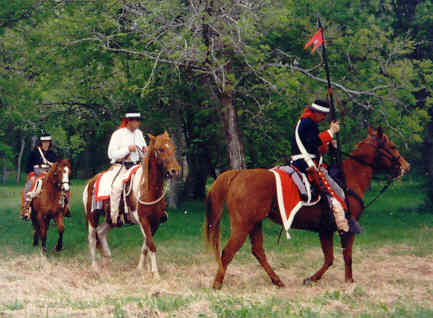
1836 was a leap year, giving the Alamo defenders an extra day of misery in the month of February. While politicians argued at Washington-on-the-Brazos, while Colonel Fannin worried about supplies and impending attack, the men in the Alamo endured continued shelling and an encroaching sense of isolation. The only thing good about this day is that the temperature has risen to 55 degrees, still cold, but an improvement over the frigid temperatures of previous days. However, even this fact has a dark side. The rising temperature also means that General Santa Anna can move his men away from their camp fires and closer toward the Alamo walls. And so he does. Slowly but steadily Santa Anna is moving his troops closer to the old mission, preparing them for the final assault he is determined to make.
To be sure, both armies are worlds apart. The Alamo defenders come from all over the United States as well as Europe. Among the Alamo defenders are 1 Dane, 2 Germans, 12 Irishmen, 4 Scotsmen, 1 Welshman and 12 Englishmen. There are also 9 Tejanos, Texans of Mexican ancestry who are fighting for the restoration of the 1824 constitution against the Centralista Santa Anna, just as others in the interior of Mexico have done already. These men are rugged individualists, fiercely independent and tough fighters. They are fighting for their rights, fighting against tyranny and in the minds of many even at this stage, for independence. A few hundred yards away stands the Mexican army, including many veterans. They are well disciplined, unlike the Texans, and fight as a team rather than as individuals, in true Napoleonic style. There are the Cazadores, or light infantry, the Fusileros (fusiliers), the Grenederos (grenadiers) and the elite Zapadores or combat engineers. They also have what is probably the best cavalry troops in the Americas, deemed unbeatable in open country. For them, they are fighting against foreign mercenaries and land pirates, fighting to keep Mexico Mexican. There is one fact no one can deny: whether it is the Texan volunteers fighting for their liberty, or the Mexican soldados fighting for la Patria, there were no cowards at the Alamo, in or outside the walls.


After more than a week of constant bombardment and harassment by Mexican forces, the Alamo defenders have reason to cheer. Slipping through the Mexican lines, reinforcements arrive from the town of Gonzales, but the brave men, officially known as the Gonzales Ranging Company under the command of George Kimball, are only 32 in number. Colonel Travis is painfully aware of the fact that unless more help arrives, facing a horde of 5,000, these volunteers can only increase the body count by 32. General Santa Anna cares little about this event, in fact, he considers any arriving troops as simply fuel for the fire he intends to ignite; to him, the more he can trap and slaughter in the Alamo the better. However, the Texans take this opportunity to celebrate. If these 32 men heard and were brave enough to answer their call, perhaps more will be on the way. Travis takes this opportunity to fire off the big 18pdr canon, usually fired only once every morning to save precious powder and let the surrounding settlements know that the Alamo still stands defiant. As night falls, Santa Anna is determined to silence that canon, and as the sun sinks below the hills, the nightly bombardment by the Mexican artillery relentlessly begins again.
The most tragic thing about March 2 was that to the men of the Alamo, it was not an extraordinary day. They worked, they waited, they worried, hoped and prayed as the Mexican shells continued to rain down on the old Spanish mission. They had no idea that this was perhaps the most important day in the history of Texas. Miles away, on this very day, at Washington-on-the-Brazos, politicians representing the people of the Anglo-Saxon colonies, as well as the Tejano natives, finally decided what this war was going to be all about. Led by provisional President David G. Burnet and provisional Vice-President Lorenzo de Zavala, on March 2, 1836 the delegates formally declared the independence of the Republic of Texas from Mexico. This was no longer a rebellion by federalistas against a centralista regime, this was now the War for Texan Independence. To be sure, divisions remained, but the Texans had now made a statement to the world: they were not fighting for their rights as Mexican citizens, they were fighting for their freedom as Texans.
However, the men of the Alamo, fighting under the flag of the 1824 Mexican Constitution, were totally unaware that this was Texas' Independence Day. They were more concerned with the canon balls exploding around them, the ever encroaching columns of Mexican infantry and sappers, and the all too obvious lack of aid from their comrades, other than the 32 brave men from Gonzales who had come yesterday to share their fate. They did not know that they were now fighting for the Republic of Texas, and sadly, the siege would end with none of the men inside the Alamo aware of the fact that they had died in a war for independence. However, for many of the men, regardless of what politicians said and when they said it, that is what it had been about for them all along. As far as Santa Anna was concerned, the posturing of a small collection of land pirates in an old house with no doors or windows was not of the slightest concern to him. He would crush this rebellion of upstarts, wipe the Anglo-Saxon population from Mexican lands and return to his palace in Mexico City as the true "Napoleon of the West". He would attack and slaughter these foreign interlopers in a brilliant attack, already planned out in his mind, and the time for that final attack was drawing near.
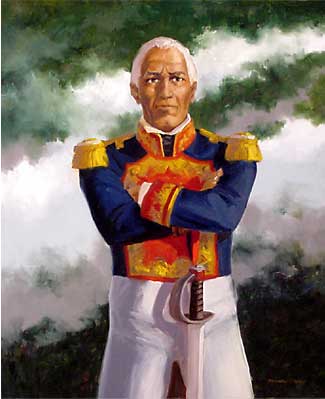
After ten days of bombardment, the psychological warfare employed by General Santa Anna is having full effect. The defiant and robust Texans are being reduced to dull, punch-drunk weariness. Most have not been able to sleep in days, none more than a few hours since the siege began. The days are filled with hard labor and the fear of attack, while night brings continued shelling. No Texans have been killed by the bombardment, but this was not Santa Anna's goal. He is softening up the mission, weakening the walls and exhausting the men with his relentless canon fire. His goal is to wear them down, and he is succeeding.
Just when it seems things can become no worse, hopes are dashed. Travis' friend, Lt. James Butler Bonham, dashed through the Mexican lines and into the fort. However, he has no hope to offer the embattled garrison of volunteers, in fact his only news is grim. Colonel Fannin is not coming. Worried and hesitant about the relief operation to begin with, Colonel Fannin has transportation problems shortly after leaving Goliad that stop his march. Then, survivors of the "Matamoros Expedition" reach Fannin and tell him that their forces have been defeated and captured almost to a man at San Patricio by a powerful Mexican column of some 2,000 men under General Jose Urrea. Fannin talks it over with his officers and all decide to promptly turn back. Bonham is forced to return to the Alamo with word that they can expect no help from Colonel Fannin. To the objective observer, by March 3, 1836 it looks as though the new Republic of Texas will have a very short life. As night falls, Travis sends out more desperate appeals, warning that if no help arrives, "our bones shall reproach our countrymen for their neglect". As night falls, the Mexican guns open fire again, on a crestfallen garrison.
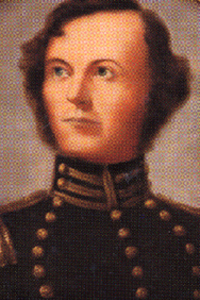
The condition of the Alamo defenders has never seemed more desperate. The Mexican artillery has advanced batteries to within 200 yards of the crumbling north wall. Colonel Travis knows that Fannin is not coming, but wrestles with the effect this news will have on his garrison. In San Antonio, on the other hand, Santa Anna knows exactly what to do and holds a council of war with his senior officers to put his plans into action. On hand is his Italian second-in-command General Vicente Filisola, his French Quarter-Master General Colonel Adrian Woll, the boot-licking General Sesma, his humiliated brother-in-law General Cos, and his more chivalrous officers like General Manuel Castrillon and Colonel Juan Almonte. Santa Anna announces that he will storm the Alamo on the morning of March 6.
General Castrillon, General Cos and other officers protested that such an attack would be too costly and was unnecessary, considering that in only a few days two 12pdr siege canon would arrive which could make short work of the old mission walls and force the Alamo to fall without risking a frontal assault. Santa Anna, however, will not wait, nor does he want to shell the Alamo from a distance. He wants a glorious charge that will cement his popular image in the minds of all Mexicans, he wants a column assault in grand Napoleonic style. General Sesma and Colonel Almonte agree with the Generalissimo that there is no need to wait, with their strength of numbers, scaling ladders and the superiority of the Mexican soldier against the undisciplined banditos, they will make short work of the Alamo.
These were the orders: General Cos would attack from the south, Colonel Jose Maria Romero from the west, Colonel Don Francisco Duque from the north and Colonel Juan Morales from the east. Colonel Augustin Amat would command the elite troops in reserve and General Sesma would command the cavalry to prevent any Texans from escaping and any Mexicans from turning back. Attention was given to the scaling ladders, all men were to wear shoes or sandals and the bayonets in particular were to be "in perfect order". Against the wishes of several of his officers, Santa Anna made it clear: no prisoners were to be taken; there would be no survivors.
As the Mexicans prepare for their final assault, inside the Alamo, it is a day of decision. They are surrounded, 5,000 against less than 200 and there is no hope of help from outside. They are trapped, with no hope of victory and a promise from Santa Anna to slaughter all who resist. Colonel Travis finally decides to clearly and honestly put the situation to his brave volunteers. The final fate of every man will be in his own hands.Travis assembles the men in Alamo plaza, with Colonel Bowie being carried in on his cot since he is too ill to stand. Travis tells the men honestly that they have fought bravely here for twelve days, but that no help is coming. Their political leaders are incoherent and non-committal, while Colonel Fannin is preparing to meet an attack of his own. They are hopelessly outnumbered, surrounded and will face a certain death if they choose to stay and fight. As Travis says, "Our fate is sealed. Within a very few days--perhaps a very few hours--we must all be in eternity. This is our destiny and we cannot avoid it. This is our certain doom".
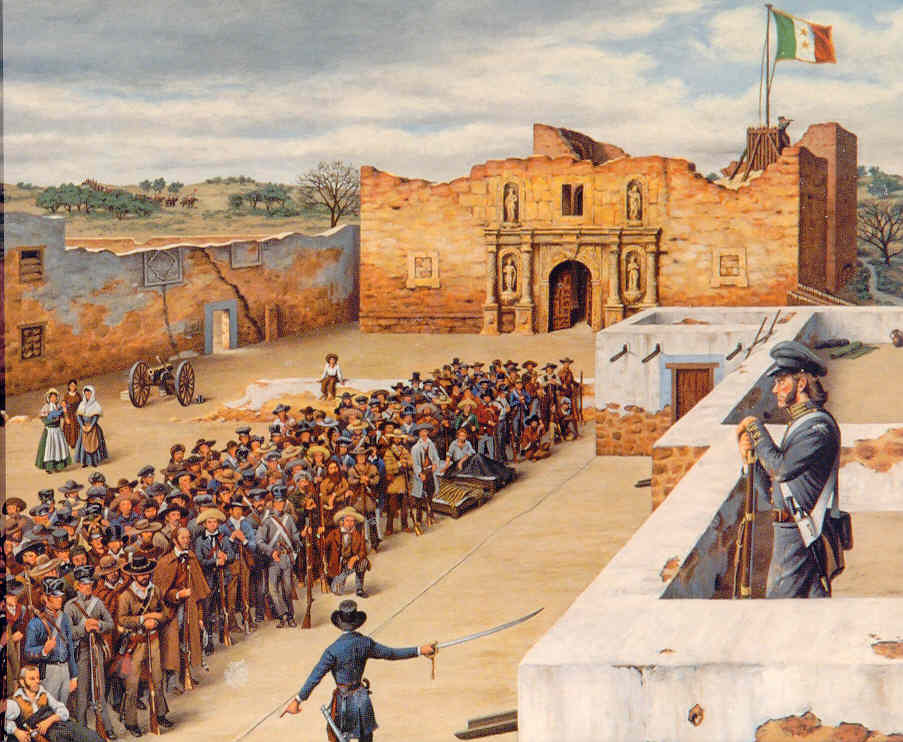
By 2am of March 6, the Mexican soldiers were in there positions. Inside the Alamo, Travis' adjutant, Captain John Baugh of the New Orleans Greys, is walking the perimeter walls. Most of the men have fallen asleep, and not even the kicks of their officers' boots can keep them awake after so many sleepless nights. A north wind blew in, dropping the temperature, the Mexican troops were to remain flat on their stomachs, and had no blankets or greatcoats to warm them. Santa Anna inspected his men one last time, and informed the parish priest of San Antonio, Fr. Don Refugio de la Garza to be prepared to give the last rites.
Around 5am, in the pre-dawn darkness, the bugles sounded, lifting the Mexican army to their feet: 2,500 front line effectives who would make the attack against a garrison of 182, with even more reserves should they be needed. The advance began, silently. Texan sentries posted outside the walls were quietly bayoneted without giving any alarm. The Texans had no idea they were under attack until one exuberant soldado shouted, "Viva Santa Anna!", quickly joined by others along with cries of "Viva la Republica!" The surprise was out and Captain Baugh ran toward his commander's quarters yelling, "Colonel Travis, the Mexicans are coming!".