 |
|
|
|
|
|
|
|
|
|
|
 |
|
|
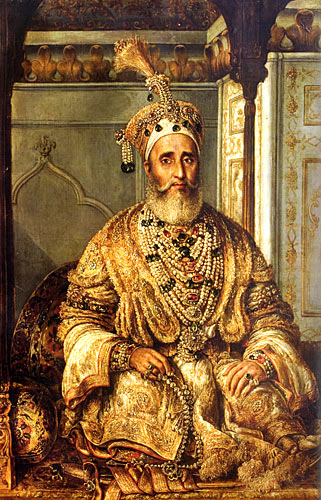
Emperor Bahadur Shah II |
|
| ����������� Bahadur Shah II has the distinction of being the last emperor of the Mughal rulers of India. At one time the Mughal Empire stretched across almost the entire Indian subcontinent and was a successor of the massive central Asian empire of Tamerlane or Timur the Lame, a descendant of Genghis Khan. Starting with Babur who first took control from the old Sultan of Delhi, the Timurid dynasty of the Mughal Empire reached its peak under Emperor Akbar the Great. Shah Jahan was one of his descendants, his most lasting legacy being the Taj Mahal which he built as a mausoleum for his beloved wife. The Taj Mahal remains the most famous Mughal monument though many of the most famous landmarks in India, Pakistan and elsewhere such as the Agra Fort and the Badshahi Mosque were also built by the Mughals. The centuries, however, had taken their toll by the time Bahadur Shah II succeeded his father, Akbar Shah II, the Mughal Empire was confined mostly to the environs of Delhi and little else. |
|
| ����������� The British East India Company had first gained influence working through native leaders and in 1803 they took control of Delhi from the Mughal Emperor Shah Alam II who had already suffered numerous personal disasters. He was forced to become a pensioner of the East India Company and place himself under the protection of the British. At first the British maintained some respect for the nominal monarch but in 1835 the company had become strong enough that it stopped even the nominal position they had previously held as lieutenant of the Emperor, by this time Akbar Shah II. Thus, on September 28, 1838 he inherited a throne which wielded only nominal power and even then it reached only to the area around Delhi. The British East India Company paid the Emperor a pension so long as he gave them no trouble and allowed him to remain inside the Red Fort palace, the walls of which marked the boundaries of his little actual authority. It was a far cry from the Mughal Empire that once stretched across most of India, Pakistan and parts of Afghanistan and Persia. Now there was no doubt that the glories of the empire were in the past and Bahadur Shah had been informed by the Company that his imperial title would die with him. |
|
| ����������� Bahadur Shah had witnessed much of this change in his own lifetime. When he was born in 1775 the British East India Company was only a minor force on the coast with a few factories and outposts in the major cities but by the time he came to the throne at the age of 63 the company dominated the subcontinent. Zafar, his well known pen name, was not an ambitious or a warlike man, yet what he represented was to prove vital to the nationalists of India who desired to throw off the East India Company and restore Indian independence. His reign also saw the last great cultural flowering of the old India and the remnant of the Mughal Empire. Zafar himself was quite famous for his poetry and the new innovations and modern ideas for the west were which had just been introduced were discussed at great length as well as how these new ideas could impact the traditional Islamic and Hindu beliefs of the Indian people. It is ironic that this cultural renaissance came when the empire was effectively on its death bed. That death was to be hastened by the great Indian Mutiny of 1857. |
|
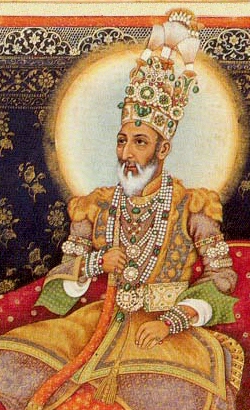
| ����������� Bahadur Shah was hardly in a position to be an effective rebel leader. He was an 82-year-old mystic and poet and certainly not a military commander by any stretch of the imagination. Yet, as the Mughal Emperor, the ruler of the last dynasty which had reigned over a united and powerful India he was naturally the one most people turned to for leadership, even if only symbolic. The Indian Mutiny had been brewing for some time as more and more people became fed up with the rule of the East India Company. The famous spark which ignited the conflict was when Sepoy troops employed by the company for the Bengal army were issued Enfield rifles with paper cartridges greased in animal fat that the soldier had to bite off with his teeth to load the rifle. The Muslim and Hindu soldiers refused as pig fat was considered unclean by the Muslims and cows were sacred to the Hindus and this was the straw that broke the camels back. They feared a conspiracy on the part of the company to convert the entire population to Christianity and a military revolt flared up which quickly spread to the civilian population. |
|
| ����������� The revolt reached Delhi on the morning of May 11, 1857 and the rebels immediately went to the Red Fort palace and clustered under the windows to the apartments of the Emperor and called on him to lead them. Many in the palace immediately joined the rebels but the Emperor took no immediate action. An unambitious man by nature he was sympathetic to the cause of the rebels but rather horrified by the horrific violence that had erupted. He remained rather hesitant the next day when he held his first formal audience in many years to meet with the sepoys and hear their petition. The scene was chaotic and somewhat unnerved the aged monarch but the rebels were adamant that they needed him to take charge of their movement as the only possible figure who could unite all India in the fight for independence. Although greatly troubled by the violence that had already occurred and which was sure to follow Zafar felt it was his duty to comply with their demands and accept their allegiance. In quick order the rebels proclaimed Bahadur Shah II Emperor of Hindustan. |
|
| ����������� When news of this event reached the countryside it caused more Indians to rally to the rebel cause. The European communities went into a siege mentality and many Muslim clerics began calling for a holy war against the British. The Emperor, however, firmly rejected such a move because he feared that to stir up such religious violence would only lead to internal conflict between the Muslims and Hindus of India. Once again the nobles and all sections of society swore allegiance to the Emperor and coins were issued in his name. Nonetheless, some claimed early on that the sepoys had coerced Zafar into allowing himself to be placed at the head of the rebellion. Additionally, his support did not make rebellion more popular with everyone in India. The Sikhs, for instance, turned against the mutiny and supported the British when Muslim rulers endorsed the emperor for fear (probably unjust) that the result would be an Islamic Indian empire. The rebels also had to rely on a rather shaky command structure since events were moving so rapidly. Although the Emperor was the symbolic leader in whose name all fought he did not have absolute control over the forces under his nominal command. |
|
 |
|
| ����������� To command the army Zafar chose one of his sons who had petitioned him to lead the rebellion, Mirza Mughal, who had no real military experience. He set about his duties with zeal and tried to make a formal military out of the disparate band of freedom fighters and provide billeting, provisions and a structured command system. However, enthusiasm is no match for experience and when Bakht Khan arrived; who was a veteran of the British forces, the Emperor placed him in command and gave Mirza the post of quartermaster general. All of this had to be done quickly because the Indian rebels were about to feel the full military might of an alarmed British Empire, fresh from victory in the Crimean War. Troops poured in from all directions; from Great Britain, across Persia from the Crimea and diverted from China and naturally Delhi was a major prize for both practical and symbolic reasons. The British also took particular aim at the Emperor and were determined that their counter-attack would bring a final end to the Mughal Empire which had stood for so many centuries. |
|
| ����������� When the British forces arrived they cut a bloody swath through India as they marched on Delhi, arriving on July 1. The East India Company had a relatively small force to besiege the city with but they had the advantages common to the proud military tradition of Great Britain: experience, training and discipline. For nearly three months the siege dragged on and as more Indian rebel troops arrived they made some attacks on the British but the company forces had little difficulty in driving them off. One of the British officers wounded in such an attack was a young Neville Chamberlain. The lack of any real success despite a significant numerical advantage worried the Emperor and he began refusing offers of help. His own control over the city was rather weak; the rebel forces did not have a great deal of discipline and despite the odds it looked like it was only a matter of time before the British re-took the city. |
|
| ����������� Disease and privation seemed to be doing the British more harm than the sepoys and as other rebellions, such as in the Punjab, were put down more Company forces arrived to reinforce the siege of Delhi. The rebels began sending out peace feelers in August but the company considered their demands unreasonable. The Indians might have regarded the war as a fight for independence but from the British point of view it was a rebellion and those taking part were traitors who could expect little in the way of mercy. Major General Archdale Wilson commanded the British forces and by the end of the first week of September his artillery train arrived and in quick order the British mortars and heavy artillery knocked out the rebel defenses. The rebels were running out of ammunition (all of which had been captured from Company stores) and on September 14 the British launched their assault. The British broke through at the Kashmiri Gate and suffered heavy losses but struggled forward in a week of hard fighting street to street and house to house before reaching the magnificent Red Fort. |
|
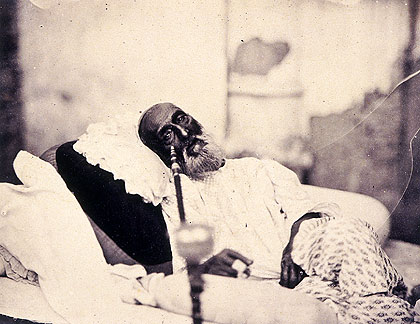
| ����������� By that time the Emperor and his entourage had fled to the Humayun tomb. The British thought he was planning a last stand there and took a cautious approach. However, Captain William Hodson took his native irregular cavalry and rode to the tomb where he demanded that the Emperor surrender. Bahadur Shah first asked if things could not go back to the way they had been before (he had not, after all, instigated the rebellion) but Hodson assured him such an idea was ludicrous but did promise that he would be fairly treated and suffer no indignities if he surrendered immediately. The Emperor agreed and turned over his jewel-encrusted swords to the captain and rode out with great dignity into British custody. The captain remarked later about how regal the procession was and what a calming presence the mere sight of the Emperor had on the public. However, despite the promises made, there was to be no happy ending for the last Mughal imperial family. Bahadur Shah was put on trial by the British who tried to blame the entire uprising on him and paint him as some sort of scheming mastermind who orchestrated the whole mutiny. His three sons, including Mirza Mughal, who were captured with him, were all summarily shot by Captain Hodson who then looted their bodies. Bahadur Shah, after his trial, was found guilty, deposed and exiled to Rangoon in Burma where he lived until his death in 1862. |
|
| ����������� When the last Mughal Emperor passed away his body was thrown into an unmarked grave and the soil was carefully replaced so that in a couple of months there would be no trace as to where his remains were located. Nonetheless, a shrine of sorts stands nearby to this day in his honor as modern India considers him something of an early Indian nationalist and champion of Indian independence. Indians travel to his resting place as if on pilgrimage to the shrine of a saint and there are many public buildings and institutions in India named in his honor. It was a campaign, effectively, to reverse the British portrayal of him after the mutiny as an arch villain. The real Bahadur Shah was probably somewhere between the two extremes. I tend to think he was something of a genuine Indian nationalist. He certainly did not have a great deal to lose at that point and an awful lot to gain. However, he was also a realist who knew a victory over the British would be close to miraculous and as a peaceful poet I think he was horrified by the idea of a bloody war and was undoubtedly disgusted by the actions of even his own nominal followers. He was a victim of circumstances beyond his control from beginning to end, as often seems to be the fate of last emperors and the best that can be said about him is that he had no hand in the worse aspects of the mutiny but a genuine love for his country and was a dutiful monarch even in the worst of circumstances. |
|
|
|
 |
|