


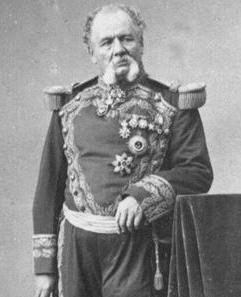


In 1829, as a colonel, Woll served as aid-de-camp to Santa Anna at the battle of Tampico against the Spanish. It was this victory which gained Santa Anna national fame and within a few years Colonel Woll was promoted to brigadier general and awarded the Cross of Tampico for his service. Woll also became involved in the chaotic world of Mexican politics when he joined in the overthrow of the conservative President Anastasio Bustamante in 1832 and helped replace him with General M. Gomez Pedraza. He marched his forces throughout the area around Guadalajara crushing those opposed to Pedraza and putting political allies in their place. In 1835, with the struggle between centralists and federalists boiling over into full scale rebellion he served as quartermaster general under General and now President Santa Anna in crushing the uprising at Zacatecas with considerable brutality.
1835 also brought the start of the War for Texas Independence and the following year Adrian Woll marched north with Santa Anna again as quartermaster general. He arrived at the Alamo two days after it had fallen. From San Antonio he marched with General Joaquin Ramirez y Sesma in the pursuit of Texas general Sam Houston, but in spite of his energetic contribution the surprise attack of the Texans at San Jacinto on April 21, 1863 ended the campaign in Texas with failure for the Mexican army. Woll served as aid-de-camp to General Vicente Filisola who sent him on a phony diplomatic mission to learn the strength and disposition of the Texan forces. He was arrested by the Texans but later released and rejoined the Mexican army as it retreated south. Years later General Woll claimed that he had convinced Santa Anna to rescind his order to massacre the Texan prisoners at Goliad, but that the new instructions arrived too late. Few Texans believed him, doubting that such humanity existed in Santa Anna.
Following the War for Texas Independence, General Woll refused to fight alongside his old commander in the "Pastry War" against France but did return to active duty to fight on behalf of Santa Anna and the centralists against the federalists. He was serving along the border as deputy commander of the Army of the North in 1842 and later that year led an invasion of the Republic of Texas and captured the city of San Antonio. Defeated at the battle of Salado Creek, he nonetheless considered the invasion a success and was hailed as a hero in Mexico winning promotion and a decoration for his leadership. In 1843 he became commander of the Army of the North but later joined other generals in a rebellion against his old friend Santa Anna for which he was imprisoned but ultimately released in 1845. He rejoined the army during the war with the United States, but again would not fight against a country he had once served. Ironically, it was his old commander Winfield Scott who led the United States invasion of Mexico. He left when Santa Anna was exiled, returned with him again during his return to power but left again when Santa Anna was overthrown in 1853.
When he returned to Mexico it was to fight with the conservative General Miguel Miramon during which time he won a number of victories over the liberal forces. Forced into exile once again with the victory of Benito Juarez. When Emperor Napoleon III invaded Mexico, Woll returned with the French forces and was given a top command as well as serving on the council which selected the Assembly of Notables who decided to invite the Archduke Maximilian of Austria to become Emperor of Mexico. He accompanied the delegation which formally offered Maximilian the crown and upon his arrival in Mexico the new emperor made Woll Adjutant-General of the Imperial Mexican Army as well as chief aid-de-camp to the monarch. The French rewarded him with the prestigious Legion of Honor. It was General Woll who drew up plans for the formal organization of the Imperial Mexican Army. He was sent as a special envoy to Napoleon III when Emperor Maximilian had difficulty with the French high command, but upon learning from Napoleon that French troops were to be withdrawn Woll could see the game was up and he never returned to Mexico. He died in France in 1875 having served two republics and two empires in his colorful career.