 |
|
|
|
|
|
|
|
|
|
|
|
|
|
|
|
|
|
|
|
|
|
|
 |
|
|
|
|
|
A Short History of Mexico |
|
|
|
|
|
|
|
 |
|
|
|
The mightiest civilization to arise in the heart of modern Mexico prior to the discoveries of Christopher Columbus was that of the Aztec Indians. The Aztecs were an advanced civilization but very much a warlike one. Most of their learning was acquired from conquered subject peoples and they made extensive use of slave labor taking from those whom they had defeated. Aztec warfare concentrated a great deal on capturing prisoners both for use as forced labor as well as for ritual human sacrifices. Human sacrifices were carried out frequently and often in huge numbers. The Aztecs believed that human sacrifice was necessary just to make the sun rise every day. However, the Aztecs were also skilled builders, engineers and farmers. Their primary city, Tenochtitlan, was one of the largest in the world and rested on an artificial island in the middle of Lake Texcoco which was connected to land by several huge causeways. They used ingenious methods of agriculture and had a complex government, economy and education system. Yet, their brutality towards those they conquered paved the way for their own downfall. |
|
|
In 1519 the daring Spanish conquistador Hernando Cortes landed at the site of modern Veracruz with about 600 Spanish soldiers. He boldly burned his ships so that his men would be motivated to conquer or die and with this relative handful of troops he led the way to the conquest of all of Mexico and about six million Indians. Emperor Montezuma II of the Aztecs did not act decisively to meet the invasion as many thought the appearance of these strange men and beasts was the fulfillment of an ancient prophecy about an Aztec god who would one day return to rule their empire. When Montezuma tried to calm his people after the Spanish entered Tenochtitlan his people stoned him to death and his nephew assumed the throne. He tried to fight the Spanish but was unsuccessful. The Spanish had steel weapons, a few firearms and horses and armor which gave them a significant advantage. More important though was the help of the many Indians who had been subjects of the Aztecs and who were eager to throw off their oppressive rule. By 1521 the Spanish had destroyed the power of the Aztecs and laid the foundation for what would become the Viceroyalty of New Spain. |
|
|
The Spanish put a stop to the human sacrifices, smashed the pagan idols of the Aztecs and erected crosses in their place; tore down their temples and built churches over the rubble. Catholic priests began converting the Indians to Christianity and the Spanish Crown began establishing forts and exploiting the great mineral wealth of the country. The conversion of Mexico was greatly helped when the Blessed Virgin Mary appeared to St Juan Diego, an Indian convert, with a message to build a church on the site of the apparition. As proof, she left her image imprinted on his cloak and this image, known as Our Lady of Guadalupe, on the simple cactus cloth became the most honored and revered religious icon to the Mexican people. After this the conversion of Mexico happened very rapidly. Hailed as the Queen of Mexico, the Virgin of Guadalupe is still the single most significant icon to Mexicans and her devotion is the most widespread. |
|
|
For three hundred years the Spanish ruled Mexico, or New Spain, and stretched her borders from northern California to the bottom of Central America. An intricate social hierarchy evolved with the Spanish at the top, Mexicans of Spanish blood second, Mestizos or the offspring of Spanish and Indian mixtures who were the majority were next while the Indians and the very few African slaves in the country were at the bottom. The Viceroy, who ruled on behalf of the King of Spain was almost always a Spaniard as were the high Church officials and leading military commanders. The Mexicans of Spanish blood were restricted to lower posts and offices while those of mixed blood and the Indians were almost exclusively laborers and peon farmers. |
|
|
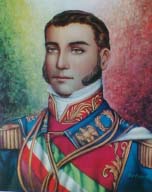
This situation sowed the seeds of discontent and while Europe was dealing with the crisis of the French revolutionary wars an independence movement arose in Mexico. On September 16, 1810 a Mestizo priest, Father Miguel Hidalgo, issued his call for independence and launched a rebellion that resembled more of a race war as his mob of Mestizos and Indians sacked towns and slaughtered Spaniards and Spanish Mexicans. After only a few weeks this peasant rabble was crushed by the Spanish army and Father Hidalgo was executed by a firing squad. However, his cause was taken up by another rebel priest turned soldier, Father Jose Maria Morelos. Yet, he too was defeated and likewise executed in 1815. As long as the movement for independence existed only among the lower classes the struggle was hopeless. Success would require the cooperation of the landed elite, the army and the Church who were all loyal to the Spanish Crown. However, that changed when King Ferdinand VII of Spain was forced to adopt a liberal constitution. The conservatives in Mexico were opposed to this and an alliance was worked out between the liberals and conservatives by a former Spanish officer Agustin de Iturbide. |
|
|
 |
|
|
|
 |
|
|
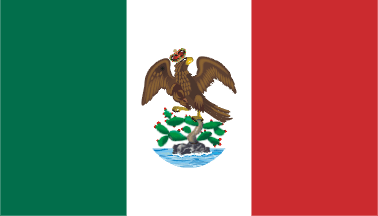
Iturbide united all sections of society, albeit briefly, behind the idea of an independent Mexico that would also be a conservative and church based monarchy. In 1821 the last Spanish Viceroy of New Spain, Juan O'Donaju, recognized the independence of Mexico and joined forces with Iturbide who was crowned Emperor Agustin I of Mexico. Yet, Emperor Agustin ruled for only 10 months from 1822 to 1823 before he was forced to abdicate under liberal pressure and leave the country. When he attempted to return he was executed as soon as he landed. Today it is Father Hidalgo, who actually lost his bid for independence, who is remembered as the George Washington of Mexico whereas Emperor Agustin, the first ruler of an independent Mexico, is mostly forgotten and appears on none of the national monuments honoring independence. Mexico became a republic and one president after another was overthrown and succeeded by another in a long list of coups and conspiracies. Sadly, the list of Mexican presidents consists mostly of power hungry men seeking their own benefit rather than having any genuine concern for the welfare of the people they sought to rule. |
|
|
|
One of the most selfish and arrogant of all the Mexican dictators was General Antonio Lopez de Santa Anna who served as President of Mexico no less than nine times. He had originally been an officer in the Spanish army but joined the rebels when they were clearly the winning side. He supported Emperor Agustin and swore his undying loyalty to him but later was one of the ringleaders in his overthrow and the establishment of a republic. He ran for office on the promise of respecting the rights of the states but once in office declared himself a centralist and ruled as a dictator. In 1835 his action sparked a rebellion in the northern province of Texas where the mostly Anglo population captured all the government posts in the country and even defeated the large Mexican garrison in San Antonio under the command of General Martin Perfecto de Cos who was the brother in law of Santa Anna. The President determined to crush this rebellion and rapidly marched north with an army of about 7,000 men in two columns, the largest under his personal command. |
|
|
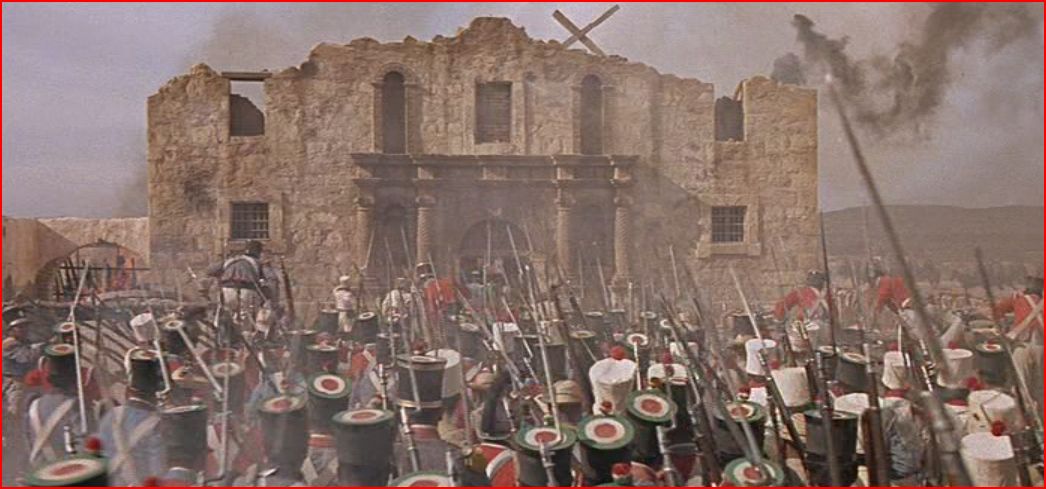
On March 6, 1836 Santa Anna stormed the tiny Texan garrison at the old Alamo mission, taking no prisoners and killing every last man. When the largest Texan force in the field was forced to surrender at Goliad to General Jose Urrea the President ordered that they receive the same treatment. On Palm Sunday around 400 unarmed Texan prisoners were massacred by the Mexican troops. The Texan government and the still assembling army under General Sam Houston were in full retreat north and Santa Anna raced after them in pursuit. However, on April 21, 1836 the Texans launched a surprise attack on Santa Anna, catching him overconfident and off guard. The Mexican army was routed, Santa Anna became a prisoner and the former Mexican state became the Republic of Texas. |
|
|
|
 |
|
|
|
Mexico refused to recognize this new country and sporadic fighting continued for years to come. In 1845 Texas and the United States voted in favor of a treaty that would make Texas part of the Union. Mexico adamantly opposed this and when Texas joined the Union Mexico broke off diplomatic relations with the United States and made another armed foray into south Texas. This sparked the disastrous Mexican American War in which the American army, despite being heavily outnumbered, invaded Mexico and time and again soundly defeated the Mexican armies. Santa Anna came to power again but sold out his country for his own personal gain. The American army captured Mexico City and the Mexican government was forced to make peace. Mexico gave up all claims to Texas and also ceded California, Arizona, New Mexico, Nevada and parts of Kansas, Colorado, Wyoming and Utah though the United States paid compensation for the lands. |
|
|
Even worse than after the loss of Texas the Mexicans now felt humiliated and angry. The government continued to be corrupt and chaotic as liberal and conservative factions battled for control. No one trusted each other and some Mexicans began to favor inviting over a neutral third party from a European nation to be monarch over Mexico and clean things up. This idea was adamantly opposed by the liberal President Benito Juarez who came to power in 1860 following the Reform War in which the conservatives in Mexico were suppressed or driven into exile. Juarez instituted liberal reforms, land redistribution and oppressed the Catholic Church. He also announced that the debts Mexico owed to several European nations would not be paid. This gave the French Emperor Napoleon III a reason to invade Mexico. Many Mexican conservatives had been at his court trying to enlist his help and did manage to gain the full support of his devoutly Catholic wife Empress Eugenie, a Spanish noblewoman. The French soon defeated the Mexicans, drove Benito Juarez from the capital and restored the conservatives to power. |
|
|
In 1864 the Archduke Maximilian of Austria and his lovely Belgian wife Archduchess Charlotte were invited to become the royal couple of a restored Mexican Empire with French support. Young and idealistic, they agreed, thinking that they would transform Mexico into a monarchial Utopia that would prove their noble if naïve ideas were correct to the world. They crossed the sea and were crowned Emperor Maximilian and Empress Carlota of Mexico. However, they were not to enjoy a peaceful reign. Bandits and guerilla troops fighting for Juarez were a constant nuisance. He hid in the deserts of northern Mexico and kept constantly on the move to stay ahead of the French army. The United States would have loved to give more support to Juarez in opposing the French and Emperor Maximilian. Juarez had earlier given the U.S. extensive special privileges in Mexico. However, the United States was then engaged in a fierce civil war of their own with the Confederacy who controlled the Texas border and the Confederates were supportive of the French and the Mexican Emperor. |
|
|
 |
|
|
Things began to change in 1865 when the Confederates were defeated and the U.S. was able to bring her full military and diplomatic pressure to bear on France. Napoleon III withdrew his French forces and advised Maximilian to leave as well since there was no hope of defeating Juarez if he had the military support of the United States. However, Maximilian felt honor bound to stay and fight for his adopted country and share the fate of those who were loyal to him who would certainly be killed by Juarez for supporting the Emperor. The war dragged on but the cause of Emperor Maximilian was clearly lost with Juarez receiving supplies, money and guns from the U.S. and as his side looked to be winning more and more Mexicans deserted the Emperor to pledge their loyalty to the republican cause. At the siege of Queretaro Maximilian was betrayed and captured by the republicans. Although offered the chance to escape he nobly refused to do so and chose to die alongside his generals. On Sunday morning, June 19, 1867, Maximilian was executed by a firing squad at the order of Benito Juarez. His last words were "iViva Mexico!" |
|
|
Following this war traditional conservatism was, for all intents and purposes, dead and gone in Mexican politics. Juarez promised liberalism and democracy but he violated the terms of the very constitution he wrote to stay in power. Once again warlords battled each other for control of the country and eventually it was Porfirio Diaz, formerly a cavalry general under Benito Juarez in the war against the Emperor, who became the dictator of Mexico. Diaz, as a former student of Juarez, knew how to talk about liberty and democracy but he still favored the elites of the country at the expense of the poor and ruled with an iron fist. He encouraged foreign investment in Mexico which helped build up the infrastructure of the nation and he did bring about a brutal style of law and order in what had been a very lawless country. Yet, while the rich became richer the poor were as poor as ever and discontent began to boil over. |
|
|
In 1910 revolution erupted in Mexico and forced Diaz to resign and go into a luxurious exile in Europe. Francisco Madero was the leader of the revolution and he proposed a total reorganization of Mexican society. However, he too was beset by problems both from divisions among the revolutionaries as well as from remaining loyalists of the Diaz regime. Madero was finally killed by a former supporter of his, General Victoriano Huerta. From 1913 to 1914 General Huerta was President and dictator of Mexico. He was very friendly with the German Empire and tried to establish a militaristic Prussian style society in Mexico but he was widely unpopular and ultimately unsuccessful. The United States occupied the port city of Veracruz and the revolutionary bandit Pancho Villa caused chaos on the northern border. In 1914 Huerta was overthrown by Venustiano Carranza who was president for five years. |
|
|
Carranza was opposed by Pancho Villa in the north and Emiliano Zapata in the south. The bandit raids of Pancho Villa even crossed into the United States and provoked a punitive expedition into northern Mexico led by General John J. Pershing. In 1917 a new constitution was adopted but in 1920 Carranza was killed by General Alvero Obregon. In 1924 he was succeeded by General Plutarco Elias Calles of the Institutional Revolutionary Party or PRI. The PRI was a socialist party and was to hold absolute power in Mexico for the next 70 years with the help of symbolic elections which always came back in favor of the PRI. One of the worst early actions of President Calles was a brutal suppression of the Catholic Church in Mexico. This provoked a Catholic peasant rebellion against the government in 1925. The Catholic rebels, known as the Cristeros, were very successful in the countryside but lacked the heavy weapons to take major cities. A stalemate eventually developed and the government eventually concluded peace with the Catholic forces. Unfortunately, once the Cristeros were disarmed the PRI did not honor their promises. The Church was not as actively persecuted as before but it would be some time before anything close to religious freedom returned to Mexico. |
|
|
In 1938 President Lazaro Cardenas ordered the seizure of all oil properties owned by British and American companies. These countries protested, Mexico ignored them and as a result lost considerable overseas markets for their oil. During World War II German submarines sank some Mexican ships and in June of 1942 the Mexican government, under General Manuel Avila Camacho, declared war on the Axis powers. The military was expanded, Axis nation property in Mexico was confiscated and there was even plans for a Mexican Expeditionary Force to be sent to the Pacific front. However, by and large Mexico played no active role in the conflict though Mexico was active in the formation of the United Nations after the war. The next few decades in Mexican history were marked by the economic recovery that often marks the establishment of a stable socialist system in its early stages. However, the inevitable downturn came about quickly thereafter. |
|
|
 |
|
|
The socialist policies of the PRI began to catch up with the country and the economy tanked. Once again Mexico defaulted on foreign loans and despite a bail out by U.S. President Clinton conditions in Mexico fell from bad to worse. Foreign investment was severely diminished because of this because of the realistic view of Mexico as a bad credit risk. At the same time the police state tactics of the PRI attracted more and more criticism at home and abroad and PRI voting manipulation attracted more action from the international community. Mexico tried to put on a brave face for the world but it was to no avail. During the First Gulf War against Iraq the President of Mexico favored sending a Mexican military contribution but was not allowed to due to the fact that the Mexican constitution forbids the deployment of Mexican troops outside the border without a declaration of war from the Congress. Finally, cracks began appearing in the hold on power of the PRI. |
|
|
|
In 2000 the international community monitored presidential elections in Mexico to ensure a fair result. Because of this, for the first time since their seizure of power, the PRI lost the presidency to Vicente Fox of the National Action Party or PAN. The administration of President Fox, the son of American and Spanish immigrants, free trade was emphasized, especially with the United States and Canada. Mexico also began to more actively encourage immigration to the United States, legally or illegally because the money Mexican workers north of the border sent home became the largest source of income for Mexico. The Mexican government was also troubled by powerful drug cartels and liberal, anti-globalization revolutionaries in Chiapas. In recent years, despite limited privatization efforts the Mexican economy remains largely government controlled and the majority of the people remain impoverished. The bloodshed on the border caused by feuding drug cartels resulted in near anarchy along the Texas and Mexico border. The Mexican army occupied the region and for certain periods of time the border was closed at Laredo by U.S. officials. Eventually the problems subsided but controversy over illegal immigration remained as did contested reports of Mexican military forces being seen crossing the border. Whether these were regular army forces, private mercenaries or deserters remains disputed. |
|
|
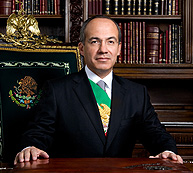
At one point, the power of the drug cartels in Mexico became so powerful that the private schedule of President Fox was compromised and his security seriously threatened. Illegal immigration, security threats and the support of the Mexican government for illegal immigration set off a firestorm of debate in the United States as many Americans began to favor the building of a wall or network of security fence between the U.S. and Mexico. Mexico adamantly opposed this and it soon seemed that opposition to the respect for the U.S. border was the only thing most Mexicans agreed upon. Divisions inside Mexico remain deep. The most recent presidential election in 2006 saw a very narrow victory by PAN but the runner up, Andres Manuel Lopez Obrador of the Democratic Revolutionary Party (PRD) brought back memories from Mexican history by opposing the results and even threatening revolution. There were fist fights in Congress, confrontations in the streets but with the Presidential Guard behind him Felipe Calderon was able to take office and has since consolidated his position. |
|
|
|
 |
|