
|
|
|
|
|
|
|
|
|
|
|
|
|
|
|
|||||||||
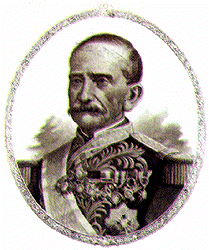
| General Jose Mariano de Salas | |||||||||||
| ��������������� Jose Mariano de Salas was a general, sometime president and loyal conservative in Mexico. He was born in Mexico City on May 11, 1797. From a respectable family he joined the Spanish royal army as a cadet in the infantry in 1813, his first posting being with the Pueblo Infantry Regiment. This was after Padre Hidalgo had sparked the first revolt against Spanish rule and revolutionary activity was rife in Mexico. It did not take long before Cadet Mariano de Salas saw combat putting down rebel uprisings. At the taking of Jalapa in Veracruz he first served with another young officer, Antonio Lopez de Santa Anna, whom he would serve with and under in the future. In 1821 when Agustin de Iturbide, also formerly in the Spanish royalist army fighting the rebels, joined the cause of Mexican independence and issued his Plan de Iguala; calling for a free, Catholic and monarchist Mexico, he endorsed the plan and joined the ranks of the supporters of Iturbide. | |||||||||||
| ��������������� Salas supported Iturbide as the first Emperor of Mexico but his throne survived only a matter of months and after a period of rather chaotic committee rule before Guadalupe Victoria became the first President of the Mexican republic. Guadalupe Victoria (an assumed name meaning Our Lady of Guadalupe Triumphant) was a firm republican who had not supported the Iturbide plan for independence and who instead had backed the Plan de Casa Mata to overthrow the Emperor put forward by Santa Anna. Despite obvious ideological differences, Salas was loyal to the President during the Masonic revolt against the army (or rather the opposing Masonic faction which dominated the army) in 1827. In 1829 he fought against the Spanish invasion of General Isidro Barradas who was trying to restore Spanish control over Mexico. The Spanish were repelled at Tampico with Santa Anna in overall command and this action propelled him to national fame. | |||||||||||
| ��������������� In 1832 Salas was promoted to lieutenant colonel. He survived the chaotic politics of Mexico by avoiding power struggles and simply remaining loyal to his country and the army though never forgetting his conservative principles. �In 1835 a rebellion broke out in Texas and seized control of the region. In 1836 Santa Anna, now dictator of Mexico, marched an army north to eradicate the rebels and purge the Anglo population from the state. At the famous battle of the Alamo Lt. Colonel Mariano Salas was deputy commander of the third column under Colonel Jose Maria Romero which attacked the main gate and the palisade defended by Davy Crocket and the Tennesseans. After the Alamo was taken Salas was sent with other chosen units to reinforce the second army under General Jose Urrea marching up the coast from Matamoros to Goliad. After the battle of Coleto Creek Colonel Salas was one of three who helped convince the Texans under Colonel Fannin to surrender. He fought at Llano Perdido and after the defeat at San Jacinto he commanded the first brigade under General Jose Urrea which included the Queretaro and Jimenez battalions. Salas sympathized with Urrea in opposing the retreat of the Mexican army in Texas but obeyed orders and tried to avoid conflict with General Filisola, in command since the capture of Santa Anna. Salas and his men covered the retreat of the Mexican army as they marched back across the Rio Grande to Matamoros. | |||||||||||
| ��������������� In the years that followed Salas was, like most army officers, caught up in the political chaos and constant intrigues in the Mexican government. Always supportive of strong and stable government he helped suppress a military revolt at the NationalPalace on July 15, 1840 and in 1844 he was exiled from Mexico for supporting General Santa Anna, his old commander in chief and political strongman. However, he was soon back as the threat of war with the United States loomed over the country. Despite his support of Santa Anna, Salas was a federalist, which is one who supports the rights of the states over a powerful central government. As with most issues Santa Anna had flip flopped back and forth on the issue. When the centralist General Mariano Paredes gave the presidency to Nicolas Bravo while he dealt with the latest Mexican rebellion, Salas launched a revolt against him on August 4, 1846 from the Ciudadela in Mexico City. | |||||||||||
| ��������������� Salas immediately proclaimed the era of centralist rule at an end and on the following day, August 5, he was sworn in as President of Mexico. The federalist Constitution of 1824 was immediately restored and Salas called a new Congress. This was the same states rights constitution that the Texans Salas fought against had championed against the centralist rule of Santa Anna whom Salas served loyally. This, however, merely serves to show that, especially regarding the war in Texas or other rebellions, being on a particular side did not necessarily mean that one was totally in agreement with the leader of that cause. Sometimes experience changed opinions and especially when it came to rebellions and the Texas war in particular there were many Mexicans whose nationalism trumped their other political views. Federalist or not, Salas had certainly not lost his nationalism and patriotic love of country that had motivated him throughout his career. Although he sought no power and was openly only a temporary President he got busy as soon as he took power to strengthen the national militia and raise money for troops and munitions in preparation for the looming threat of war with the United States which was expected to annex the Republic of Texas which Mexico still regarded as their own. | |||||||||||
| ��������������� As he had promised (and in a very unusual move for anyone who ever succeeded in taking power in Mexico) on December 23, 1846 Salas gave up his power and turned the presidency over to Santa Anna and the vice presidency to Valentin Gomez Farias who also acted as president for the absent Santa Anna. He returned to his career in the army and in 1847 was promoted to general of a division. When war finally did break out with the United States following the annexation of Texas Salas was once again on the front lines, this time as deputy commander of the Army of the North. His talents were lost when he was captured by the Americans at the battle of Contreras on August 20, 1847, which, if nothing else, showed that he was better than many Mexican generals who never got close enough to the actual fighting to ever be in danger of being taken prisoner. | |||||||||||
| ��������������� Once the war was over, Santa Anna had fled the country and almost a third of the national territory of Mexico was sold to the United States a very disgruntled General Salas was made military governor of the state of Queretaro. Like many, he looked back at the disastrous history of his country since independence, the succession of corrupt politicians and constant rebellions and lost wars and determined that only a return to their basic values would save them. He joined the cause of the conservatives and Catholics who championed taking a hard line against the liberal elements that had been dominating Mexico off and on ever since the establishment of the republic. During the Reform War he backed the young conservative champion Miguel Miramon. When the conservatives proclaimed Miramon President of Mexico it was General de Salas who acted on his behalf from January 21, 1859 until February 2 when Miramon was able to take up his duties, though all the while civil war was raging off and on between liberals and conservatives. | |||||||||||
| ��������������� When the liberals under Benito Juarez prevailed, with the help of the United States and suppressed or exiled all conservative opposition the traditionalist Mexicans turned to France for help. When the French invaded General Salas was made military commander of Mexico City and as a prominent and respected conservative was quickly recruited to participate in the formation of a new government for Mexico. Many Mexicans were calling for a return to their original imperial monarchy under a European prince who could be impartial, with no ties to the corruption in Mexico City and who could come set things right and restore Mexican greatness. Miguel Miramon had spent his exile in Europe arguing for this and with the French victorious in Mexico against Juarez the time seemed right. | |||||||||||
| ��������������� On June 21, 1863 General Salas, who had taken a leadership position in the conservative faction some time before in Mexico City, became a member of the temporary Regency Council of the Mexican Empire. The other members were Archbishop Antonio de Labastida and another revered national hero and fellow veteran of the war in Texas General Juan Almonte. This council was to hold executive power under the protection of the French army until a new Mexican Emperor could be found and installed in Mexico City. It was this council which sent Gutierrez de Estrada and his delegation to offer the Crown of Mexico to the Austrian Archduke Maximilian von Hapsburg. Gutierrez de Estrada had been lobbying in Europe for some time for help in creating a Mexican monarchy. In 1854 the then dictator General Santa Anna had sent him to deal with the courts of Paris, London, Vienna and Madrid to find a European prince who might be willing to become a Mexican monarch. Earlier, also with the help of the French, Estrada had offered the throne to the Duc de Montpensier, who refused it. Miramon had confirmed the mission of Estrada, he approached the Archduke and Maximilian accepted the offer. | |||||||||||
| ��������������� On June 12, 1864 when Maximilian was proclaimed Emperor of Mexico the Council of Regency immediately lost its reason to exist. After Maximilian and Carlota came to take up their crowns Salas remained on as a general in the Imperial Army though he was too advanced in age by this time for field service. Nonetheless, he held a respected position in society for his patriotism and for the courage and wisdom he displayed in the past in holding his country together in times of crisis. He died at his home of Villa de Guadalupe in Mexico City on December 25, 1867, outliving his Emperor by about six months. | |||||||||||
|
|||||||||||