 |
|
|
|
|
|
|
|
|
|
|
|
|
|
|
|
|
|
|
|
|
|
|
|
 |
In Honor and Defense of the Tradition of Bullfighting |
|
|
|
|
|
|
|
 |
|
|
|
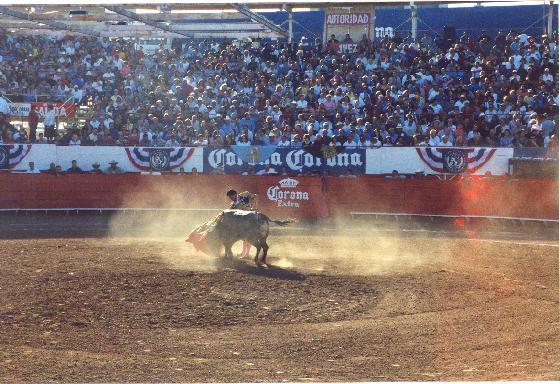
I will not deny it, I am an avid fan of the imperiled sport of bullfighting. When the new season started (Feb, 2008) in Nuevo Laredo, Mexico it was pointed out that this was a local tradition going back about 400 years and it continues today. Nothing can compare to the thrills and skills on display at a traditional bullfight. There is the skill, speed, grace and agility of the matador pitted against the fury and brute force of a 2,000 pd wounded, angry bull that was born and bred to be a killer. I believe it was Ernest Hemmingway who said that the only real sports were rock climbing, racing and bullfighting --all the rest were just games. I agree with Ernie and I fail to see how anything can compare in excitement to a tradition Spanish bullfight which, despite falling on hard times, is still a force in Mexico. In fact, bullfighting may be more widespread in Mexico than it is in Spain these days thanks to the opposition of fanatical "animal rights" groups.
There is no denying the fact that bullfighting is a bloodsport and it is not for the faint-hearted. Because of this, it has come under criticism by the aforementioned "animals rights" organizations. However, it is often forgotten that more acts of violence and terrorism have been carried out by animal and environment activists than by any other group! The fact of the matter is that cattle are not an endangered species (in fact some environmentalists claim that cattle are harmful to the atmosphere) and I would say that the toro bravo who fights to the death in the ring has died in a more noble way than other bulls and cows that are simply bashed in the head and cut into steak. Fighting bulls go out in a blaze of glory to the cheers of the crowd while most cattle go out in an assembly line style execution. "Animal rights" extremists will go to absurd lengths to sway public opinion. Some say, for example, that bulls are often paralyzed but still conscious when their ears and tail might be cut off for trophies to present to an exceptional matador! And how do they know if the bull is conscious or not?!!!
Bulls in the ring at least have a fighting chance and can win a match and live to fight another day. However, the radical activists are doing all they can, even infiltrating the public schools with their message to turn children against something that has been part of their culture and heritage for countless centuries. However, they are the ones who are being the most cruel by trying to put animals, born and bred to fight, against human beings; even the very children in those schools. Even with the downturn in popularity in recent years the art of bullfighting is still a major attraction in Mexico and many, many tourists go across the border to Tiajuana, Juarez, Nuevo Laredo and elsewhere to attend the bullfights and spend badly needed American dollars there. In a country as poor and cash-strapped as Mexico it is downright cruel to try to destroy one of the few spectacles that still draws badly needed tourism to the struggling border towns of northern Mexico. The recent violence along the border has been bad enough for business, why should Mexicans sacrifice one of the few things that still draws American money into their economy just for the sake of some bad tempered bulls that would just become hamburgers anyway? |
|
|
|
 |
|
|
|
 |
|
|
|
|
|
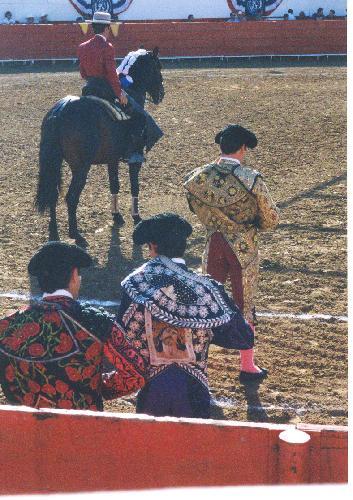
For those unfamiliar with the greatest sport in the world, I will explain the basics of what happens at a traditional bullfight. Warming up events vary from place to place but usually there are some races, cockfights and/or a game of fools soccer before the main event begins. The fun starts when the bulls, los toros bravos, enter the ring, usually to the great cheers of the crowd as the announcer reads out the ranches that bred them. Keep in mind these animals would be incapable of any life but this one. They have been bred for many, many centuries to be ferocious, fighting bulls. The trumpets sound and in ride the guys most everyone loves to hate (except me, I marvel at them): los picadores! On their massive, blindfolded, heavily padded and armored horses with their long lances their job is to wound the bull around the neck so as to make it difficult for the animal to sling its head and be an even greater threat to the matador as well as to infuriate the animals. After their time is up, the horns sound and the picadores exit the ring. Next come the banderilleros who stick the bulls with large, barbed darts to wound the animal around the neck and shoulders and make it even more angry (*this also benefits the animal as the loss of blood causes his blood pressure to go down and prevents the animal from having a heartattack in the excitement). Finally, it is time for the matadors to go to work and display their skill and courage in the final act. They tease the bull into charging them while avoiding being gored through speed and distraction. If all goes well they exhaust the bull and finally deliver the death blow. Every matador is judged by how well he does this and goal is to make the death and quick and clean as possible, using their sword to cut the aorta. Matadors who perform well may be carried out on the shoulders of the crowd and presented with ears or the tail of the bull as trophies. If the bull put up an exceptionally good fight he might be dragged around the ring one last time to the cheers of the crowd. |
|
|
 |
|
|
Everything about the bullfight is steeped in ancient tradition and ritual from the elaborate costumes the matadors wear to the prayers they recite beforehand and usually pin inside their clothes. These colorful outfits are part of their test of endurance as well as they have to endure extreme heat during the fight. Lately there has been a great deal of controversy over children participating in bullfights in Mexico where there is no age limit on who can train and compete in the ring. Personally, I would oppose children actually going up against a live bull until they are of legal age but I would also point out that to date no child has ever been killed or even badly hurt in a bullfight. The same cannot be said for American children, for example, who play football or hockey every year in the United States. I see nothing exceptionally cruel about bullfighting at all. I've been in the cattle business all my life, I like animals and I don't like to see people being needlessly cruel to them. However, I do not place any animal on the same level as a human being. Cattle are raised to be killed whether for food, leather etc as in most cases or for entertainment as in the case of fighting bulls. Since a number of Latin American countries have given in to pressure groups and abolished bullfighting I am proud of Mexico for taking the lead in keeping this ancient Iberian sport and art form alive in the Americas.
To relate this issue to that of most of the rest of this website, I will relate a popular story about the first time the Mexican Emperor Maximilian attended a bullfight. He was greeted by the wild cheers of the crowd as he entered the royal box, waving to his adopted people as they shouted, "Viva Maximiliano! Viva el gran Emperador!" In fact, when the event got underway, Maximilian seemed just as interested in watching the crowd as he was the actual bullfight. He noticed that when the bull got the best of the matador the crowd cheered the animal with shouts of "Viva el Toro!". However, once the animal had been wounded and began to falter the Emperor saw the very same people start to shout, "Mata el toro!" (kill the bull!) and this rather worried him. Things were going well for him and his government at the moment and he was cheered wherever he went just as he was when he arrived at the bull ring. However, he wondered whether when he got into trouble, if the fortunes of war turned against him, if the same people who had shouted "Long live the Emperor" would also switch to shouting "kill Maximilian!" |
|
|
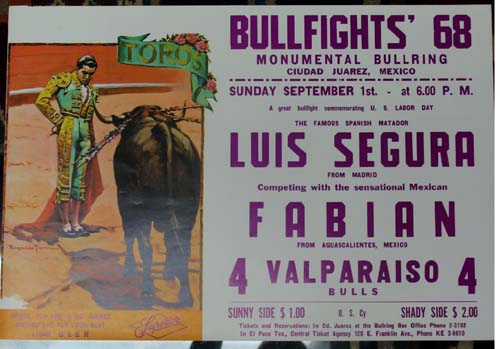
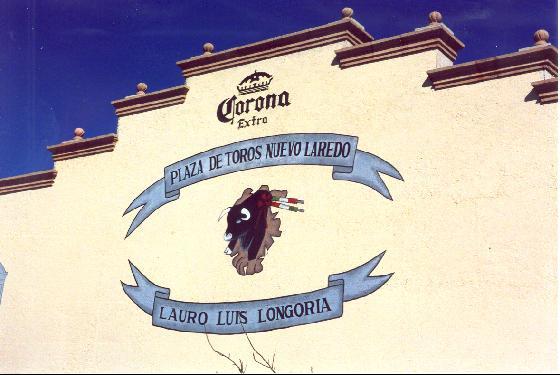
Whether or not this actually happened, I cannot say as there are many, many stories about Emperor Maximilian in the folk legends of Mexico floating around. However, it does show how much bullfighting is interwoven with the history, culture and traditions of Mexico as with the Iberian culture as a whole. It is a magnificent spectacle, the most thrilling sport and an artform that requires as much timing, grace and agility as any ballet. The day Mexico turns its back on the ancient sport of bullfighting is the day that Mexico has truly forgotten herself and where she came from. However, I will hope that day never comes and continue to view, support and argue for bullfighting even if there is only one avenue for it still open in my area. That is the "Lauro Luis Longoria" arena in Nuevo Laredo, Mexico and if anyone happens to be going there I would recommend seeing a bullfight. I would also recommend reserving your tickets early to avoid standing in line in the heat and paying a little extra for seats in the shade as, believe me, even in February the sun in northern Mexico can be brutal.
(*interesting fact: the shout "Ole!" during a bullfight was actually picked up from the Moors and comes from the word "Allah") |
|
|
|
 |
|
|
|
|
|
 |
|