
The French had landed troops in Mexico as part of an international punitive expedition launched alongside Great Britain and Spain to force the government of Benito Juarez to pay its foreign debts; which he had earlier defaulted on. New promises were made and the British and the Spanish quickly withdrew. The French, however, stayed and planned to expand the conflict in Mexico for a variety of reasons. Mexican conservatives had long been lobbying European powers to intervene in Mexico to restore order from the chaos of one coup d'etat after another which had become common policy in Mexican government as well as to restore some balance to the political system which had been upset since the victory of the liberal Juarez in the Reform Wars after which the conservative voice in Mexico had been destroyed, suppressed or forced into exile. In any event, the result was a liberal tyranny. The Empress Eugenie of the French was also particularly moved by the plight of the Catholic Church in Mexico where Juarez had seized Church property, attacked Churchmen and at one point even attempted to set up his own puppet pope in Mexico. Her husband, Emperor of the French Louis Napoleon III, also had his own ambitions; seeing an opportunity to gain the mineral wealth of Mexico, win laurels for the Second French Empire and gain an ally and foothold for France in North America.
As a result, an "entrada" as the Spanish once called it, was launched under the command of the French General Charles de Lorencez numbering about 6,000 men consisting mostly of light infantry, zouaves and marines which some artillery support. In command of the Mexican forces opposing Lorencez was General Ignacio Seguin Zaragoza; one of the best the Mexican nation had to offer. Zaragoza was a native Tejano (Mexican Texan) having been born at the Texas town of Goliad in 1829. His father was an infantryman in the Mexican Army during the Texas War for Independence and when Mexico lost that war he moved his family south of the Rio Grande. Young Ignacio considered being a priest and spent time in a seminary before deciding that the priesthood was not his vocation. Joining the army, like his father, he led the opposition to the dictator Santa Anna and restored the prior form of consitutional rule to the country. He supported Juarez in the Reform Wars against the conservatives and was rewarded with the post of Minister of War and Marine in 1861. He was an obvious choice to command the forces opposing the French invasion; which had the support of many Mexican conservatives and assorted traditionalists.
This is important to note when considering the battle of Puebla because today one assumes that this was simply Mexican patriots opposing French conquerors. However, many Mexicans had long desired some foreign power to deliver them from the corruption and chaos that had gripped their country virtually since independence. It is worth considering that even in these early stages when the French fielded only a small force of light troops that they usually outnumebered the Mexicans who had the numbers on hand to have easily outmatched the French at every turn. Few people today bother to ask the question of why so few Mexicans seemed to have been willing to fight in the service of Juarez against the French and later and the Mexican imperial armies. Nonetheless, General Zaragoza was determined to resist the French with what he had and after an initial defeat in April he established a defensive line at Puebla which lay along the natural invasion route toward Mexico City where he knew the French were headed. His army consisted of roughly 3,000 Mexican soldiers. However, though Zaragoza commanded possibly as few as half the numbers the French had, Puebla had long been a stronghold of the liberal Juarista forces and was heavily fortified.
General Zaragoza entrenched his forces between the fortresses of Our Lady of Loreto and Our Lady of Guadalupe and waited for the French to come to him. General Lorencez, however, after his initial victory over Zaragoza was overconfident and too willing to believe reports that were favorable rather than being realistic. He believed that Puebla was full of people who had long opposed Juarez and the liberal forces since they had taken control of the city in the Reform Wars. He was convinced they would greet his French troops as liberators and that it would take very little effort on his part to secure this key fortress city (doesn't this sound familiar). Of course, he should have known better than to believe that the Mexicans would have failed to make their best effort to defend so strategic a position. This overconfidence was to cost the French dearly. Moreover, the weather had been very bad of late and had bogged down the French army in their advance and gave extra time to General Zaragoza to better prepare his position. Finally, on May 5, General Lorencez was ready to make his attack.
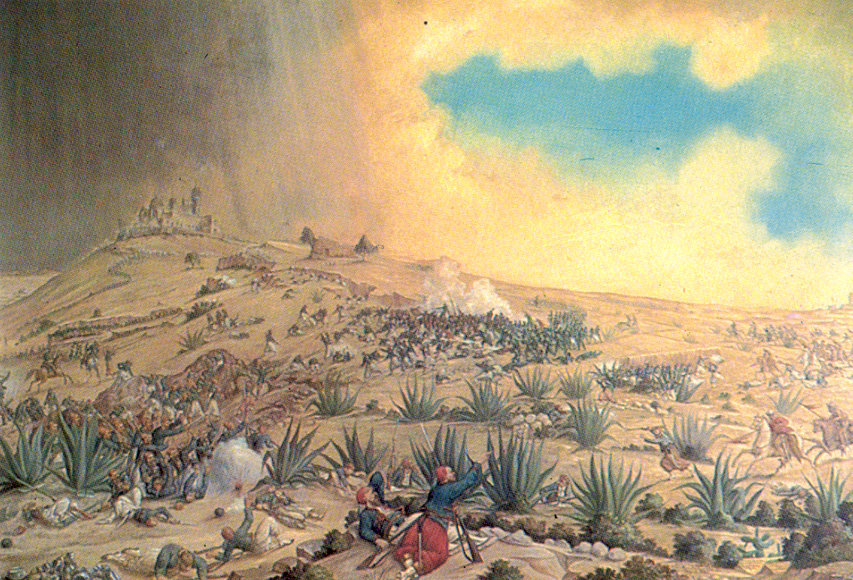
However, the French effort seemed to be botched from the begining. Lorencez did not have a very accurate assessment of his own strength and started his opening artillery strike sooner than he should have. Several of his officers had, in fact, warned him against assaulting the Mexican position in such a reckless fashion but he paid them no heed, convinced of his own superiority. At midday he gave the order to send in the infantry. The French charged bravely forward but were met by blistering Mexican rifle fire and the guns of Ft Loreto. The initial wave was repulsed and Lorencez was forced to send in a second wave to support them. These too became heavily engaged against the Mexican defenders and were soon calling for assistance. The French were forced to make a third attack, throwing in all of their reserves in what had by then become a frantic effort to break the Mexican lines. However, because he had not taken stock of his artillery and had started shelling too early Lorencez's guns ran out of ammunition and so were unable to cover the third, and final, French assault. The result was a disaster for the French troops sent forward in a gallant but futile, unsupported and bloody charge.
The result was to be expected. With no cover, the French attack was blunted and soon the French forces were forced to fall back all along the line. Then, at the crucial moment, General Zaragoza launched what he hoped would be the killer blow. Waiting for just such an opportunity he let loose his cavalry and a reserve infantry force he had hidden from view to sweep around and attack the fleeing French on their flanks. Some have argued that Lorencez could have saved the situation, and others that Zaragoza could have destroyed the French force entirely but we will never know since by the end of the battle the skies opened and the rain began to fall again; bogging down both armies and bringing an end to the action. The French retreated having lost nearly 500 men killed and over 300 wounded compared to only 83 dead and a little over 100 wounded for the Mexicans. Lorencez thought he might provoke Zaragoza into making the same sort of costly attack he had made but the young Mexican general would not take the bait and remained entrenched in Puebla. Finally, he gave up and took his battered expeditionary force back to Orizaba. General Zaragoza, on the other hand, was hailed as a hero and, as we know, President Juarez declared the 5th of May a holiday to be honored from that time on to remember the victory of his army over the French.
Yet, despite the years of celebration since, this was really an illusory victory for the Mexican forces of Benito Juarez. The disaster only alarmed the French and convinced Napoleon III that he needed to take the situation more seriously and soon nearly 30,000 crack French troops were on their way to Mexico to take revenge for the defeat on the 5th of May. When the next offensive came, things would go very differently for Benito Juarez and the Mexican republicans. General Zaragoza died of typhus shortly after his brilliant victory over the French and the next time the French generals would be better and the liberal Mexican generals would be worse. In the following year, 1863, not only did the French take the fortress city of Puebla, they continued on and captured Mexico City, breaking up the Juarista government and forcing the President to flee into the wastelands of northern Mexico. A new interim government was set up under the conservative Mexican General Juan Almonte which began to undo what Juarez had done and which, soon thereafter, held a referendum on the restoration of the monarchy and sent the formal invitation to Archduke Maximilian and his lovely wife Carlota to become the Emperor and Empress of Mexico. So, all in all, while Cinco de Mayo was a brilliant victory for the liberal Mexican forces, it was just a battle and not the war and ultimately was only a prelude to the victory of the French, the defeat of Benito Juarez and the coronation of Emperor Maximilian of Mexico in 1864. Benito Juarez would have to wait two more years for a Union victory in the American Civil War and the evacuation of French imperial forces, to restore himself to power and have his revenge on the hapless Hapsburg who bravely remained behind to die with his loyal Mexican generals.