 |
|
|
|
|
|
|
|
|
|
|
|
|
|
|
President Benito Juarez: Great Statesman or Typical Mexican Power Politician? |
|
|
|
 |
|
|
|
 |
|
|
|
|
|
|
|
|
|
|
|
|
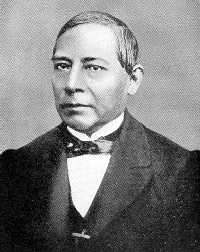
There is no denying today that the name of Benito Juarez is revered throughout Mexico as no other political figure ever has been. He is almost unanimously hailed as the greatest political figure in Mexican history, someone who is sacrosanct and anyone who questions his preeminent status should be prepared to be considered a traitor. In his own time he was called (by northern Americans) as the Mexican equivalent of Abraham Lincoln and that comparison still holds today. Much like Lincoln, President Juarez is arguably even more famous and revered than the man who secured Mexican independence or who was the first Mexican president. In many ways this makes any honest assessment of him difficult, however, it also does him some harm. Anyone deified to such an extent as Benito Juarez is in modern Mexico will be unable to live up to their lofty image and the cracks will stand out all the more if anyone only has the courage to reveal them. |
|
|
All of this is not to say that Benito Juarez was not an important figure. He certainly was and no matter how he is portrayed his life story is extremely significant. His victory in Mexico was the end of one era and the birth of another. He was the first full blooded American Indian to lead a nation in the Americas pretty much since countries were first established in the New World by European powers. He presided over two very significant conflicts in Mexican history and set the stage for all that followed. That is especially significant since, for some time after his very long hold on power, those who succeeded him often did so on the basis of being one of his camp and they encouraged the cult of Juarez in order to benefit from it as inheritors. This eventually led to the odd situation where a former general in the army of Juarez, hailed as the champion of liberalism and democracy, became one of the most famous dictators in modern Mexican history. But how does the popular image of Juarez measure up to the facts of the man Benito Juarez? The answer is probably not what most Mexicans would expect or even want to hear. |
|
|
Benito Juarez was born in Oaxaca in 1806 when what is now Mexico (and the southwest US and California) were part of the Viceroyalty of New Spain. When he was young he was illiterate and could only speak the language of the Zapotec Indians. After herding sheep for a time he moved to the city to become a house servant and pursue an education. A third order Franciscan took a liking to him and arranged for him to enter the seminary. In the end he decided to become a lawyer rather than a priest and did so in 1834, later becoming a judge. He eventually became an important and popular man and served as Governor of Oaxaca from 1847 to 1853 when his opposition to the dictatorship of General Antonio Lopez de Santa Anna forced him to leave Mexico and take up residence in New Orleans. In these early years of his political career it is important to understand the context of what was happening in Mexico. General Santa Anna was a very shifty figure who had overthrown both liberal and conservative presidents while standing as the champion of whichever side was not in power and offered him the chance to be. However, on the whole, correctly or not, Santa Anna was seen as the leader of the conservative, land-owning, Catholic Church, military faction in the country. Off and on for more than two decades Santa Anna was the most powerful man in Mexico and early on was the primary enemy of young Benito Juarez. |
|
|
While living in New Orleans the former Governor of Oaxaca worked in a cigar factory while planning an eventual political comeback with other exiled liberals and enemies of Santa Anna. He helped to come up with the famous Plan of Ayutla which called for the overthrow of Santa Anna and the establishment of an assembly to draw up a new constitution along the lines favored by the liberals. Again, to keep in context, Mexico first became independent in 1821 as an imperial monarchy under the former general Agustin de Iturbide. The regime did not last long (partly due to a young Santa Anna in his first act of duplicity) and the result was the republican constitution of 1824. This was modeled in part after the US constitution and lasted for about ten years when General Santa Anna, after becoming president and dictator, tore it up; an action which helped provoke the War for Texas Independence in 1835-36 which Santa Anna ingloriously lost. Mexico had been in a rather chaotic state since then, even by her own standards, and the Plan of Ayutla was the vision of the liberal party for what was to replace this confused situation. This was sure to set off trouble with the conservatives of Mexico who certainly had a different vision of what the country should be than Juarez and his fellow liberals did. |
|
|
In 1855 the situation fell apart when Santa Anna resigned from office and went into exile once again. Many of the conservatives had turned against him, but their popularity was still tainted by their former association with the man. It must be remembered though that very few conservatives were ever very enthusiastic about Santa Anna but regarded him as simply being someone who could keep order, fight for the integrity of the nation and who they regarded, more or less, as a necessary evil. Nonetheless, perceptions matter, even in a country like Mexico where real and fair democracy is something of a novelty even today. With Santa Anna gone in 1855 Juarez returned to Mexico and joined with the liberal elite who took power, declared an era of reform and organized a provisional government under General Juan Alvarez while their new constitution was being drawn up -by Benito Juarez and liberals of his thinking. While in power the liberal enacted many sweeping changes at the outset, mostly aimed at weakening the Mexican army and the Roman Catholic Church. Their stated goal was to modernize Mexico and, significantly, to create a capitalist federal republic very similar to the United States and quite apart from the more corporatist pattern of the conservatives who still held on to the traditional laws and privileges inherited from Spain. New laws were enacted that abolished the right of a court martial for soldiers and courts of canon law for Catholic clerics. Finally, in 1857, their new constitution was completed and enacted in a new administration led by President Ignacio Comonfort in which Juarez served as Chief Justice in the newly instituted Supreme Court. |
|
|
The new government and constitution contained many elements that were anathema to traditional conservatives such as withdrawing government recognition of titles of nobility, hereditary honors, removing the Church from education and making it a secular, government domain, secularizing marriage, doing away with religious holidays, prohibiting official Church attendance, confiscating vast amounts of property from the Church and the landowning aristocracy, removing all of the former recognition and status of the Catholic Church as the established religion and reiterated the previous laws abolishing special courts for soldiers or clergy. A new legislature was established that consisted of a single house of directly elected members, a rather weak presidency but which was in most other ways very much like that of the United States. There were guaranteed freedoms of speech, assembly, press, conscience, gun ownership and mandated state governments that had to be republican as well as the institution of the Supreme Court. A difference that would be important later was the limitations to the power of the president, the abolition of the death penalty as well as the stipulation that a president could not succeed himself once his term was over. Every one of those would become even more significant later under Juarez. |
|
|
Obviously, as had always been the case in Mexico, the other side of the political divide was not about to take these changes handed down to them without resistance and the conservative, Catholic, military faction soon rose in rebellion under General Felix Zuloaga. President Comonfort, who was more moderate than Juarez, tried to forestall civil war by dissolving the Congress and forming a new cabinet with some conservative members. However, as long as the new constitution and laws remained the conservatives were not about to give up and at the start of the following year (1858) they rose up again and declared Zuloaga President of Mexico. The overwhelmed Comonfort recalled Congress but then promptly emptied the jails and resigned from office at which point (as per the new constitution they had just put in place) the Chief Justice Benito Juarez became President of Mexico (in opposition to Zuloaga) and began prosecuting the so-called Reform War between the liberal and conservative factions. The liberals always like to say that Juarez was the true democratic President fighting against the un-elected Zuloaga but the fact of the matter is that neither of them were elected and Juarez only assumed office on the basis of a new set of rules that had never been agreed to by a majority of the entire nation. |
|
|
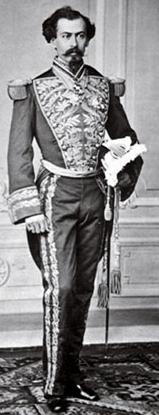
Zuloaga set up his government in Mexico City and repealed the liberal laws against the Church and other old Spanish privileges while Juarez set up his own administration in Guanajuato. The war was fierce and soon exhausted the national resources as well as the public strength of Mexico. A major boost for the liberals came in 1859 when the United States officially recognized the government of Benito Juarez as their favorite to rule Mexico. The conservatives, by then under the leadership of the young General Miguel Miramon, tried to reconcile at that point but the liberals were not about to quit with the dominant North American power now officially on their side. In December, 1860, the liberal army under General Jesus Gonzales Ortega defeated General Miramon in the final major battle of the war and cleared the way for Juarez to march in triumph into Mexico City as the undisputed president. Juarez had already called for new elections as his own constitution was working against him as he had assumed vast powers on the basis of a national emergency and his legal term of office was being stretched past what the letter of the law entailed. |
 |
|
|
It is also important to note just how Juarez was able to win the war against Miramon and the conservatives. He did so by the government seizure of property (mostly Church property) and to a large extent because of the support and intervention of the United States. The biggest symbol of this is the often overlooked McLane-Ocampo Treaty which any modern Mexican would surely consider as a selling out of Mexican sovereignty to the United States and which any American president would be promptly impeached if he ever even dared to discuss such a thing for the US. The treaty stated that in return for a payment of four million dollars to the Juarez government the USA would receive perpetual rights of transit across the isthmus of Tehuantepec, protected trade routes in certain areas and ports on both coasts, the right of the US to intervene militarily at the request of Mexico if trade is threatened or even without the request or permission of Mexico if there is an emergency, Mexico gave the US the right to send in military forces on these transit routes as they saw fit, Mexico promised that no other nation would be given the same privileges and Mexico would effectively be under the military protection of the United States. The American plan was to eventually construct a railroad across the Tehuantepec isthmus or a canal and thus make vast amounts of money on the lucrative trade with and through Central America (a sort of forerunner of the Panama Canal idea). The extent of this treaty was never completely formalized but it nonetheless demonstrates something which would shock any patriotic Mexican; that is that Benito Juarez was willing to totally sell out the sovereignty of Mexico to the United States for four million dollars to ensure victory in a war against his own people. |
|
|
|
|
|
conservative president and general Miguel Miramon |
|
|
|
|
That was the background for Juarez occupying Mexico City for the first time in January of 1861. He then claimed to be the properly elected president after an election which was conveniently held under the constitution of 1852 and which was done after the conservatives had been defeated in battle and all of their leaders killed, imprisoned, forced into hiding or chased into exile; still not exactly a fair example of democracy in action. With the country in ruin and the government bankrupt it was then that Juarez announced he would default on all foreign loans which greatly upset European powers like the Kingdom of Spain, the French Empire and the British Empire. The United States was still his biggest ally but with their own country plummeting into civil war they could offer little assistance and by the end of the year Spanish troops from Cuba had landed in Veracruz, followed soon after by expeditionary forces from Britain and France to force Juarez to pay his debts. Knowing an open confrontation would be futile he promptly promised to pay again and the Spanish and British withdrew, but as we all know, the French did not. |
|
|
The exiled conservatives, especially Miguel Miramon, were lobbying in Europe for aid in establishing a monarchy in Mexico; something which had been going on for quite a while actually. Gutierrez de Estrada had been sent to Europe some time before by Santa Anna to advocate such an enterprise. Empress Eugenie of France provided a great deal of support in pushing her husband Napoleon III to intervene on behalf of the Catholics of Mexico of whom Juarez was an avowed enemy. Not only was Juarez a mason who had secularized the country and nationalized Church property, at one point he even attempted to set up his own government ruled church in Mexico with a pliant bishop as the national pope but his plan was thwarted when Pope Pius IX refused to ordain the man and forbid any Catholic to go along with such a move and even among those most inclined toward the liberals the common people were overwhelming Catholic and would not go along with outright break with Rome along the lines of King Henry VIII and his Church of England. Thus Mexico was soon at war again between Juarez and his liberal republicans on one side and the French and conservative Mexicans on the other. |
|
|
When the French first attempted to advance into the interior they were defeated at Puebla by a republican army on May 5 which Juarez declared a national holiday forever after. However, this was a short lived victory and Napoleon soon sent more French troops, took Puebla and drove Juarez out of Mexico City. Before fleeing, however, the liberal controlled Congress granted Juarez dictatorial powers for the duration of the national emergency. To the unbiased eye in might seem rather odd for the self-proclaimed champion of democracy and republicanism to be granted absolute power for the second time in an over extended presidency to which he was never fairly elected by a majority of all people. However, an even more significant action by Juarez had already taken place when he issued an order in 1862 that any foreigner taken in arms in Mexico would be shot, any Mexican opposing his regime taken prisoner armed would be shot and any Mexican citizen who gave any aid to any of these people would also be shot. Today history still condemns Emperor Maximilian for his "Black Decree" of October 1864 which stated that any rebel taken in arms would be shot within 24 hours. However, very few historians are honest enough to relate that Juarez had issued a far worse decree years earlier, which violated his own constitution and which meant death not only for all prisoners of war but even for any citizen who so much as gave them food or water! This is the side of the Juarez regime that is never talked about. In any event, with the French and conservatives in power in Mexico City and expanding their control rapidly Juarez was forced to flee further and further north into the barren deserts of the Mexican frontier. He still claimed to be the leader of the legitimate government, but his was a government on the run that held power only where his forces marched. As the French and Mexican conservatives gained control of more and more of the country he was forced to order his troops to stop fighting pitched battles and to focus only on harassing actions to the point that the republican armies became little more than scattered groups of bandits. |
|
|
He appealed for help to the United States, who naturally favored him considering that he had already displayed his willingness to sell out his country to American interests but considering that the US was by then engulfed in a desperate fight against the southern Confederacy which had declared its own independence they were in no position to help. The US Congress did vote a unanimous condemnation of the French presence in Mexico and the establishment of the monarchy under Maximilian, but even here the unanimous support for Juarez must be taken with a grain of salt considering that not all states were represented in the US Congress since the secession of the southern states and the formation of their own country. The southern states were very friendly toward Emperor Maximilian and even proposed a treaty between the two governments in which the Confederates promised to recognize the government of Maximilian and support his war against Juarez and his insurgents in return for Maximilian recognizing the Confederacy and pushing for France to do the same. Maximilian favored such a move, but though Napoleon III desired a southern victory as well, at that particular time he had lost interest in the American civil war and no action was taken. |
|
|
Juarez was pushed north from city to city until settling into the most permanent of his many capitols at Chihuahua City. As usual, Juarez turned to the United States for help and sent General Placida Vega y Daza to California to try to raise support. Throughout the northern states of the US republican clubs sprang up to raise money for Juarez, partly because he was seen as their man south of the border and also because his enemy was Emperor Maximilian who was seen, along with Napoleon III, as the unofficial allies of the southern Confederacy. He was desperate for foreign assistance even while condemning the foreign assistance of his enemies. Likewise, Juarez spurned all efforts by Emperor Maximilian to end the war and reconcile the country. The Emperor sent him an offer of clemency and pardon for Juarez and his followers but Juarez refused. Maximilian even sent Juarez a message offering him the post of prime minister as leader of the government of the empire which Juarez also refused. He took comfort in the fact that as long as he stayed one step ahead of the French and Mexican Imperial forces the United States would continue to back him and they refused to send an ambassador to the imperial court in Mexico City. |
|
|
With all of the peace and reconciliation efforts by Maximilian scorned by Juarez and the military situation becoming more secure but more cruel and frustrating, all hopes of a peaceful solution were finally ended in October of 1864 when Emperor Maximilian signed the one decree no one seems able to forget; that is the so-called Black Decree which called for all rebels taken under arms to be shot within 24 hours. The conservatives were very unhappy that Emperor Maximilian had even tried to make peace with Juarez and had offered him control of the government. They pushed for the decree and after Juarez refused the peace efforts and continue to launch guerilla attacks against helpless imperial posts and columns Maximilian felt he had no choice but to sign it. A death warrant was also signed for Juarez should he ever be captured as the instigator of the bloodshed still scattered around the country. From then on it was clear that this was to be a fight to the death and either the Mexican republic or empire would have to be victorious or perish. It was also a significant year for the fact that on November 8, 1864 it yet another trampling of his own democratic propaganda, Juarez had his term in office extended because of the continuing war, even though that war had basically been reduced to raids by irregular forces and self-serving civilian bandits and brigands who merely paid lip service to the republican cause. |
|
|
Fortunately for Juarez, time was on his side as his friends in Washington DC were on the cusp of victory over their own southern enemies. 1865 was one of the darkest years for Juarez but by the spring he had the greatest victory his cause would ever have. Oddly enough, it did not take place in Mexico but in southern Virginia at a little town called Appomattox Court House where the primary Confederate army under General Robert E. Lee surrendered to Union General Ulysses Grant; effectively ending the American Civil War. By 1866 the United States used strong-arm diplomacy to block the Emperor of Austria from sending his brother additional troops and demanded that the French withdraw their forces as well. With a massive US army dispatched to the south Texas border for the intimidation factor and with problems in Europe mounting, Emperor Napoleon III felt he had no choice but to cut his losses and abandon Mexico. So it was that just as the French were pulling out their forces from Mexico, Juarez was gaining more support than ever that same year from the United States. Officially, of course, the US was neutral but went to little effort to hide their favoritism toward Benito Juarez. Tens of thousands of rifles and artillery pieces were sent to Mexico including the most modern Henry repeating rifles and parrot rifled artillery so that the northern republican army had every advantage over their imperial enemies. Uniforms, equipment and supplies of every kind were sent to Juarez so that many of his troops were fighting in complete Union blue US Army uniforms with US stamped buckles, belts, ammo boxes and so on. Even troops were sent over, unofficially. These were men who would often be given leaves of absence on the understanding that they would go to Mexico to fight for Juarez. Others were listed as deserters who would return when the war was over and who were never punished. In all, it is estimated that some 3,000 Union army veterans served with the forces of Juarez against Maximilian. In a study undertaken by the United States roughly 109,000 US soldiers expressed their willingness to fight in Mexico if needed to ensure the victory of Benito Juarez. Surely such numbers should give any proud Mexican pause. |
|
|
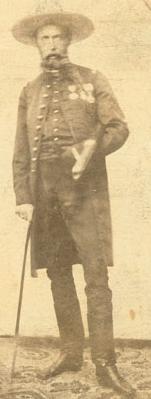 |
With all of this support, having Emperor Maximilian outmatched in every way thanks to his big brother north of the border, Juarez defeated the imperial forces at Queretaro on May 15, 1867. As we all know, soon thereafter Juarez had Emperor Maximilian executed by firing squad along with his top generals Miguel Miramon and Tomas Mejia. It is worth remembering at this point that this was yet another violation of the very constitution Juarez had enacted which had abolished the death penalty. However, just as he had continuously violated his own rules to stay in power and keep his dictatorial powers he did so again to eliminate Maximilian and his loyalists even though practically every civilized country in the world pleaded with him not do so as even the most biased international observer (such as the United States) could see that the Emperor was a good man who had nothing but the best of intentions from beginning to end. However, Juarez was concerned first and foremost with securing power and he feared that if Maximilian were to remain alive he would always be a focus of loyalty for Mexican conservatives who would wish to see him restored to the throne. |
|
|
Of course, the brief unity enjoyed by Juarez while the Emperor lived was also cut down with the crack of rifle fire on the Hill of Bells at Queretaro and President Juarez immediately had to deal with internal rebellions with reared their head again almost as soon as Maximilian was dead. After numerous other Mexican monarchists were killed, again, all in violation of the very constitution Juarez had enacted, factions amongst the republicans began to battle for power in states as well as on the national level when General Jesus Gonzalez Ortega rose up to challenge Juarez for the presidency which he continued to hold in spite of numerous violations to his term limit. Juarez used the dictatorial powers he still held to crush the rebellion as well as to ensure his success in a certainly unfair reelection in 1867. His former general Porfirio Diaz rose in rebellion later to challenge him for the leadership of Mexico but Juarez had already been so deified as to be almost impossible to oppose and this first bid for power by Diaz was crushed, though he would be seen again in the years to come. In 1871 Juarez was elected president again, yet another example of his violating his own constitutional term limit as well as the prohibition against a president succeeding himself which he himself had pushed to get put into law. That point cannot be stressed enough. |
|
|
|
|
In the end, all together, Juarez had served five terms as president according to his own liberal followers who did not recognize the conservative opposition governments and the monarchy of Maximilian set up during that same period. It was all done under the authority of a constitution which Juarez himself had enacted and which said that the president was limited to one term only. In all, Benito Juarez was the professed President of Mexico for a span of 15 years; longer than Franklin D. Roosevelt in the United States or Adolf Hitler in Germany for a more modern point of comparison. During many of those years his power was contested and the vast majority of those years (by any legal stretch) his administration was absolutely unconstitutional according to his own constitution. Furthermore, throughout many of those years he held absolute, dictatorial power with absolutely no checks on his authority in any area under his control at the time. Does this sound like the record of a champion of democracy, republicanism and the rule of law? |
|
|
Looking at the entire life and career of Benito Juarez it would extremely difficult if not impossible for any dispassionate observer to conclude that he was anything other than yet another case in the long history of Mexico of a president who clawed his way to the top, assumed power at the point of lances and bayonets and who did whatever was necessary to remain in power for as long as possible. In this, he was at least more successful than most Mexican potentates in that Juarez held power until his own death in July of 1872 by a heart attach still at his desk in the National Palace in Mexico City. Looking at the whole of his career we certainly do not see that of a great statesman. We see someone who came to power by succession and conquest rather than fair election. We see someone who nationalized private property, who championed the government taking over lands, education, marriage and even tried to assert government control of religion by his attempt to set up his own anti-pope in Mexico. We see a man who ruled absolutely to stay in power, who sold out the sovereignty of his country to the United States to stay in power, who violated his own rules to extend his term of office when it suited him, who violated his own abolition of the death penalty to kill off his political enemies and who violated his own term limits to remain in power as long as he lived. In short, Juarez was far from being a great statesman and certainly not worthy of the adulation and deification he continues to receive to this day. If there was a leader of Mexico truly worthy of such acclaim it would much more justly be applied to Emperor Maximilian rather than Benito Juarez. |
|