
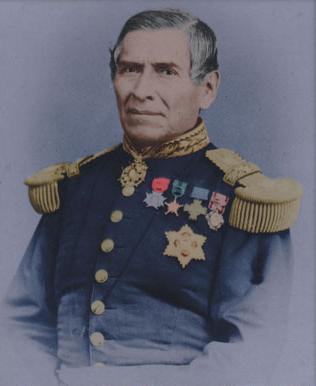

Young Juan Almonte grew to be a very intelligent and refined man. From 1815 he lived in the United States where he was educated, worked and gained strong opinions about the nature and ambitions of the North Americans. At school in New Orleans he learned to speak English fluently before coming back to Mexico. Absolutely opposed to Spanish rule, he joined the revolutionary forces of Vicente Guerrero when he returned to Mexico. Guerrero was eventually joined by the forces of General Iturbide who succeeded in winning Mexican independence in 1821. Almonte distinguished himself and a newly independent Mexico sent Almonte to England as an envoy to negotiate the first Mexican trade agreement with a foreign government. Upon returning to Mexico, Almonte edited a newspaper and served in the Mexican National Congress. Seen as a member of the liberal camp he criticized President Anastasio Bustamante for allowing foreign control of Mexican assets. Almonte made his debut in what would be a pivotal role in the history of Texas in 1834 when he toured the region to better establish the U.S.-Mexico border as well as assessing the situation in Texas itself which was becoming worrisome for the Mexican government.
Juan Almonte was disturbed by what he found in Texas; filled with people predominately English rather than Spanish speaking, Protestant rather than Catholic, of Anglo-Celtic rather than Latin culture and who saw themselves as Americans first rather than Mexicans. He saw that Texas was a powder keg waiting to explode and advised sending more troops to keep a hold on the region. That being said, Almonte did not believe that the rowdy and rebellious Americans could match the soldiers of Mexico in battle. He saw them as undisciplined, uncivilized and extremely lacking in culture. That opinion likely changed in the following two years. When the War for Texan Independence broke out fully in 1835 Colonel Juan Almonte accompanied the President-turned-dictator General Antonio Lopez de Santa Anna with his Army of Operations to crush the revolt and restore Mexican authority.
At the famous battle of the Alamo it was Colonel Juan Almonte who delivered the initial demand for the surrender of the mission-turned-fort and he was among those who advised waiting for the heavy artillery to arrive and shelling the Alamo into submission rather than expending lives in a frontal assault, which Santa Anna did anyway. After the battle Almonte saved the lives of the remaining civilians in the Alamo and escorted them to safety. He deplored the heavy losses suffered by the Mexican army in taking the Alamo and when Santa Anna commented that it had been "but a small affair" Juan Almonte famously said that, "another such 'small affair' and we are surely lost". His command of English enabled Santa Anna to capture a ferry during the cat-and-mouse campaign against General Houston's Texans that followed and he commanded a troop of dragoons which almost captured the Texan government. When the final battle came at San Jacinto Colonel Amonte fought bravely and was taken prisoner though not before he managed to save 400 of his fellow soldiers from the angry Texans. Because of his skill with English he served as translator between Houston and Santa Anna and was held prisoner with his commander for seven months. The Texans commented on his gentle manner and friendliness, evidence perhaps that Texas had earned his respect. The following year, 1837, he was sent with Santa Anna to Washington D.C. where he met President Andrew Jackson and other U.S. leaders of the time.
Jackson sent Santa Anna and his party back to Mexico where Juan Almonte contintued to serve in the army, government and diplomatic corps. Elevated to the rank of general of a division, in 1839 he headed the Mexican legation to Belgium before becoming Secretary of War in 1840 under conservative President Anastasio Bustamante whom he had earlier opposed. General Almonte was also instrumental in suppressing a rebellion against Bustamante led by General Jose Urrea, whom Almonte had fought with in the Texas war. After Bustamante was overthrown and Santa Anna returned to power, Almonte was appointed ambassador to the United States prior to the annexation of the Republic of Texas but resigned after that incident which sparked the Mexican-American War in 1845. It was Almonte who announced the end of diplomatic relations with the U.S. over the acceptance of Texas into the Union. During the conflict he served as Secretary of War with his old commander Santa Anna. Afterwards, he was envoy to London and while in Europe he devoted his time to supporting the conservative, Catholic faction in the civil conflicts in Mexico surrounding the "War of the Reform". He encouraged the plan for invite foreign intervention to end the chaos and divisions in Mexican politics and restore the monarchy under a European prince. When the French Emperor Napoleon III sent troops to Mexico in opposition to the liberal, anti-clerical regime of Benito Juarez, Almonte accompanied the French soldiers, arriving in Veracruz in March of 1862.
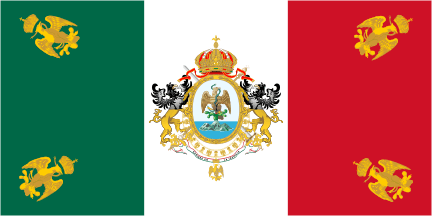
A leading and extremely respected conservative figure, Almonte was installed as temporary head of state of Mexico over the military junta and later served 6 months as President of the Council of Regency which actually did a great deal more than simply arrange the vote on the restoration of the monarchy and inviting the Archduke Maximilian of Austria to become Emperor of Mexico. In fact, in many ways Almonte was far more conservative and even reactionary in his rule than the Emperor was to be. Confiscated lands where restored to the Mexican aristocracy and Roman Catholicism was reinstated as the official state religion of Mexico with laws even passed making it legally mandatory to kneel when the Holy Eucharist was being carried in procession through the streets. To the dismay of many Mexican conservatives, after the arrival of Emperor Maximilian and the end of the Council of Regency most of this legislation was overturned. Maximilian, after all, was simply not a radical conservative and he was determined to not play favorites and tried to win the support of all sections of society by being a moderate liberal. Juan Almonte became a Major General in the Mexican Imperial Army, was decorated with the Order of Our Lady of Guadalupe and was given the important post of ambassador to France by Maximilian; important because France was the primary source of support for the new Mexican monarchy.
General Almonte, however, was not to ever see his beloved Mexico again. He was in Paris when the French pulled out of Mexico and he died not long after the fall of the second Mexican Empire, dying in Paris on March 21, 1869, only three years after the final victory of Benito Juarez in 1866. Few others can boast of a career to match Juan Nepomuceno Almonte. His life story is the story of Mexico from 1821 to 1866. He was involved in the internal conflicts Mexico suffered as well as being a key player in the wars with Texas, the United States and France. Unlike many who supported Emperor Maximilian, Almonte has also been rather fortunate in escaping the slanderous label of "traitor" so often given to men like Miramon, Mejia and Marquez. This is mostly due to his long record of service to his country and because even north of the Rio Grande he gained a good reputation among the Texans and norteamericanos who admired him for his courage, humanity and gallantry. All who knew him commented on his good nature, his dignity and his high principles. He is one of the figures from history of which Mexicans should be justly proud.