 |
|
|
|
|
|
|
|
|
|
|
|
|
|
|
|
|
|
 |
|
Don Lucas Alaman: Preeminent Mexican Monarchist |
|
|
|
|
|
|
|
|
 |
|
 |
|
|
|
|
|
|
|
|
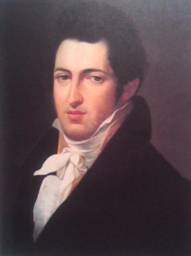
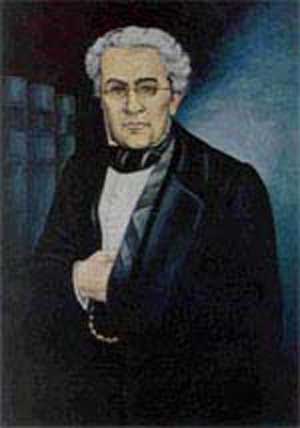
Mexico has, from even before her independence, been torn between very liberal and very conservative factions. This was not the arguments and debates of opposing political parties but most often violent civil wars, coups and revolutions which did not end even after the liberals gained control and managed to stamp out all organized conservative resistance in the country. Since the liberals were ultimately victorious they have more or less controlled the history of Mexico and dismiss, sometimes correctly and sometimes not, all of the conservatives as backward and oppressive landed elites, clerics and generals. However, one man they have not been able to totally write off is Don Lucas Alaman. His intelligence and foresight were so great that even his modern day liberal detractors must recognize his ability and rank him as one of the preeminent figures in the early history of Mexico. |
|
|
He was born Lucas Ignacio Alaman y Escalada in Guanajuato on October 18, 1792 when modern Mexico was still the Viceroyalty of New Spain. Educated at the royal college he soon became renowned as a scientist, historian and diplomat. He was, from start to finish, a staunch and committed conservative and traditional Catholic who wanted no part of the liberal, racial revolutionary spirit that was rising up at that time and particularly took form in the bloody revolt of Father Hidalgo in 1810. Although Father Hidalgo is today celebrated as the Father of Independence, his revolt was never very clearly a war for independence but rather seemed to be a racial war against the Spanish and the Mexican born Spaniards who held power in New Spain. Alaman was greatly influenced when in September 1810 he saw first-hand the massacre of Spanish families in Guanajuato by the revolutionaries. For the rest of his life he was committed to conservative principles, a strong government, strong army, strong Church and favored monarchy over republicanism as the ideal government form. |
|
|
The Alaman family had gained wealth and prestige through mining in Mexico and was taken into the Spanish aristocracy and the hereditary title given the family was retained by Alaman throughout his life; that of Marquis de San Clemente. He was given a first class, international, education. As a young man he studied chemistry and mineralogy in Germany and chemistry and natural sciences in Paris, France. In the end, however, he would become most known, academically at least, for his work as a historian. His life spanned almost all of the crucial events in the early history of Mexico, the struggle between liberals and conservatives and he was to die only a short time before the final showdown between these factions in the Reform War and the subsequent French intervention and the Second Empire of Mexico. |
|
|
Despite what many may think today Father Hidalgo lost his war, he was excommunicated by the Church and executed by the Spanish as a traitor. In the years that followed Alaman became a deputy to the Spanish Cortes for the province of New Galicia as Guanajuato and the surrounding area was known in the days of New Spain. The year was 1821 and it was in that year that, after many unsuccessful liberal revolts, Mexico became independent under the leadership of General Agustin de Iturbide who finally succeeded in uniting the elites of the country around the idea of independence. As such a staunchly traditional monarchist this would not have been the sort of thing that Lucas Alaman would have looked favorably on. However, strong as his devotion to the symbol of the King of Spain and that of the Spanish Empire was, Alaman could see that liberalism was creeping into Spain itself. The last Spanish king to hold power over modern Mexico, King Fernando VII, was in many ways a liberal absolutist rather than a traditional conservative. Like many other conservative Mexicans this made Alaman more open to the idea of an independent Mexico that would hopefully maintain the best traditions of the old regime. |
|
|
Alaman returned to Mexico and was one of the founding members of the Mexican Conservative Party which took a position favoring a strong centralized government (which many Catholic conservatives in other countries would have had a problem with) which was deemed as necessary to defend against the radical liberal elements and for a favored position for the army and the Catholic Church. He would have preferred to import a Spanish Bourbon prince to rule Mexico and so keep the ties with Spain alive, but it was soon evident that this was not an option desired by either most Mexicans or the Spanish royal family. In these rather chaotic months the short-lived monarchy established by Iturbide as Emperor Agustin I dissolved and Mexico became a republic. In the provisional government that came afterwards Alaman served as Minister of Interior and Exterior Relations from 1823 to 1825. Some claimed that he collaborated in the assassination of the liberal second President of Mexico Vicente Guerrero but there is no hard evidence for this. What is certain is that he did not favor the liberal president and preferred the conservative general Anastasio Bustamante who claimed the fallen mantle of the short-lived Emperor Iturbide. |
|
|
When the Plan of Jalapa, which called for the overthrow of Guerrero, was adopted Alaman was, in 1829, a member of the ruling junta which held power in the interim. When Anastasio Bustamante became President of Mexico Alaman returned to government in his old ministerial post from 1830 to 1832. In this job he appointed Manuel Victoria governor of Alta California on March 8, 1830 and later that year founded the first bank in Mexico to give some stability and infrastructure to the growing Mexican economy. He also worked out mutual recognition of the borders of Mexico with the United States which was to last until the War for Texas Independence and the subsequent Mexican-American War. Texas was an area of interest for Alaman and one which he tried, in vain, to get more Mexicans to pay attention to. Unlike many others, Alaman was greatly concerned by the growing influx of immigrants from the United States into Texas. They were increasing in number yet most did not learn Spanish or accept Catholicism and continued to see themselves as Americans rather than Mexicans. He tried to warn that this was a crisis in the making. He advocated flooding the region with European immigrants who would have no ties to the USA and thwart what he saw (correctly as it turned out) as the threat of the US expanding into what was then northern Mexico. |
|
|
Unfortunately for Mexico the various factions were more concerned with taking power for themselves than paying attention to the gathering threat to the north and war eventually broke out and ended in the independence of the Republic of Texas in 1836. Alaman saw this as a national disaster and largely retired from national life. He did, however, continue to write and promoted industrial expansion and wrote a conservative history of Mexico as he himself had witnessed it up to that time. His remains one of the primary historical works on early Mexico and probably the only one to look favorably on Spain which all the liberal histories seem to try to out do each other in vilifying. He also worked to establish the Natural History Museum in Mexico City and the General National Archive which are still significant to this day, especially in understanding the early history of the Mexican republic. In the private sector Alaman also founded and presided over a mining company and established the first metal foundry in Mexico in 1825 as well as administering the estates that had once belonged to the famous conquistador Hernan Cortes and in 1849 was the president of the Mexico City council. |
|
|
Like many conservative Mexicans Alaman supported General Antonio Lopez de Santa Anna who had often switched back and forth between the liberal and conservative camps but who many conservative Mexicans came to view as something of a necessary evil to maintain order and the territorial integrity of the country until something better could come along. It was because of this that he returned to public life for the last time in 1851 when Santa Anna reappointed him Minister of Internal and External Relations where he served until his death by pneumonia on June 2, 1853. He had the misfortune of seeing his greatest fears come to pass with the independence of Texas and the outbreak of war with the United States in 1846. In that year he looked hopefully for leadership from General Mariano Paredes Arillaga who was considered a leader in the conservative, Catholic faction. Paredes declared, "we seek a strong, stable power which can protect society; but to protect that society we do not want either the despotic dictatorship or the degrading yoke of the orator". For Alaman this meant the establishment of a traditional Catholic monarchy. |
|
|
It was under Paredes that Alaman tried to revive the Plan of Iguala, originally put forward by the general turned emperor Iturbide to import a European prince to establish a Mexican monarchy in the traditional fashion. Alaman hoped this would bring about a strong and united Mexico that could halt American expansion but his plan was not adopted by the nation at large and the result was the disastrous defeat of Mexico at the hands of the United States. Part of the reason for this was the replacement of Paredes with the political opportunist Santa Anna (who Alaman later supported) who essentially sold out Mexican territorial integrity to save himself after arriving to play the hero during the war. The fact that Santa Anna had no real political convictions was proven when he chose the radical liberal Valentin Gomez Farias as his Vice-President which outraged Alaman to no end. After the initial defeat of Santa Anna in Texas in 1836 Bustamante had returned as president and Alaman did not hesitate to lay the blame for the defeat of Mexico at the hands of the liberals who took their inspiration, in part at least, from the American Revolution while Alaman was constantly trying to raise the alarm of the danger of American expansionism. |
|
|
Although Alaman is mostly remembered today for his intellectual accomplishments one should not overlook his more practical accomplishments. It was largely thanks to him that textile industries rose up in Celaya and Orizaba, cattle raising increased and Mexican debts to European creditors were worked out in a more fair fashion. In the area of the textile industry alone Alaman had a huge impact and drastically increased the national production from 63,000 pounds of yarn in 1838 to ten million pounds in 1884. In the regime of Bustamante, in which Alaman served, the government may have been centralized and rather intolerant but the seemingly impossible goal was accomplished of eliminating banditry and rapidly expanding the economy of the country. It should also be pointed out that, while Alaman did support Santa Anna in the end for a time, he never did so enthusiastically and as early as 1853 advocated the rule of Santa Anna only as a temporary measure until a European prince could be imported as monarch of Mexico to set thing right and establish a traditional, conservative government. He knew what sort of vain and ambitious man Santa Anna was and hoped that he could be controlled as long as he was necessary. Unfortunately it was within a year after the death of Alaman that Santa Anna had robbed the treasury and left Mexico essentially bankrupt. |
|
|
Don Lucas Alaman did not live to see the fulfillment of his lifelong goal when Archduke Maximilian of Austria came to Mexico with his wife Carlota to become Emperor and Empress of Mexico. Like Alaman, Maximilian envisioned a Mexico that would be united, prosperous and powerful with a navy that ruled the gulf and an army that would make Mexico the dominant power in Central America to balance the power of the USA in the north and Brazil in the south. Had Alaman lived to see it he would have no doubt been among the staunchest supporters of Emperor Maximilian who embodied so much of what he had advocated throughout his life. |
|
|
|
 |
|
|
|
 |
|
|
|