 |
|
|
|
|
|
|
|
|
|
|
|
Theobald Wolfe Tone: A Typically Unusual Irish Republican |
|
|
 |
|
|
|
 |
|
|
|
|
|
|
|
|
|
|
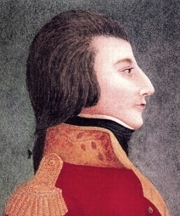
��������� Known by some as the Father of Irish Democracy or Irish republicanism, Theobald Wolfe Tone is one of the legendary figures in the history of Ireland today. He was, however, a man quite out of step with the majority of common Irish people, most especially in his own time though he would probably be regarded as more mainstream today. He was born in Dublin in 1763 to a Presbyterian family. He attended school in Dublin and London, married and had three children. He seemed in every way a typical middle class or upper middle class Irish Protestant. Additionally, he seemed at first willing to accept the role of Ireland in the British Empire when he proposed establishing a military presence in Hawaii and was for a time associated with the liberal Whig party. However, when the British Prime Minister, William Pitt the Younger, brushed him off, in the way of many revolutionaries, he seemed to make a personal slight into a guiding life mission and became increasingly radical and revolutionary. |
|
|
|
��������� Although he is admired by many Irish Catholics today, it must be remembered that Wolfe Tone was a great admirer of the horrific French Revolution which destroyed Catholic France and persecuted the Church horrifically. Although he had proposed an alliance between the Catholics and the Presbyterians under the flag of Irish nationalism, he nonetheless had a disdain for Catholicism that was just as common in Ulster then as it is now. He opposed the Grattan parliament in Ireland and those moderates, like Henry Grattan, who sought Catholic emancipation under the British Crown and was among those in the republican pubs of urban Ireland drinking toasts to the French Revolution. In the world of politics, even revolutionary politics, Tone favored the likes of Danton and ridiculed Washington. In fact, he thought the American Revolution far too conservative and as much a French-style egalitarian as he was, still asserted that the European nobility of blood was preferable to the American nobility of wealth. |
|
|
|
��������� Tone waited for his chance as Grattan and the moderates struggled with the question of Catholic emancipation and whether or not the Irish parliament would be given real independence in deciding policy. At first, it seemed that Catholic emancipation, which had become the effective test of Irish parliamentary autonomy, would be granted. However, when the British government swung firmly against emancipation in 1795, though voicing appreciation for the loyalty of Grattan, the major voice for loyalty to the British Crown was undercut and what Grattan had warned London came to pass. Feeling that their loyalty had not been repaid and that the Crown would never grant Catholic emancipation a great many Irishmen, most of them Catholic, turned toward the republican camp. Wolfe Tone saw his chance and was waiting with his dusted off proposal for a Protestant and Catholic alliance to resist British rule and ultimately to revolt and create an IrishRepublic. As another sign of the unique position Tone held, he wrote a pamphlet called Argument on Behalf of the Catholics of Ireland in 1791, the same year that the Rights of Man had been issued in Ireland written by the radical American leftist Thomas Paine who praised the French Revolution and who was anti-Catholic and indeed generally anti-Christian. |
|
|
|
��������� Nonetheless, a combination of British oppression, desperation and simply being taken in by those who promised something better, more and more Irishmen; Catholic and Protestant alike, rallied to the leadership of Wolfe Tone and his Society of United Irishmen which he had formed with likeminded Protestants. Not all the members were as radical as Tone to begin with, initially most simply wanted greater autonomy within the British Empire and parliamentary reform but British actions convinced many that this was impossible. The militantly Protestant and pro-British Orange Order had also recently been formed and many Irishmen, not just radicals and revolutionaries like Tone, but ordinary, conservative Irish Catholics, began to feel that they and their children and grandchildren would die of old age waiting for the British to be reasonable. With Europe falling into the wars of the Napoleonic era, the United Irishmen looked to France, the traditional enemy of England, for an alliance and support in an armed rebellion. Contacts were soon made with the French and Wolfe Tone led the way, urging the French to send troops and promising that Ireland was ripe for revolution and with just a little support Britain could be dealt a crushing blow. |
|
|
|
��������� Unfortunately for Tone, the British were keeping a close eye on the United Irishmen. The group had been a terror to British authorities from the very beginning. As long as anyone could remember one of the primary pillars of British rule over Ireland was the fact that the more affluent Protestant, who were closer to Britain, could keep the native Irish Catholics under control without a great deal of support from Britain. If these two groups could form a working partnership it was definitely something to worry the elites in London. Under so much scrutiny it is no wonder that the British found out about the dealing between Tone and the French. British power came down on the United Irishmen with some fleeing the country and others being arrested. Tone, who despite his egalitarianism was still a man with friends of influence, was able to save himself by giving evidence to the British authorities who sentenced him to exile on the condition that he make no further trouble for the British government. In May of 1795 he traveled to the United States and took up residence in Philadelphia, Pennsylvania. However, Tone was not happy in America. The new republic, full of dreams of building an Empire of Liberty, was not to his liking. He soon broke his agreement with London and journeyed to France where he again urged the government there to launch a French invasion of Ireland. |
|
|
|
��������� The actions of Tone in France would not be regarded as honorable by many people. He accepted a commission in the French army so that if he was captured by the British he would have to be treated as a prisoner-of-war rather than as a traitor. However, he also claimed responsibility for an announcement by the United Irishmen that any Irishman taken prisoner from the British army would be summarily executed. He also devised a plan to form an army of criminals to invade England to burn, loot and pillage. Tone also provided the French with extensive details about the country and suggested plans for a French invasion which would set off an Irish rebellion against Britain. In 1796 Tone accompanied a French invasion force of 14,000 troops to Ireland but bad weather prevented the ships from landing the soldiers and they finally went back to France. In an extremely ironic turn of events Tone then went to Holland and prepared French-backed Dutch invasion force but this time it never reached sight of Ireland as bad weather kept the Dutch force bottled up in port until it was eventually destroyed by the British navy. It is left to the imagination just how the Catholic Irish majority would have reacted to another Dutch invasion of their island; the great General Sarsfield might have awakened from death due to the shock. |
|
|
|
��������� Meanwhile, in France, Napoleon Bonaparte had become the most powerful man in the country and to the disappointment of Tone he had little interest in Ireland. Yet, it was the British who were to come, unwittingly, to the aid of Wolfe Tone. The fear of rebellion and French invasion caused a British crackdown in Ireland and a widespread campaign of intimidation which brutalized countless perfectly innocent Irish people. This campaign of terror finally pushed the Irish to rise up even without the French and the result was the 1798 Rebellion. The case of the brave priest Father John Murphy illustrates the situation quite well. Like all in the Church, Fr Murphy had preached against the revolutionary liberalism of the United Irishmen and urged his people toward peace. However, when they were attacked and persecuted anyway, even after giving up their arms and pledging their loyalty to the Crown, he said, "it is better die courageously in the field, than to be butchered in your homes" and so he became a great hero and eventually a great martyr of the 1798 rebellion. It was, ultimately though, a doomed undertaking and when the French help that Tone had so long sought finally came it was half-hearted and really a case of too little, too late. The most major of these was the invasion of General Joseph Humbert in August but who came on his own authority and without the official sanction of the French government. He won a few victories, including a marvelous one in Connacht against 3,500 British troops who he sent flying in a battle known thereafter as the "Races of Castlebar". However, Humbert was later defeated by Lord Charles Cornwallis. Among those taken prisoner was Matthew Tone, Wolfe's brother, who was promptly hanged. Another raid was attempted but brushed aside with little difficulty and finally came a third which Wolfe Tone himself accompanied in October. Again, the French forces were defeated and though he could have escaped, to his credit Wolfe Tone remained with the fleet and was taken prisoner by the British. |
|
|
|
��������� Tone was brought before a court-martial in Dublin, one of the most famous Irish rebels to fall into British hands. Surrounded by his enemies though he was, Tone did not back down. He openly declared that he was and would always remain an advocate of war between Britain and Ireland so long as any vestige of British control of the island remained and asked only that he die as a soldier rather than a criminal in recognition of his status as a French officer. Regardless of his political opinions and prior actions, no one can claim that Tone did not face his enemies bravely, at least in court. Not surprisingly, despite his request, he was sentenced to be hanged as a criminal and traitor rather than executed by firing squad as a soldier. However, the courage he showed at his trial reportedly failed him and shortly before his execution, which was set for November 12, 1798, he committed suicide and died in prison, already a legend and soon to be a political martyr, at the age of 35. |
|
|
|
��������� It did not take long, either, for Tone to achieve iconic status. Although he had a lifelong struggle with alcoholism and put forward some fairly horrific ideas, he had earned many admirers throughout his life for his honesty, determination and steadfast devotion to the cause of Irish independence. He was, and still is by many, seen as the champion of unity and of the common people and he is still honored annually at his memorial by modern Irish leaders. There are certainly aspects of his character and certain of his opinions which anyone can admire. However, personally, I have a hard time looking at Tone too favorably for a number of reasons. He was a Protestant but more than that he championed the idea of putting nation before God which is a principle that would only grow in horrific consequences as time went on. I also have a hard time, especially as a Catholic but simply as a human being, holding too favorable a view of anyone who could praise the horrific bloodbath that was the French Revolution or glorify the hateful minds who carried it out as Tone certainly did. I cannot help but view his efforts at alliance with the Irish Catholics with a pinch of skepticism and the absolute hatred he felt toward Britain, while perhaps understandable, is certainly not admirable and should not be for any Christian or even a civilized pagan. He played his part in the Irish struggle for freedom and it was an important part, but as for myself, I will always favor the Catholic reluctant warriors who had more love for Ireland than hatred of England such as Patrick Sarsfield, Fr John Murphy or later Dan O'Connell than the radical revolutionaries like Wolfe Tone. |
|