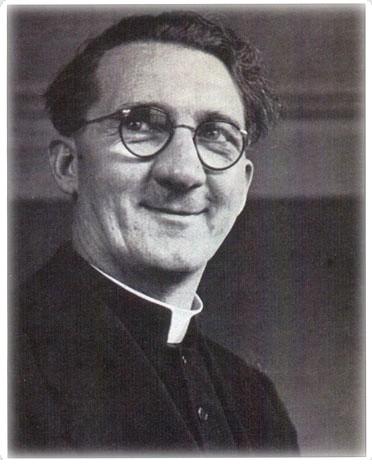


O'Flaherty had a lifelong passion for sports and especially loved golf but while serving as an assistant to a Vatican diplomat in Egypt it was found that he had a natural talent for diplomacy with his keen mind and friendly personality. In 1934 he was made a monsignor and took over when his superior died in the Vatican diplomatic corps and served in that capacity for four years in Haiti and Czechoslovakia. In 1938 he was recalled to the Vatican and appointed to the Holy Office (formerly known as the Inquisition, now known as the Congregation for the Doctrine of the Faith). He worked his way up higher and higher within the Holy Office all the while winning many friends among Roman society. While other Vatican officials were polished and aristocratic Monsignor O'Flaherty charmed with his simple style, his love of golf, boxing, handball and hurling. He often golfed with the son-in-law of Italian dictator Benito Mussolini and even the exiled King Alfonso of Spain. Some members of the Curia disapproved of his informal style but it was impossible not to like the man. When World War II broke out Msgr O'Flaherty was neutral (both as an Irishman and a priest) but lived in the midst of Axis Italy. The Vatican was neutral territory but the Germans (who eventually occupied Rome) made it very clear that the Holy See was an island under siege and a close watch was kept on the gates and the entrance to St Peter's square.
The onset of the war gave the Holy Office new duties such as keeping track of prisoners of war. While on visits to POW camps Msgr O'Flaherty would talk to the Allied prisoners for hours and then use Vatican Radio to inform their families in various countries that their loved ones were okay. This won him many friends among the Allied soldiers. Many of these camps were in northern Italy and during the Winter months O'Flaherty would scrounge warm blankets to send to the troops. He also delivered books and Red Cross packages to the men and managed to get some Italian camp commanders fired for the poor conditions in the prison camps. By the end of 1942 he had so infuriated the Italian military that pressure was applied to have him assigned to other duties. Back in Rome he was approached by many of his former friends who were being oppressed by the authorities. Some were Jews, some were simply anti-Fascists but O'Flaherty gave them a helping hand and developed a secret network to hide the fugitives in the homes of other friends of his until they could be got to safety. Some he sent to monasteries and convents and finally he took to hiding people inside the Vatican itself.
The largest and most significant group that began to call on Msgr O'Flaherty for help were escpaed Allied prisoners. They remembered the kindness O'Flaherty had shown to them and so would seek him out while many also made for Vatican and the Irish embassy as the only neutral territories in Rome. Many of these were British soldiers who tried to reach the British envoy to the Vatican, however, this presented a problem as Pope Pius XII had already made the Vatican a haven for so many Jews and other oppressed groups that soon there was no more room for anyone. The Swiss Guard had to turn many asylum-seekers away. The situation became worse when Italy switched sides to join the Allies which resulted in the Germans occupying Rome. The Nazis kept a close eye on the Vatican looking for any Allied troops released from the Italian prison camps. One such group appeared in St Peter's square and would surely have been caught if they had not been brought to O'Flaherty's attention. Showing his typical Irish daring he actually had them hidden away in the barracks of a friendly Italian police brigade. Word soon spread amongst the Allies that they should head for the Vatican in times of trouble and this soon came to the attention of the man who would be the archenemy of Msgr O'Flaherty; the Gestapo chief in Rome, a Wurttemberger Colonel in the Nazi SS named Herbert Kappler. During his time in Rome Colonel Kappler earned a horrific reputation for his many cruelties and atrocities against Jews, Italians and anyone deemed an enemy of Nazi Germany. However, O'Flaherty was the one to out-fox the German colonel.
The flood of Allied prisoners coming to the Vatican soon became too much for O'Flaherty to handle alone and as a majority of them were British he went to the British envoy to the Vatican, Sir Francis Godolphin D'Arcy Osborne for help. The irony of this was not lost on the nationalist Irish priest who had no love for the British. At their first meeting the British aristocrat expressed sympathy but stated that he could offer no help as it would endanger the neutrality of the Vatican and was, essentially, none of his business. The Monsignor was furious and there were probably visions in his head of the many cruelties inflicted on Ireland by her British masters when the British minister told him to speak to his butler John May. The Monsignor had to swallow some of his prejudice as John May would prove to be a great friend and invaluable asset to him and his work. The British minister knew this, which is why he directed O'Flaherty to him since he could not get involved himself. John May became the chief scrounge of the Monsignor's secret network as he seemed to be able to produce almost any item that was needed no matter how impossible it seemed through his many contacts and black market connections. Sir D'Arcy did himself come to play a significant part in O'Flaherty's operations. Also on hand helping the Monsignor were Count Sarsfield Salazar of the Swiss legation and Delia Murphy, a noted signer and the wife of the Irish ambassador. Henrietta Chevalier, a heroic widow from Malta, put the lives of her and her daughters on the line by harboring Allied prisoners in her home at O'Flaherty's request, even having her home searched by the SS on several occasions. All of this activity was detected by the Germans who knew something was up even if they could not determine exactly what was going on and who was involved. Colonel Kappler tightened his noose around the Vatican and this forced Msgr O'Flaherty to get creative.
Msgr O'Flaherty was kept under an ever closer watch by Colonel Kappler and the fearsome Ludwig Koch, the Austrian torture expert for the Gestapo. The Monsignor would, with typical Irish daring, slip out in disguise and even began obtaining his own real estate when he began to run out of places to hide the Allied prisoners. In fact, he even had the audacity to rent an apartment right behind the SS headquarters to house his fugitives in! He also showed no favoritism and was just as compassionate to Americans, British, French, Protestants, Catholics, Jews and even Arabs and some Yugoslav communists. However, what distinguished him the most from the other good-doers was his daring and audacity. He certainly pushed his Irish luck farther than anyone would have thought prudent. He would smuggle people into the Vatican dressed in his own clerical robes and even got a female fugitive inside by dressing her up in the uniform of the Swiss Guard and having her march in with the other halberdiers while the Germans looked on. When one of his fugitives developed appendicitis O'Flaherty borrowed a car and drove the man to Santo Spirito Hospital where the friendly sisters added his name to the surgery list. The man was then operated on by a German doctor and recovered in a ward full of Germans all ignorant of the fact that one of their enemies was right beside them. O'Flaherty later took the man back to Urban College and no one was ever the wiser.
Rumors and stories spread about the "Pimpernel of the Vatican". He was reported to be here and there all over Rome and yet the Germans could never catch him actually leaving the Vatican. Colonel Kappler became infuriated and more and more determined to catch the elusive Irish priest. He once staked out the residence of a known friend of the Monsignor; Prince Filipo Doria Pamphili. The Prince often gave money to help O'Flaherty's cause and when the Irishman was reported to be at the Palazzo Doria Colonel Kappler struck with his Gestapo, surrounded the place and stormed in to search certain that he had the Vatican Pimpernel at last. Thinking fast, Msgr O'Flaherty put his clothes in a sack, smeared coal dust all over himself and passed right through two rings of SS troops with the other coalmen and got 'clean' away. The Germans did not want to get too close for fear of soiling their uniforms. As the Irishman returned to the Vatican Colonel Kappler spent two hours turning the palazzo upside down in a fury looking for the priest who seemed to be impossible to catch. Over time O'Flaherty also gained the help of talented prisoners such as Major Sam Derry of the Royal Artillery. He brought a great deal of organizational skill to the operation and kept detailed records that he buried in the Vatican gardens. Major Derry eventually became head of his own secret force, cooperating with the Monsignor, which focused on intelligence gathering and other clandestine activities to aid the war effort.
The Germans tried to get evidence against O'Flaherty anyway they could. Once Colonel Kappler captured and tortured an Italian peasant who aided the Monsignor to force him to betray the priest. However, when it came down to it the poor man could not go through with the operation and ended up being aided himself by O'Flaherty in being smuggled out of Rome. Desperate to win at any cost Colonel Kappler cracked down on the entire population and put into effect a strict curfew and set up checkpoints to scrutinize everyone going in or out of the Holy See. He sometimes shut off their water or electricity and the Germans only became more paranoid as the Allies landed in Italy and they could see their own defeat looming on the horizon. His raids and arrests were very troublesome but each time Msgr O'Flaherty would rearrange his operations, shuffle everyone around and stay one step ahead of the Gestapo. At one point Kappler sent two undercover SS agents to mass in St Peter's to assassinate O'Flaherty. However, the British butler May smelled the trap and had them escorted out by four Swiss guardsmen. Once deposited outside they were roughed up by a group of Yugoslav former prisoners and then returned to Kappler badly bruised and with their tails between their legs.
In March of 1944 the situation became extremely dangerous when the brutal Koch captured a teenage boy who was the son of one of O'Flaherty's confederates. He was grusomely tortured and betrayed the hiding places of the group to Koch who sent out his troops and had all the occupants of every place named shot on the spot. Yet, in many ways, this was a last gasp of cruelty as the Allies were steadily advancing on the Eternal City. At last the Allied forces were approaching the city and even the most hardcore Nazi could see the game was up. It was then that Msgr O'Flaherty had his most outrageous request of all. An Italian aristocrat brought him a message that a certain individual wanted the Monsignor's help in getting his wife and mother safely out of Rome. There would have been nothing unusual about this request except that the man making it was none other than Ludwig Koch. This was the cruelty expert of the Nazis in Rome, the man who was probably more feared than any other, whose specialty was inflicting pain and who had horribly tortured and killed many dear friends of Msgr O'Flaherty and yet it was to him that the Austrian Nazi was now appealing to for help. The Monsignor was outraged at the request, yet, he was torn by his human emotions and his Christian compassion. In the end, he agreed to help Koch's family if he would leave all those prisoners he still held unmolested for the Allies to liberate them (standard procedure would have been to kill them all). All but one group of 14 were left behind, while those unfortunates were taken outside of Rome and shot. True to his word though O'Flaherty made arrangements to smuggle out Koch's wife and mother. However, the two women refused to leave.
While the Allies, their freed men and the Romans celebrated the arrival of the Allied armies O'Flaherty was in a chapel praying. His devotion to mercy did not end with the victory of one side or the other and soon he was visiting prisoner-of-war camps again to give what help he could, this time to Allied camps full of German prisoners. He also helped the many refugees moving throughout Europe at the end of the war and immediately thereafter. He was promoted in the Holy Office in 1946 but would become quite upset if anyone called him a hero as he was, from first to last, a humble man. In all he had saved the lives of nearly 4,000 people and was recognized by many of the governments whose people he had saved. He recieved the Medal of Freedom with Silver Palm from the United States (the highest civilian honor American can bestow) and he was made a knight commander of the Order of the British Empire; something which must have caused an ironic chuckle in the ardent Irish nationalist. However, he simply sent all of his decorations to his sister who kept them in a drawer in her home in Ireland. His enemies did not come out as well. Ludwig Koch was captured by Italian partisans as he fled Rome for Milan and was killed. Colonel Herbert Kappler was captured and sentanced to life in prison at Gaeta where, throughout his time there, his former archenemy Msgr O'Flaherty was a regular visitor of his. In March of 1959 Msgr O'Flaherty baptized Herbert Kappler into the Roman Catholic faith. He later escaped from prison with the help of his wife and his very poor health meant that West Germany would not send him back and he died in his home in 1978.
In the summer of 1960 Msgr O'Flaherty suffered the first of two strokes. He worked for a couple of years in the diocese of Los Angeles, California before his poor health forced him to return home to Ireland. His great deeds during the war came to be largely forgotten, probably mostly due to the fact that he never talked much about what happened and did not like any special attention being given to him. He died in Ireland on October 30, 1963. A grove of Italian trees was planted in his memory at Killarney National Park and a tree was planted in his honor at the Yad Vashem Holocaust Memorial in Jerusalem for his assistance in saving Jews from the inferno. Further, the Holocaust Martyrs and Heroes Authority named him a Righteous Gentile for his heroic acts of compassion in saving Jewish lives from the Nazis. All too often Ireland is criticized for remaining neutral during World War II, and that issue can be debated to no end, but there were certainly a great many Irish heroes during the Second World War and probably none were so courageous, determined, audacious and humble as the patriotic Irish priest Monsignor Hugh O'Flaherty, "the Pimpernel of the Vatican".