 |
|
|
|
|
|
|
|
|
|
|
|
|
|
|
|
|
|
|
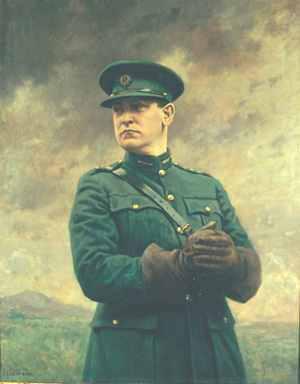
General Michael Collins, IRA |
|
|
 |
|
|
|
 |
|
|
 |
|
|
|
|
|
|
|
|
|
|
 |
|
|
|
��������� One of the most noteworthy figures in the pantheon of early Irish independence heroes is General Michael Collins, though like almost all the others his actions remain controversial to this day. He was an Irish patriot, an early fighter of independence, a leading political figure, founding father of the Fine Gael party, a highly effective commander of the Irish Republican Army and most controversially the supreme commander of the forces of the provisional government for what became the Irish Free State during the Civil War. It is one of the tragic ironies of the troublesome history of Ireland that the famous General Mick Collins, former leader in the IRA, would be assassinated by the IRA himself and further, for so ardent and lifelong a republican, that it would come in the service of a compromise government with the British Crown. |
|
|
|
��������� He was born Michael John Collins on October 16, 1890 in Cork County, Ireland, the third son and youngest of eight children. He came from rebellious stock as his father had been a member of the Fenian Brotherhood in his youth before settling down to farm and raise his family. His father was 60 when he married 23 year old Marianne O?Brien and he died when young Michael was only six years old. As he grew up he became known for his intelligence, mischievousness, short temper, excellence at sports and zealous devotion to Irish independence. He was encouraged in his nationalism by a local blacksmith, James Santry, and by the headmaster of Lisavaird National School Denis Lyons who was a member of the Irish Republican Brotherhood. When he was 15 he left school to live with his sister in London and in 1906 too the British Civil Service examination and was employed by the Royal Mail. |
|
|
��������� Collins fed his appetite for physical activity by joining the Gaelic Athletic Association and when he was 19 joined another group to feed his patriotic appetite. It was the Protestant republican Sam Maguire who introduced him into the secretive Irish Republican Brotherhood which sought the total liberation of Ireland from Britain and the establishment of a republican government. Eventually, he came to play a key role in the IRB in which he became financial advisor to Count George Plunkett and aid de camp to his son Joseph Mary Plunkett. The younger Plunkett was one of the organizers of the Easter Uprising of 1916 and it was there that Collins first came to widespread notoriety. |
|
|
 |
|
|
��������� Collins fought alongside Padraig Pearse in the seizure of the General Post Office in Dublin and displayed considerable natural military talent. However, he took a very different view of the uprising that Pearse and many others. In military terms it was undeniably a disaster but Pearse and others argued that, like the scourging of Christ, it was a necessary sacrifice of blood to awaken the people and bring about the final victory. For Collins, it was simply a military disaster and one that need not have happened. He was a man who focused on results and never went into anything expecting to lose. He criticized the way the whole rising was organized, the poor positioning of forces and the barricade mentality which effectively made them prisoners of besieging British forces as soon as the rising began. |
|
|
��������� Collins was arrested, very nearly executed and finally was sent to an internment camp where he quickly took the lead in organizing the prisoners for the next campaign to liberate Ireland. It had been and would long after be the case that British prisons were some of the most fruitful recruiting and training centers for the Irish nationalists. Collins joined the Sinn Fein party and quickly rose to prominence within it. A relatively small and somewhat moderate party at the start which advocated compromise with Britain, it became the leading party of Irish nationalism when the British blamed the Easter Uprising on the rather unknown group. Many veterans of the rising, such as Collins, saw the opportunity and joined the party knowing that being vilified by the British government was a sure way to win support among the public of Ireland. Only one year after the rising Collins had become director of the Irish Volunteers and a member of the executive council of Sinn Fein under President Eamon de Valera. |
|
|
��������� When election time rolled around Michael Collins was elected Sinn Fein MP for Cork South but with his party comrades refused to take his seat in Westminster and formed the first Irish Parliament. The British reacted quickly to arrest these man but Collins had intelligence contacts which warned him of the British action and allowed him to escape. His efforts to warn his comrades came to nothing as De Valera believed it would be better for their cause if they were arrested to further highlight oppressive British policy towards Ireland. However, this result was not as great as was hoped and also resulted in De Valera losing control of Sinn Fein for a time. However, Collins helped the Irish statesman escape from Lincoln prison in April of 1919 and resume his leadership of the party. |
|
|
 |
|
|
|
��������� By that year Michael Collins had become president of the Irish Republican Brotherhood (and leader of their republican shadow government) as well as the Director of Intelligence for the Irish Volunteers which were renamed the Irish Republican Army by September. Collins was to excel in this assignment especially and was to prove invaluable as the Irish War for Independence gained momentum. De Valera also made Collins Minister for Finance and he surprised everyone with his natural talent in this position as well. The National Loan he obtained for the Irish Republic became famous around the world. On the military side he set up a special unit called The Twelve Apostles who were specially trained to eliminate British agents and assassins. When De Valera left on a fund raising trip to the United States Collins was left in charge and along with General Richard Mulcahy organized and led the Irish Republican Army against the British. |
|
|
��������� One of the most important areas Collins emphasized was intelligence gathering and the planting of informants throughout British organizations. This worked so well that there was hardly any British operation which General Collins did not have previous knowledge of. He also emphasized mobility, hit and run tactics and a strategy of harassment to wear down the superior British forces which could never be defeated in open combat. These so called Flying Columns took a heavy toll on the British, the RUC and their auxiliary militant groups. By 1920 the 30 year old General Collins had so infuriated the British that they were offering 10,000 pounds sterling as a reward to the person who would kill the elusive Irish general. Eventually, the IRA under Collins and Mulcahy was able to bring about a deadlock and force the British to the negotiating table to end the ongoing conflict. |
|
|
��������� It was first expected that Eamon de Valera would lead the Irish delegation in the negotiations. However, when he learned that King George V would not be attending, De Valera, as Irish President, refused to be present either and dispatched Collins to bargain for the Irish. General Collins was very reluctant to do so. Despite forcing the talks he knew that the IRA had not won a total victory over Britain nor had the Irish republic gained recognition from any world powers other than the Soviet Union who did so only because the Irish gave them a loan in exchange for such recognition (evidence of how well Collins had managed money for the government as well as how poor the USSR was). Some later whispered that De Valera had chosen Collins simply because he knew the negotiations would fail and did not want to be held responsible, though this seems unlikely. |
|
|
��������� In any event, Collins was ultimately only the deputy of Sinn Fein founder Arthur Griffith who was the leader of the Irish delegation sent to London. The result of these peace talks was the notorious Anglo-Irish Treaty, the partition of Ireland and ultimately the civil war and years of struggle and hardship Ireland has known ever since. The December 6, 1921 agreement brought about the creation of the Irish Free State, a self governing dominion within the British Empire with the monarch as nominal head of state and which allowed for a separate state within a state for the Protestants of Ulster if they so desired. Of course, the Protestants jumped at this opportunity, carving the six counties out of the body of Ireland to create an artificial Protestant majority that would forever after oppose a united, independent Ireland. Collins was not terribly worried about this as he never believed that such a microstate could long survive, but of course he had no idea how the British commission was going to draw the border either. |
|
|
��������� Irish republicans were immediately outraged by the fact that Ireland would still be part of the British Empire and that an oath of allegiance to the (Protestant) King was still required for all officials of the Irish Free State. Sinn Fein split in two between those who thought that half a victory was better than none at all and those who wanted to go on fighting, be it Briton or fellow Irishman, rather than accept the treaty. The stage was set for the Irish Civil War. The existing Irish government approved the treaty by a very narrow margin and General Collins, the long time republican and IRA general, joined with the government and those forces fighting to enforce the treaty. Eamon De Valera denounced the treaty and joined the republican opposition, becoming a front man for the IRA in their war against the pro-treaty forces of the Irish Free State. Arthur Griffith succeeded De Valera as President of Parliament (not of the Republic as De Valera had styled himself as the Irish Free State was a monarchy) but this was still an opposition government which London did not recognize. When a Provisional Government was formed specifically for the Irish Free State Michael Collins was chosen for Prime Minister. |
|
|
��������� As with any period of civil conflict the situation became very confused but Irish politics have always been more complex still. Michael Collins was Prime Minister of the Irish Free State, a Dominion of the British Empire, yet he was still also Minister of Finance in the prior government of President Arthur Griffith, both of which were opposed by the IRA and former President Eamon de Valera and in yet in early 1922 Collins was sending IRA forces, some of whom supported the treaty and some of whom opposed it, to attack Northern Ireland in an effort to regain what had been lost at the negotiating table! In fact, for a time, the IRA were attacking British held Northern Ireland with British weapons supplied by London to Collins and the Irish Free State. Naturally, once the facts of the matter became clear London exerted political pressure on Collins to halt his offensive into Ulster though this early action earned him support among many IRA units who came south to fight for the Provisional Government while others of both sides continued intermittent guerilla attacks on the Ulster border region. |
|
|
��������� General Collins did his best to avoid civil war and it should have been clear to anyone that the Crown dominion Irish Free State was not long for this world with so devout a republican as Collins in charge of it. He proposed making the State a republic in all but name; not defying the treaty but simply taking their autonomy as far as it would go with George V being King of Ireland solely in the minds of the British Protestants. He even proposed boycotting the elections for his own government with both Sinn Fein factions to cause the collapse of the compromise state after which they could reunite in forming a republican government to their liking; essentially a repeat of the founding of the first Irish Parliament. However, De Valera, who said that British control over the Irish Free State was too extensive for true independence was proven right when Collins tried to put these plans for reconciliation into effect. The British government vetoed all such propositions that would diminish the Crown in Irish government and threatened military action if the treaty was not enforced to the letter. |
|
|
��������� There would be no peaceful reunion of the Irish factions and with the threat of a native Irish government recognized by Great Britain under threat of going the way of previous British allowed Irish governments Collins felt he had no choice but to support the treaty, the Irish Free State and fight those who would undermine it violently. By Spring and Summer of 1922 things were coming apart. Catholics were being persecuted in Ulster by the British supported Protestants, the Irish Free State was being threatened by the IRA opposed to the treaty as well as being threatened from London to take more aggressive action against them. When British Field Marshal Sir Henry Wilson was shot in London by the IRA (on orders from Collins as it turned out, in reprisal for Protestant atrocities against Irish Catholics in Ulster) Churchill ordered Collins to move against the IRA who had taken over Four Courts in Dublin or the British army would do it for him, yet another example to republicans, and even Collins himself, that the British version of Irish autonomy within the Empire was nothing of the sort. |
|
|
��������� When the IRA kidnapped General J.J. O?Connell there was no choice for Collins but to react and when the IRA refused to withdraw peacefully Free State forces bombarded them into submission. With this engagement the Irish Civil War was fully on with Collins taking full control of Dublin. Once again General Collins took on a military rather than political role as commander of the National Army with his old IRA comrade General Richard Mulcahy as one of his top subordinates and Minister of Defense. Also on hand was Eoin O?Duffy, future leader of the Blueshirts, as chief of staff. Naturally the British supported the Free State National Army against the IRA and this allowed General Collins to launch attacks from the sea into the republican stronghold of Munster, quickly retaking the region. However, fighting fellow Irish Catholic republicans was never something Collins was enthusiastic about, his physical and emotional health suffered and he never stopped trying to find a way to reconcile the two sides. |
|
|
��������� To the great surprise of most everyone, on August 22, 1922 General Collins was assassinated by the IRA in County Cork while on his way to try to talk to republican leaders and arrange a truce to stop the fighting until a national vote could be held on the subject of the Anglo-Irish Treaty. He could have ordered his convoy to speed on once they came under attack but true to his nature he ordered his men to stop and return fire. This giant of Irish independence, revolutionary, Prime Minister and general died at the age of only 31. Although not without controversy, he was a hero of Irish independence. His anger over the Easter Rising as well as his actions in the civil war can be understood due to his constant focus on results, concrete accomplishments and this was always his focus. His stance in divisive times can be debated but his commitment to a free and united Ireland is something that all must recognize. |
|