 |
|
|
|
|
|
|
|
|
|
|
|
|
|
|
|
|
|
 |
|
John Mitchel: Ireland's First Felon |
|
|
|
|
|
|
|
 |
|
|
 |
|
|
|
|
|
 |
|
|
|
|
|
|
|
|
 |
|
|
|
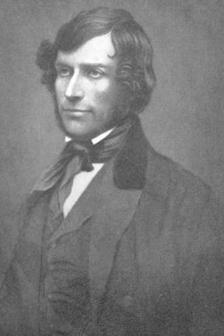
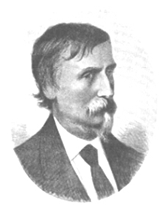
����������� The ranks of Irish nationalists are filled with people, truth be told, that many today would consider less than admirable figures. Were all people honest about their history this would be a much more common thing. George Washington was a racist and Thomas Jefferson forced himself on his slave girls but that has, so far, not diminished the status of these two Founding Fathers of the United States of America. John Mitchel also had some viewpoints which would be considered quite outrageous by our standards today though he is still honored in Ireland today for his contributions to the cause of freedom yet it was his actions in America most would view as unsavory. Of course, that does not stop me from considering him one of my favorites, religious differences aside. Like many of the Irish republican rebels he was a Protestant, the son of a liberal Presbyterian minister named John Mitchel and his wife Mary Haslet. He was born in Camnish, Londonderry on November 3, 1815. As a young man he went to Dublin and studied at Trinity College. He earned his qualifications as a lawyer and worked a less than glamorous job as a bank clerk before going to County Down in 1840 where he worked as a solicitor at Banbridge. |
|
|
����������� With many Irish nationalists it seems strange that someone from their background would adopt their radical, republican opinions. With Mitchel, though it might seem odd today for a Protestant to take his views (though it should not as many nationalists, such as all the founders of the United Irishmen, Tone, Russell and Neilson were all Protestants) his was a very liberal brand of Protestantism; indeed practically Unitarian. Given that, what is strange about Mitchel is that he was not more radical than he was. However, Mitchel was certainly second to none when it came to his adamant opposition to British rule and his longing for an independent Ireland. Together with his wife Jenny Verner, the daughter of an English army officer and an Irish mother (the two eloped at a young age) they endured a great deal of suffering, hardship and persecution for their stand on Irish independence and zealous devotion to republicanism at a time when such views were not only considered politically incorrect but literally criminal. John Mitchel and his wife lost two sons and two daughters over the years in their persistent pursuit of justice and freedom for Ireland. |
|
|
|
����������� Mitchel first made his mark for the cause as a newspaperman, writing for the nationalist paper The Nation. Mitchel quickly earned a reputation as a rebel among rebels, going more extreme than even the nationalist paper was comfortable with and indirectly bringing about the prosecution of his editor, Charles Gavin Duffy, for libel and sedition by the British government. In the revolutionary year of 1848 Mitchel started his own paper called the United Irishman, calling to mind the past revolutionary organization of that name. He was part of a strong reaction in Ireland against the British government following the outbreak of the Potato Famine. This had caused many Irishmen to break with the peaceful opposition of the great Dan O?Connell in the face of the horrific suffering in their country; made all the worse by the fact that British landlords continued to export vital food to enrich themselves while the Irish were starving. Mitchel went as radical as he could and took an extreme risk by openly advocating armed rebellion against Britain. |
|
|
����������� This, as expected, got Mitchel in trouble with the law and under emergency powers the British government had just voted itself Mitchel was arrested and convicted of sedition. Sentenced to 14 years at hard labor he was imprisoned on prison hulks to work on a naval installation in Bermuda before being sent to a penal colony on Tasmania off the coast of Australia. This was the fate of many Irish nationalists and it would be the time in which Mitchel won his greatest fame in Ireland. Locked in a reeking ship over the 17,000 miles from his beloved homeland to Australia he penned his famous Jail Journal, still considered one of the greatest patriotic literary works in Irish history. He poured out his devotion to his wife Jenny, his children and his beloved homeland. His writing touched the hearts of a nation and the Jail Journal remains a standard among Irish activists all around the world to this day. However, one often overlooked point is that what the British were most upset with Mitchel about were not his calls for rebellion but his detailed reports on exports and the famine; which revealed a dark side of British policy to the world they would have liked to keep hidden. |
|
|
����������� Once on Tasmania, Mitchel was joined by his devoted wife and family. They seemed to settle down and accept their situation but in 1853 he affected his escape and he and his family set sail for America. Like many Irish immigrants he first landed in New York and there established another paper called The Citizen to continue his literary call for Irish freedom and criticism of the British government. Once again he was considered one of the most extreme, but on this side of the pond and in an area with a large Irish immigrant population his views on Irish politics were no threat to his safety or freedom. However, Mitchel could never stay long away from controversy and it was his views on American politics that soon brought him notoriety in the New World. He looked at the exploitation of Irish immigrants by the greedy capitalists of New York and became an impassioned enemy of the international industrial elite that was going strong in the northeast United States, Great Britain and other places around the world. In seeking an alternative to this set up he took a very favorable view of the southern states and their agrarian, slave dependent economy. This, naturally, is what Mitchel is most criticized for today and a part of his life not often widely discussed in Ireland. As this was the time leading up to the American Civil War it was a view none too popular in his own time in the very Yankee state of New York. |
|
|
|
 |
|
|
 |
|
|
|
|
|
|
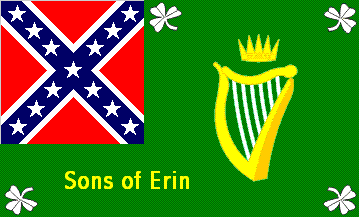
����������� John Mitchel became an avowed southern sympathizer and toured the southern states speaking in support of their cause, complaints and what was called the "peculiar institution". He also saw obvious parallels between the southern Confederates and the people of Ireland. Each were the less affluent, predominately rural sections of a country struggling for independence against a wealthier, industrialized and more powerful north where the dollar ruled rather than any devotion to tradition and sacred soil. His stand in America and the values he passed on to his children were to affect them a great deal. By this time one daughter, God bless her, had come home to the Roman Catholic Church and entered a convent in Paris but sadly died a short time later. Their sons, however, grew to adulthood and were to win their own laurels in America during the War Between the States. It was a difficult position for the Mitchel family to be in. Most of his fellow Irish rebels who remained up north sided with the Union against the Confederacy, and though they remained his beloved enemies, Mitchel could not understand how they could flee Ireland because of government persecution only to take up arms against others in America to inflict government persecution on the south. |
|
|
����������� When war came John Mitchel had moved to Richmond, Virginia, capital of the Confederate States of America. He was just as zealous and radical a Confederate American as he had been an Irish nationalist, even criticizing Confederate President Jefferson Davis for being too moderate. His oldest son, Captain John C. Mitchel, was on the scene at the very first official battle of the war as an officer in the South Carolina Regular Artillery that bombarded Union forces out of Ft Sumter at CharlestonHarbor on April 12, 1861. John C. Mitchel went on to command that symbolic prize after its surrender to General Beauregard and he gave his life defending it on July 20, 1864. His last words were a paraphrase of the dying words of the great Irish Catholic hero General Patrick Sarsfield, the Earl of Lucan who had died in Holland. Mitchel said, "I willingly give my life for South Carolina. Oh, that I could have died for Ireland!" These words are today etched on his headstone inside a miniature replica of Ft Sumter at his resting place in MagnoliaCemetery. |
|
|
����������� The younger brother of that Irish Confederate hero, Private William Mitchel, also enlisted in the Confederate army and died gallantly in combat during the glorious, doomed charge of General George E. Pickett on the last day of the battle of Gettysburg on July 3, 1863. The only survivor of the three Mitchel boys was Major James Mitchel, also of the Confederate army, who survived the war, had his own family and whose son, ironically enough, eventually became the mayor of New York City. During the war their father continued to work at what he knew best serving as editor for two local papers in Richmond throughout the war. When overwhelming Union strength finally succeeded in crushing the southern Confederacy under their boot heels John Mitchel remained a totally unreconstructed rebel. Even following the defeat he relented in none of his support for a free Ireland or for the Confederate States. He found himself in a familiar position once again when some of his pro-Confederate views were published in a New York newspaper for which he was quickly arrested by the Union army and thrown in jail. |
|
|
����������� Union General John Dix sent Mitchel to the dungeons of Fortress Monroe, Virginia where he was confined in Casemate #2, next door neighbors to none other than the former Confederate President Jefferson Davis who occupied Casemate #1. The two met on occasion and talked to each other, Mitchel being able to compare the accommodations afforded him by the government of Queen Victoria to that of the United States Army. Mitchel finally secured his release thanks to the help of some other members of the Union Army who were members of the Fenian Brotherhood and great admirers of Mitchel for his actions in the cause of Ireland. Mitchel was able to go back and report to Mrs. Varina Howell Davis, former Confederate First Lady, that her husband was doing well in spite of the inhuman treatment of the Union commander at Fort Monroe who devised a number of little ways to bedevil the life of the former President. To his credit though his imprisonment did not change Mitchel in the least. He remained a defender of the Confederate cause as well as the most impassioned Irish patriot and enemy of British rule alive at the time. Known as the First Felon of Ireland there was no one who loved his country or hated its occupation more than John Mitchel. |
|
|
����������� Once free of the dungeons of Fortress Monroe, Mitchel and his long suffering but ever loyal wife traveled to Paris, France where he acted as agent for finances for the Fenians in Europe. The Fenians were a wild group of Irish rebels (taking their name from the legendary knights of the Fianna in Irish lore) who may have lacked organizational talent but made up for it with an excess of zeal. Their rather poorly executed schemes including a rebellion in Ireland itself as well as an effort by a Fenian army (made up of Irish veterans of the Union army) to invade Canada and hold the dominion hostage in exchange for the liberation of their homeland. Needless to say, none of these expeditions worked out very well. Mitchel finally broke with the Fenians and returned to his beloved Ireland where he was received with wild acclamation, having become a living legend in his absence. The proud people of Tipperary elected him to represent them in the House of Commons in London before ever hearing him make so much as a single speech. However, though he was eligible for office as he was not a Catholic, the fact that this same governing body had convicted him in the past he was unable to take his seat because, in British eyes, he was a felon. However, it did not ultimately matter much as only a few days after his stunning electoral victory John Mitchel died on March 20, 1875. At the very end of his life, if only in a symbolic way, he had triumphed over persecution, confinement and exile. He died a beloved figure who left a lasting legacy and a hero to the subjugated on two continents. |
|