 |
|
|
|
|
|
|
|
|
|
|
|
|
|
|
|
|
|
|
|
|
|
|
|
|
|
|
|
 |
 |
|
The Irish Confederates |
|
|
|
|
|
|
|
|
|
|
|
(no, not that kind) |
|
|
|
|
|
 |
|
|
|
|
|
| ��������������� Everyone knows that the Irish were a major presence in the armies of the American Civil War and were known on both sides of the Mason-Dixon Line for their courage, tenacity and good humor. Since most immigrants from Europe tended to land in places like New York and Boston, the greater number of Irishmen served in the Union army of the north (which just seems wrong associating Irish Catholics with the words Union and north) such as the Irish Legion of Illinois and most famously in the Irish Brigade of New York under the noted radical Irish nationalist and Fenian General Thomas Francis Meagher. The Irish Brigade was considered by many to be the best regiment of the best division of the best corps in the Army of the Potomac -in other words they were pretty damn good. The battle of Anteitam was one of her finer hours and there is a monument there for the Irish Brigade which even this ardent southern Texan found very moving. Other notable Irishmen who fought for the north included Myles Keogh, John J. Coppinger, Joseph O'Keeffe and Daniel J. Keily who were all veterans of the St Patrick Battalion which fought in defense of Pope Pius IX and the Papal States of the Church. Keogh was later killed at the Little Big Horn with George Custer. |
|
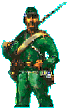
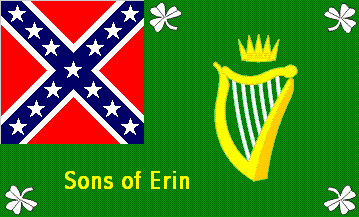
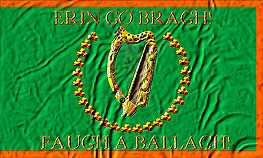
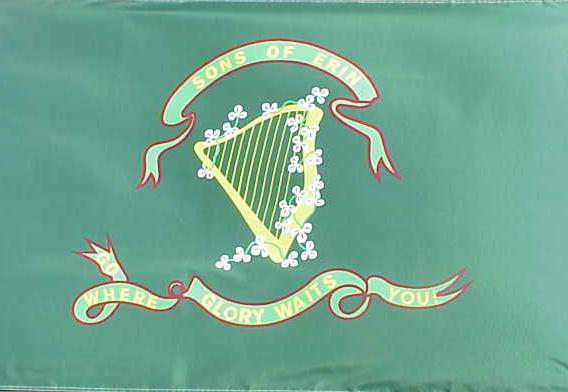
| ��������������� However, the south had many talented Irishmen on their side as well. Small units of Irish soldiers served in regiments from across the south. Most of these units had proud names reflecting their heritage such as the Sarsfield Guards, the Southern Celts, the Irish Volunteers and the Irish Tartars from Louisiana; the Emmet Guards of Virginia and the Emerald Guard of Alabama. Those men, the Emerald Guard, were part of the 8th Alabama Infantry and wore dark green uniforms when they first marched off to battle. The southern Irishman George Washington Parkhill of Richmond, Virginia formed the Howell Guards who trimmed their Confederate grey uniforms with Irish green. The Emerald Light Infantry and the Irish Volunteers came from South Carolina. In Louisiana an Irish unit formed up and took the name of the famous firebrand from back home calling themselves the Meagher Rifles. When they found out that Meagher had cast his lot with the Union they changed their name to that of another famous Irish nationalist, who was an ardent Confederate sympathizer, calling themselves the Mitchell Guards. The 10th Tennessee Infantry was a largely Irish unit and carried a green flag into battle with the Irish harp and the proud inscription: Sons of Erin. |
|
|
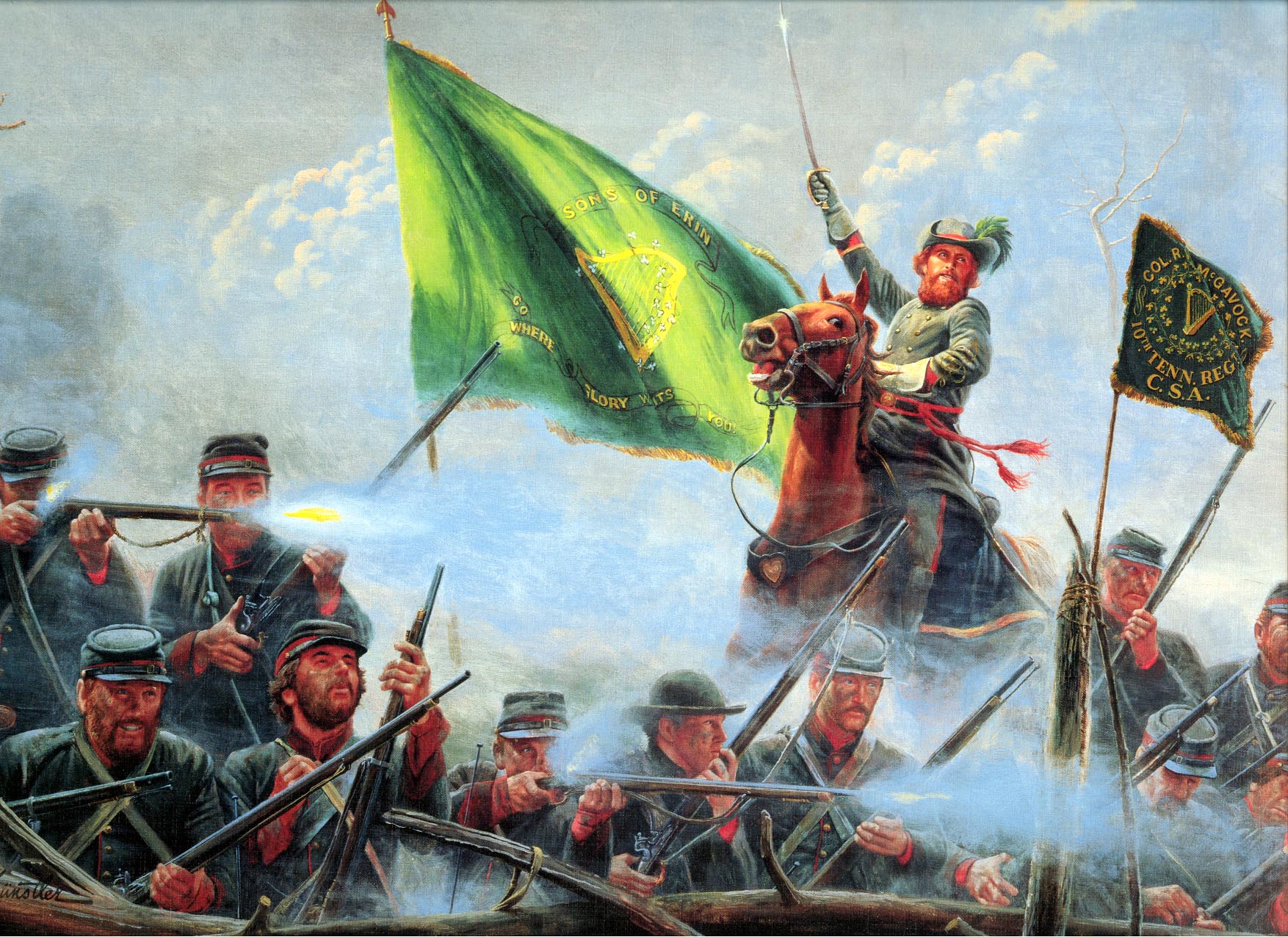
| ��������������� One particularly adventurous Irish Confederate soldier was 19-year-old Patrick Griffin of the 10thTennessee. At the bloody battle of Raymond he was struggling to carry away the body of his gallant, fallen commander Colonel Randal McGavock. He was overtaken by a Union officer with an Irish accent who demanded his surrender. As they talked it was learned that this Union officer, Colonel McGavock and the parents of young Griffin were all from the same county back in Ireland. Needless to say, the Union captain gave orders for the Confederate Irish colonel to be treated with the utmost respect and buried in town. Griffin said later, "I want to say right here that I am convinced that if ever there was a good Yankee he must have been Irish!" |
|
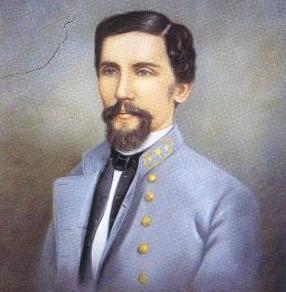
| ��������������� However, there was certainly no Irishman, north or south, who rose to such great fame as Confederate Major General Patrick R. Cleburne. I will certainly never forget him as the central Texas town of Cleburne was named in his honor. Born on the Feast of St Patrick he failed to become a doctor and joined the British army as a young man before buying his way out and moving to America, eventually settling in the state of Arkansas. When the great conflict came Cleburne cast his lot with the Confederacy and soon became a star in the western theater of the war (western meaning anything west of Virginia in this case). In time he became known as the Stonewall of the West in comparison to the legendary General Stonewall Jackson who was the best corps commander in the army of General Robert E. Lee. Cleburne has also earned the title from many historians of being one of if not the very best divisional commander of the entire war. There seemed to be no limit to how high his military star could rise until he got himself into political trouble by proposing that the south allow slaves to serve in the Confederate army and to emancipate them in return for their service. Unfortunately, the extent to which the Union had held up slavery as the moral justification for their invasion of the south only made more southerners cling to slavery as an absolute right and as a result Cleburne fell out of favor in Richmond. Yet, in the end Cleburne may have got some satisfaction from the fact that the Confederacy did eventually adopt the idea of arming slaves in 1865 though by that time any innovation was too little too late. Cleburne, sadly, did not live to see this, nor the collapse of his beloved Confederacy as he died, gloriously in battle, at Franklin, Tennessee in 1864. |
|
 |
|
|
General Patrick R. Cleburne |
|
|
|
| ��������������� All across the south, like their (misguided) brothers in the north, the sons of Ireland fought with great skill and heroism. In fact, the aforementioned Stonewall Jackson himself was of Scots-Irish ancestry, his family having moved from Ireland to England before migrating to America. Irishmen also served the Confederacy off the battlefield with great distinction such as the Confederate chaplain Father Peter Whelan. A Democrat and a firm believer in the right of secession, Father Whelan willingly volunteered his services to the Confederacy and first served as chaplain to the Irish Jasper Greens of South Carolina and later the Montgomery Guards. Assigned to Ft Pulaski he was present on the walls in the midst of battle when the fort was stormed and eventually overrun by Union forces. Although offered his freedom as a non-combatant, Father Whelan went with his comrades into Union captivity, administering the sacraments to the poor soldiers the whole time. This experience may have benefited Father Whelan though for what was to be his most famous assignment and that was ministering to Union prisoners of war at the notorious prison camp at Andersonville, Georgia. Due to the poverty engulfing the south because of the Union blockade the Confederates could not provide for their own soldiers, much less the enemy and conditions in Andersonville soon became horrific, especially after the Union halted the custom of exchanging prisoners. Disease and starvation were rampant, at one point Union prisoners were dying at the rate of 100 per day. In the midst of this hell on earth Father Whelan calmly and compassionately carried out his priestly duties, indifferent of his own safety, administering the sacraments to these Union men from the north. |
|
| ��������������� In Texas one Irishman who gained great fame during the war was Richard W. Dowling who was a successful saloon owner in Houston before the war. At the outset of the war he joined the Jefferson Davis Guards, a unit composed largely of the Irish immigrants who worked the docks of the busy Houston port. He fought in the battle of Galveston in 1863, known as the most humiliating defeat ever suffered by the United States navy. He was subsequently assigned to command the small earthen Ft Griffin at SabinePass. It was here, in late 1863, that he gained immortality when a massive Union invasion force of warships and troop transports carrying 5,000 men appeared intent on moving up river to attack the Lone Star state. Although he had only 44 men and a battery of artillery, Dick Dowling stood his ground. Since taking command of the tiny fort he had drilled his gunners in target practice until they knew the range of the pass perfectly. When the Union flotilla attempted to run past the fort he opened a withering fire on them. Dowling and his men scored hit after hit before the Yankees realized nothing was getting past the Irish Texans and their guns. The flotilla was turned back and the invasion plan thwarted by Dowling and his tiny battery of 44 men which captured 350 Union prisoners. As a result of this engagement, known as the most stunning, one-sided victory of the war, Dowling and his men received the only medal ever awarded by the Confederate States, made especially in their honor made of Mexican silver and inscribed with the words SabinePass, 1864. Lieutenant Dowling himself was commended by President Jefferson Davis and later assigned to recruiting duty where his status as a hero could be best put to use. His saloon became one of the most prosperous businesses in Houston after the war and a statue of him still stands in HermannPark and memorial services are still held, around St Patrick's Day, every year by the Dick Dowling Society. |
|
| ��������������� So, it is easy to see that from east to west, north to south, the Irish played a major part in the War Between the States and were vibrant and active in the brief but glorious life of the Confederate States of America. The extent to which the Irish impacted southern culture can perhaps best be illustrated by the famous Pulitzer Prize winning novel, and later Academy Award winning motion picture Gone With the Wind, which to many is the quintessential pop culture work on the war and the Old South. As everyone surely knows the story is that of the Irish Catholic O?Hara family who have become immensely successful in Georgia and are deeply devoted to their southern homeland. Their love of the land they live on and determination against hopeless odds are characteristics they took with them from Ireland. It would not be the first time that historians and authors have looked at the life of the Confederacy and the southern culture as a whole as being very influenced by Irish and Scots-Irish Jacobite attitudes of local freedom against centralized power, holding fast to faith and old traditions and to an eternal love for lost causes and hopeless fights. Yet, perhaps the most fitting compliment to end with are the words of a Confederate soldier who had just laid down his arms following the surrender of General Robert E. Lee in 1865. He defiantly told his northern captors that the only reason the south was vanquished was because "yall just had more Irishmen than we did". |
|
|
 |
|
|
 |
|
|
|
Ireland and Old Dixie Forever! |
|
|
|
|
|
|
|
|
|
10th Tennessee Flag |
|
|
|
|
|
|
Emerald Guard Flag |
|
|
|
 |
|
|
Colonel McGavock and the 10th Tennessee at the Battle of Raymond: "Rebel Sons of Erin" by Troani |
|
|