 |
|
|
|
|
|
|
|
|
|
|
|
|
|
|
|
|
|
|
|
|
| The Fenian Raids: Irish Invasion of Canada |
|
|
|
 |
|
|
 |
|
 |
|
|
|
 |
|
|
|
|
|
|
|
The Fenian Raids, like many aspects of Irish history, mean different things to different people. To some, they were a heroic effort by Irish soldiers to liberate their homeland from British rule. Others view them as nothing less than criminal invasions by terrorists attempting to hold a nation hostage. There are also those who simply view them dispassionately as an aftershock of the American Civil War, a sort of adventurous military romp by audacious Irishmen. Actually, all of these perspectives are partly true. The Fenian Raids were a series of attacks carried out by Irish veteran of the Union army fresh from victory in the War Between the States. Their glorious, albeit rather hair brained, goal was to invade and hold a portion of Canada in an effort to force the British Empire to give independence to a new Republic of Ireland. In fact, the Fenians were the first to use the now controversial name; the Irish Republican Army. |
|
|
These raids, launched from the United States of course, came at a time of high tension between the USA and the British Empire. The Trent Crisis, the seizure of the Chesapeake and the St Albans Raid as well as the success of the British built Confederate commerce raider CSS Alabama all caused the US to view Great Britain as an enemy. The Irish veterans certainly had many and age old reasons for thinking so and now there was a huge number of trained, battle hardened Irish soldiers with love for Ireland and hatred for Britain in their hearts with little to do. This is where the Fenians come in. The Fenian Brotherhood was a specifically militant Irish republican group (officially secret though they did a terrible job of keeping anything secret) which aimed to establish a united nationalist front for Irish Catholics and Protestants to create an independent Republic of Ireland. It made some noise in Britain but never got very far as the British had little trouble discovering their plans and stopping them before they could come to fruition. America was another story. |
|
|
The Fenian Brotherhood found great success in America where it could not be molested by British authorities and where it took on the character of an immigrant group rather than one focused on religion and Irish politics. Many of the leaders were veterans of the Young Ireland movement who had been forced into exile after the failed uprising of 1848 in Ireland. This was the case with Fenian leader Colonel John O'Mahony, one of the founders of the Irish Republican Brotherhood and he established the American branch of that organization which became known as the Fenian Brotherhood. Originally this was intended only to raise support for the armament of the Irish branch but in time it became much more. O'Mahony was a significant leader in the Irish immigrant community and became colonel of the famous 69th New York Infantry Regiment during the American Civil War, probably the most famous Irish unit in the US Army. He also played a major part in the planning of the Fenian Raids into Canada. |
|
|
O'Mahony is alleged to have come up with the name of the Fenians while translating a history of Ireland and being inspired by the deeds of Finn McCool and the knights of the Fianna. In time the organization developed armed militia units across the United States such as Corcoran's Irish Legion (named for General Michael Corcoran who died in the Civil War) and the Phoenix Brigade from New York City, the O'Mahony Guards of San Francisco and the Emmet Guards of Richmond, Virginia to name a few. When the Civil War broke out these units rushed to the colors though not all the Fenian leaders were happy about it. The Protestant nationalist James Stephens, for one, said that Irish independence was more important that preserving the size of the United States and warned Irishmen that they would be fighting each other. Few listened, though Stephens proved correct and numerous battles saw Irishmen in blue and gray killing each other for their respective adopted countries. Yet, the Fenian leaders looked for a silver lining to the cloud of being ignored by their members and found one in the fact that this war would give Irish Americans battle experience and create a foundation for an Irish army that could later be used to liberate the homeland. |
|
|
In the course of the war this led to the creation of a sort of paper republic in New York City which set about doing all the things that other countries do such as raising a military, issuing credentials and dealing with foreign (i.e. the United States) powers and establishing a constitution, in this case largely copied from the American model. When O'Mahony put forward the notion of an invasion of Canada as a prelude to the liberation of the homeland he was impeached and removed but this only split the organization as he set up his own organization which appealed to those who favored immediate action. Even some of those he broke with later came over to his way of thinking as the prospects for such a plan working seemed more plausible as the Civil War came to an end. The Irish had purchased a great deal of surplus arms and had a large number of well trained and experienced veterans who were patriotic Irishmen ready to fight for the cause of liberty in the homeland. Some of the more Americanized members also saw this as an opportunity to annex Canada to the United States, a dream long held by many Americans but which had been thwarted in the War for Independence and the War of 1812. |
|
|
In 1866 O'Mahony, hoping to beat his political rivals to the punch, began to organize his volunteers for an army of liberation fighting on behalf of an Irish republic that existed only on paper. Their first action was the Campo Bello Island Raid. This was an island claimed by both New Brunswick and the state of Maine and thus the Fenians hoped that, regardless of the outcome of their raid, trouble there might spark a clash between the United States and the British Empire which would serve their purposes. The raid was launched in April of 1866 but, unfortunately for the Fenians, it was squashed before it ever even got off the ground when Union and British gunboats patrolling the border intercepted them and turned them back. A lack of foresight and no small amount of arrogance meant that the would be raiders had no provisions and had to beg their way home in humiliation. The Irish incursion into Canada had, needless to say, got off to a very bad start. |
|
|
 |
|
|
|
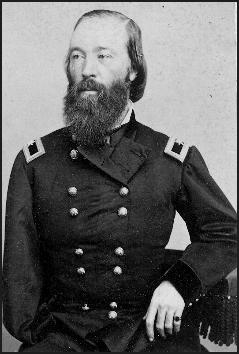
General "Fightin' tom" Sweeny, IRA |
|
|
|
The next raid was planned by the Irish General Thomas Sweeny and got underway in May of 1866. His idea was to enter Canada, grab some land along the St Lawrence River and use it as a base of operations for privateers to attack British shipping on the river in order to force Britain to make concessions to Ireland with the ultimate goal being the hoped for liberation of the entire country. Buffalo, New York was to be the jumping off point of the invasion. Some of the troops had traveled considerable distances to take part. Colonel John O'Neill had come from Nashville, Tennessee starting on May 27 with the grandly named 13th Regiment of the Irish Republican Army of 150 men. In Louisville, Kentucky they were joined by another 150 men of the 17th IRA Regiment under Colonel George Owen Starr and later by another hundred men under Captain James Haggerty. Wearing civilian work clothes they pulled into Cleveland, Ohio late on May 28 where they expected to meet brevet US Brigadier General William Francis Lynch with boat transport to Canada. |
|
|
Once there, however, General Lynch was nowhere to be found nor were the boats. After political leaders tried to communicate with the Fenian high command, General Charles Tevis in Chicago, Illinois, General Samuel P. Spear in St Albans, Vermont or General Michael C. Murphy in Malone, New York they finally got word from General Sweeny to continue by rail to Buffalo along with the 18th IRA Regiment from Ohio under Colonel John Grace. When they reached Buffalo they found the USS Michigan prowling the harbor with armed US Marines on deck; they had to act carefully. They loaded ammunition into furniture wagons while US officials were trying to asses the information and confirm the reports coming in that Fenian soldiers were on the move north all across New England. Sweeny had ordered his men to come by circuitous routes to throw off British and US spies while Fenians in conspicuous green uniforms left Cleveland in all directions. |
|
|
Eventually though, the intentions of the Fenians could not be masked. British officials determined that they were massing in the Malone - St Albans region, possibly intending to cross the Niagara at Buffalo and so they put their forces on the alert. The British also called out the Upper Canada Volunteer Militia and ordered the Toronto Militia and those on guard at the Niagara peninsula to move to Port Colborne. General Sweeny ordered Colonel O'Neill to cross the Niagara at Buffalo with the 7th IRA Regiment on barges pulled by steam tugs on June 1, 1866. He was to have the top command in the subsequent campaign, if so grandiose a term can be used for a raid by a few hundred men. While other Fenian forces demonstrated to confuse onlookers newly promoted General O'Neill prepared to take his force, swelled to about a thousand men, across the river to Canada. |
|
|
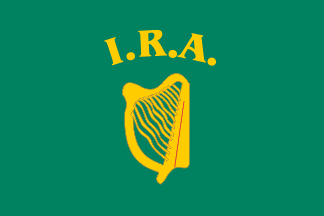
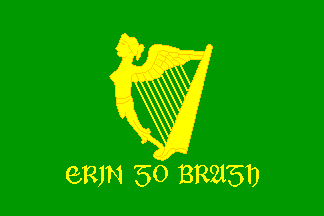
For being more or less a private army, the Fenian IRA was a rather impressive sight. O'Neill was dressed in grey with a green cap, many soldiers wore black slouch hats which had become popular during the war, the troops under Starr from Louisville wore blue army jackets with green facings and the Ohio Fenians under Grace donned green shirts and caps. They marched under five banners, two being US national flags and the others being green flags of the Fenians, two featuring their symbol of the golden sunburst and plow and the other a golden harp with the initials I.R.A. which would be the most famous standard. Captain Shields would command the Tennessee regiment formerly under O'Neill, Colonel Starr would have the Kentucky and Indiana detachments. Starr was to make for old Fort Erie, seizing any train stock he encountered, cutting telegraph wires and tearing up railroad tracks as he went. O'Neill, with the New York, Ohio and Tennessee Fenians would secure the fort and set up defenses. At 3:15 AM the Irish Republican Army was moving across the river. |
|
|
As the troops landed on the Canadian side of the river they received their rifles and all went more or less according to plan. By 5AM Colonel Starr had a Fenian flag flying over the decaying walls of Ft Erie and other troops were busying themselves tearing up railroads and telegraph lines. However, at that very moment in Toronto British troops of the Queen's Own Rifles were marching south to confront the Irish raiders. O'Neill planned to make a feint toward the British assembling at Chippawa and then turn suddenly to strike at Port Colborne. With the USS Michigan blocking off Buffalo the Fenians in Canada were totally on their own and the British were closing in. The Fenians made their feint, did indeed get the attention of the British and then turned toward the little town of Ridgeway, setting up on the only available high ground; Lime Ridge on June 2, 1866. |
|
|
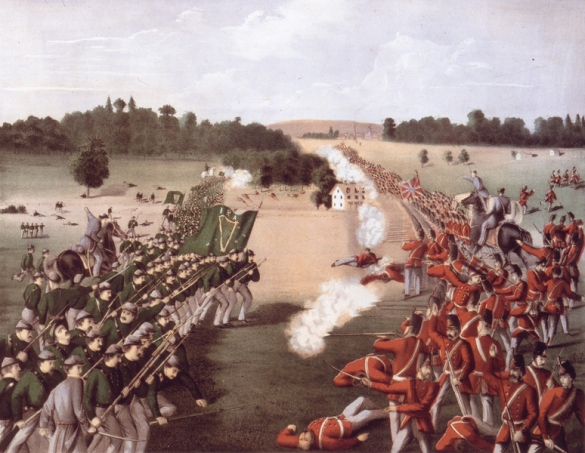
The scene was set for the largest battle of the Fenian raids with about 500 Irishmen under O'Neill arrayed against 850 Canadian militia under Lt. Colonel Alfred Booker. O?Neill hoped to defeat them before they could be reinforced by the British force of over a thousand massing at Chippawa. It would be no easy fight though as he was outnumbered and portions of the Queen's Own Rifles had been armed with the new American developed Spencer repeating rifles which allowed them to maintain a much greater volume of fire. As Booker and his men advanced it was the 5th company of the QOR which was the first to come under fire from Fenian skirmishers after crossing the Garrison Road. They returned fire on the Irishmen with their Spencer repeaters, pouring out a hail of bullets but also quickly depleting their issue of ammunition in the process. The first and second companies were soon brought up and deployed to the left and right of the fifth. More troops were deployed and pressed on until they ran into the Fenian main defensive line and a devastating fusillade of rifle fire. |
|
|
|
 |
|
|
|
The Canadians brought up more support and began to make progress, pushing the Fenians back. O'Neill may have been falling back to lure the Canadians into a trap but it is impossible to say with any certainty. However, the Irish position was coming under considerable peril when a panicky Colonel Booker gave them a reprieve. Fenian scouts had been riding in and out reporting on the disposition of the British forces in the area and at one point Lt. Colonel Booker mistook these scouts for cavalry and had his bugler relay the order for all ranks to prepare to repel a cavalry charge. The order was soon countermanded but not before confusion began to spread as some redcoats fell back and began forming a square; the classic formation for cavalry defense. Officers tried to regain control of the situation but it was difficult in the unfolding muddle. |
|
|
The tide turned and panicked Canadians began to run, trampling over some of their comrades who were trying to stop them and restore some order to the situation. The Irish saw their opportunity and charged forward to drive them from the field. The Canadians retreated back toward Ridgeway with the Fenians nipping at their heels. Officers attempted to rally their men to stand fast but it was to no avail. A general route ensued as soldiers and civilians alike were caught up in a confused, terrified flight. Officers screaming at the men to halt were ignored as the Canadians continued running on toward Port Colborne, leaving the Fenians to occupy Ridgeway. The appropriated food but otherwise did no harm to the town and respected property. This minor military disaster for the British caused quite an uproar as participants tried to explain their miserable performance. Some claimed that the Fenians had the Canadians vastly outnumbered and were equipped with far superior weaponry. This was certainly not the case as it was the Canadians who had the Irish outnumbered by several hundred men and although arms were mostly the same it was the Canadians who also had a slight edge in weaponry with their Spencer repeating rifles though they carelessly wasted ammunition. Needless to say the accusations and inquiries would go on long after the threat of Irish invasion had ended. |
|
|
Meanwhile, upon learning that the Irish had occupied the town of Ft Erie the British command dispatched Lt. Colonel John Dennis with 108 Canadian militia via gunboat to investigate. When Dennis found the town seemingly deserted and no Fenian troops downriver he returned and disembarked at Ft Erie to cut them off as he was certain that they would be defeated by the main force and would soon be returning in retreat. However, when the Fenians arrived it was with the bulk of their force and they were returning triumphantly, not defeated and disorganized. The June 2 battle of Fort Erie resulted with the Fenians making short work of the overconfident Canadian militia and sailors under Dennis. The Irish swept the field and ultimately captured almost the entire Canadian force that had come ashore. They did not capture Colonel Dennis however who cowardly exchanged his uniform for civilian clothes and abandoned his command. |
|
|
Those troops still on the river returned to Port Colborne with Ft Erie still firmly in Irish hands. However, despite these victories, O'Neill could see that his position was untenable. With his few hundred volunteers he was being moved in on from all sides by roughly 5,000 soldiers and not simply the untested Canadian militia he had faced so far but well trained and disciplines British regulars. Furthermore, with the USS Michigan on the Niagara blocking the rest of the Fenian troops from joining him he could expect no reinforcements from the United States side. As night fell he put into effect his retreat across the river to New York where they quickly surrendered to a naval landing party from the Michigan near Buffalo. The first and most significant Fenian Raid was over and would not be forgotten by anyone in Canada, Britain, the USA or Ireland and the Fenians felt rather proud of themselves upon reflection. The battle of Ridgeway marked the first Irish victory over British forces since the battle of Fontenoy in 1745. Their raid was another military case of winning the battles but losing the campaign; and a campaign it was for the Fenians were determined to struggle on. |
|
|
|
The Fenians released all the prisoners they had taken before returning to US soil but the Irishmen taken prisoner by the British were not so fortunate. On June 4 they arrived in Toronto, chained in pairs and were pelted with garbage by Canadian mobs. The 117 men were held until their trial in the Fall and which point 21 were found guilty and seven of these were sentenced to be hanged on December 13, 1866. One of these condemned seven was Father John McMahon the chaplain of the Irish Republican Army. Catholic communities in Quebec and the United States were outraged at such a sentence for a Catholic priest and eventually Church intervention saw his sentence commuted to a prison sentence at hard labor. None of the other executions were actually carried out either though the hapless Father McMahon was the last Fenian prisoner to be released. |
|
|
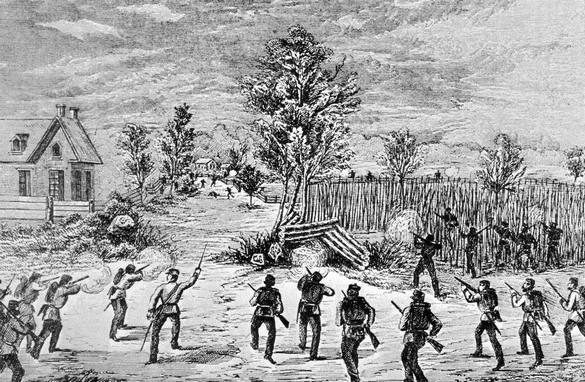
On June 6, 1866 a small Fenian force under US Army General Samuel Spear entered Quebec north of St Albans, Vermont and made a brief show before surrendering to US forces two days later. Their skirmishes with local militia caused only about 15 casualties on both sides including a woman who mistakenly walked into the line of fire of some Canadian troops. US Generals Grant and Meade came to the border to survey the situation and President Andrew Johnson ordered the seizure of all Fenian military stores that could be found and eventually authorized the arrest of anyone even suspected of being a Fenian. However, most British and Canadians believed that the US government could have stopped the raid entirely had they desired to and accused the American government of being purposely neglect in allowing some Fenians to cross the border because of their lingering hostility over British sympathy for the Confederacy during the Civil War. Furthermore, the US government was rather lenient with the Fenians they captured though this probably had less to do with international grudges than with the reluctance of political officials to risk angering the considerable bloc of Irish voters in upcoming elections. |
|
|
|
 |
|
|
|
There was another minor Fenian raid in July of 1866 at Pigeon Hill but it was not until 1870 that another significant effort was made in what came to be known as the Mississquoi County Raid. Fenian veterans General John O'Neill and General Samuel Spiers were to lead this attack which assembled in Vermont on May 25, 1870 but O'Neill was stopped by American police at the border and arrested, leaving General Spiers in sole command. A respectable force, this Fenian army also included an artillery arm but it also included a man named Thomas B. Beach who was a British spy who had infiltrated the Fenians and was passing on information about their movements. The British were thus alerted and local forces quickly spotted the Irish army as it moved into Quebec. A force of Canadian militia met the Fenians at Eccles Hill and the battle commenced though the skirmishing caused little harm to either side. The decisive moment came when Lieutenant Colonel William Smith arrived with a cavalry battalion and charged the Irish lines causing the Fenians to break and beat a hasty retreat, leaving their canon and wounded men behind. No Canadians were killed. |
|
|
There was a subsequent operation known as the Pemina Raid the following year when a group of Fenians made a foray into Manitoba but it was stopped with relatively little fuss or fanfare. For some time Fenians in the Pacific Northwest agitated for an invasion of British Columbia but such an operation never got off the ground and remained the domain of idle talk and wishful thinking. The Fenian Raids were over and Fenian operations in Ireland were also stopped though as usual British retaliation after the fact did more to help the cause of Irish nationalism than the many failed efforts of the Fenians themselves ever did. The Canadians were furious at the United States for not doing more to stop the raids and for hints that they may have even backed them had they been more successful. It was not until World War I that British and American relations fully recovered from the mutual hostility lingering from the Civil War and the Fenian Raids. The raids were also a microcosm for the struggle in Ireland as a whole. The Orange Order played a prominent part in opposing the raids and the response of Canadian Irishmen the Fenians tried to recruit depended a great deal on whether one was Catholic (who tended to support or at least sympathize with the Fenians) or Protestant (who tended to support Protestant Great Britain). They did also give the Irish a surge of pride, a reason to hope and a reminder that the struggle went on though the idea that they could have ever forced the British Empire to change policy by occupying Canadian soil was surely the purest fantasy. Nevertheless, no one can say that in the overall struggle for Irish liberation, the Irish in America did not try to do what they could, where they could to further than long sought after goal. |
|
|
|
We are the Fenian Brotherhood, skilled in the arts of war,And we're going to fight for Ireland, the land we adore,Many battles we have won, along with the boys in blue,And we'll go and capture Canada, for we've nothing else to do.-- Fenian soldier's song |
|
|
 |
|