 |
|
|
|
|
|
|
|
|
|
|
|
|
|
|
|
|
|
|
|
|
|
|
|
|
|
|
|
|
|
|
 |
|
The Easter Rising |
|
 |
|
|
|
|
First Glimpse of Irish Independence |
|
|
|
|
|
 |
|
|
|
 |
|
|
|
The Easter Uprising of 1916 is one of the pivotal events in the history of the modern Republic of Ireland and, perhaps, one of the most interesting things about it was that it might not have been. This, admittedly amateur, effort to rebel against Great Britain in the name of an independent Ireland came during the hard days of World War I and could be regarded, with the dispassionate eye of history, as nothing all that special. After all, it had become something of an Irish tradition for mismanaged uprisings against Britain to break out whenever Britain was in a major war with another power. However, the Easter Rising of 1916 was to gain a unique distinction from all the rest. This was not necessarily because of anything the Irish managed to accomplish; as usual the uprising was a resounding failure, however, because of the timing, political trends and the reaction of the British, it would come to be seen as a prelude to actual Irish independence. |
|
|
The Easter Rising of 1916 was the most significant Irish rebellion since the 1798 Rising in which the Irish were supported by Napoleonic France with whom the British Empire was at war. History repeated itself and it was with the outbreak of World War I that the first stirrings of rebellion were aroused. Ironically enough, Ireland had seemed to be more stable than ever at the start since the Catholic Emancipation Act had been passed and a measure of autonomy was finally achieved with the passing of the Home Rule Bill. However, the outbreak of war against Imperial Germany saw Home Rule repealed by Britain which angered many Irish patriots. Irish republican groups saw the possibility of the world war as an opportunity in keeping with the old Irish saying that the misfortune of Britain equaled hope for Ireland. However, not all Irish nationalists were united. Some felt that peace with Britain and loyalty to the war effort would win British sympathy for Ireland. Others felt that this was the time to strike and declare an independent republic, possibly with the support of Germany just as Irish rebels had previously been aided by France. |
|
|
It might surprise some to know that Sinn Fein was not among the firebrands. At that stage Sinn Fein was still a rather moderate nationalist party that wanted full rights for Irish Catholics and self-government in a dual monarchy with Great Britain. In fact, statistics would indicate that perhaps a majority of the Irish favored taking the side of Britain in the war and many Irishmen volunteered for the British war effort. There were dissidents though who took the Fenian point of view and began looking for ways that the war could benefit the Irish fight for independence. These included the Irish Republican Brotherhood (which organized things behind the scenes), troops of the Irish Volunteers under the idealistic Irish Catholic lawyer Patrick Pearse, the Irish Citizen Army of James Connolly and 200 fighters of the League of Women or Cumann na mBan (which is still listed as a terrorist group in the UK but not in the USA). The plan took shape in 1915 and focused on Dublin but hoped that the rebellion would spread from there across the countryside as all Irish would rush to the colors to embrace the cause of independence; or so it was hoped. Contact was also made with the Germans who were perfectly willing to lend a little assistance if it would hinder the British war effort against them. |
|
|
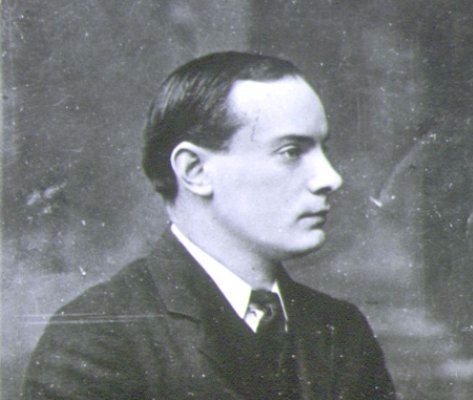
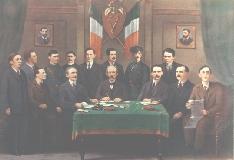
It has since become a little controversial as to just what the rebel leaders realistically hoped to achieve. The vision of an uprising in Dublin that could stand long enough to rally the entire country to its side and prevail against the combined might of the British Empire seemed a little far fetched. Some have argued that there was never any real hope for this at the top of the rebel leadership but that the effort was meant simply as a symbolic act to spark a new republican movement and, in a very Catholic way, provide some blood of martyrs to be the seed bed of an independence effort that would be successful. In any event the uprising was set for Easter week 1916 and the symbolism this represented for Catholic Ireland was no accident. This was to be, as Patrick Pearse would say, the blood sacrifice like Christ on the cross which would pave the way for the resurrection of a free Ireland. The plan was hatched by members of the Irish Republican Brotherhood and included Patrick (Padraig) Pearse, Tom Clarke, Sean Mac Diarmada, Eamon Ceannt, Joseph Plunkett and Thomas MacDonagh joined later by socialists such as James Connolly (leader of the Irish Citizen Army) and Countess Constance Markievicz. |
|
|
 |
|
|
 |
|
|
|
|
|
|
Eoin MacNeill, founder of the Irish Volunteers, had tried to steer a middle course and urged his militiamen not to fight for Britain but to make no trouble with the British either. He was, therefore, left out of the conspiracy but was still a central figure as the planners hoped to make use of his soldiers who were due to hold maneuvers at the same time. Even if they did not join in the fight they could be useful as a distraction for the British while the rebels strengthened their position in Dublin. Arrangements were also made for weapons to be smuggled in from Germany by way of a secret delivery to the Irish coast by a German ship disguised as a Norwegian trawler. This part, however, did not go exactly as planned. Roger Casement was arrested on Good Friday on the coast of County Kerry after being dropped off by a German U-Boat and the weapons were impounded by the British. He also carried the news that no further help could be expected from the Kaiser. It should also be said though that it is a debated point just how much the plotters were counting on German support. The British had won an early victory and could be forgiven for thinking they had nipped the rebellion in the bud. In this regard the British were a victim of their own success as they proved quite adept over the years at keeping track of rebel activities and had probably grown overconfident. |
|
|
This was exacerbated by the actions of MacNeill who ordered his troops to stand down in what was looking to become a highly tense moment which would likely be the ruin of all involved. His action caused many to think that the planned rebellion had, therefore, been called off but the ringleaders only postponed the uprising by a day. So it happened that the action got underway on Easter Monday 1916 though the earlier confusion meant that not as many as expected actually turned out. The Dublin division of the Irish Volunteers consisted of four battalions; the first was led by Commandant Ned Daly and mustered at Blackhall Street and consisted of about 250 men who were to occupy the Four Courts. The second battalion of 200 men under Commandant Thomas MacDonagh assembled at St Stephen Green and were to occupy a biscuit factory with other elements to gather at Fairview but later diverted to the General Post Office. The third battalion of 130 men was led by the soon-to-be famous Eamon de Valera who were to occupy a bakery and finally there was the fourth battalion under Commandant Eamon Ceannt of 100 men who assembled at Emerald Square to occupy South Dublin Union. All of these locations were chosen for their strategic importance to block expected British attack routes. The plan was to take these areas and hold them while calling on the populace to rise up for independence. Commandant James Connolly and 400 troops of the Irish Volunteers and the Irish Citizen Army were to assemble at Liberty Hall with detachments intended to occupy, among other areas, City Hall. The rest were to focus on the General Post Office which was to be the headquarters of the soon-to-be-declared Irish republic. |
|
|
|
 |
|
 |
|
|
|
|
|
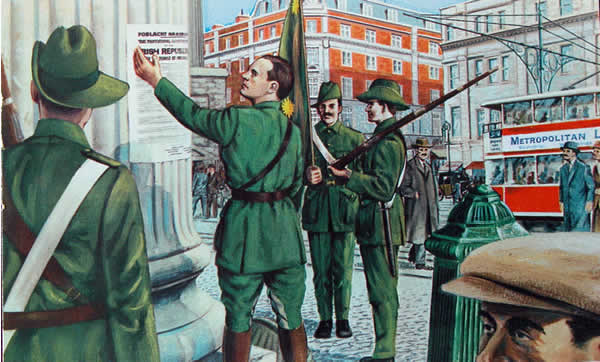
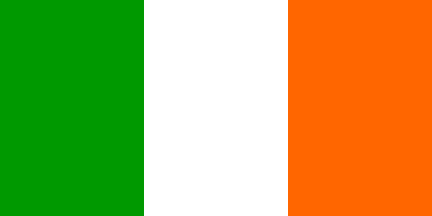
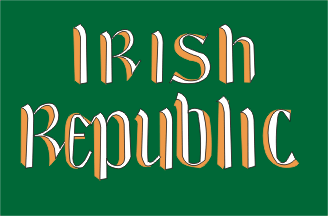
The rebels were able to seize their targets with little difficulty and attention was focused on the General Post Office. While Irish troops erected barricades and prepared to defend themselves Padraig Pearse read out a declaration of independence from the steps of the Post Office while two flags were raised over the building; one the familiar Irish tricolor and the other a green flag bearing the words IRISH REPUBLIC. To their surprise, there was no immediate response by the British which mostly had to do with the fact that, aside from being caught off guard, the British only had about 400 troops on hand as opposed to more than a thousand Irish rebels. The British held their positions and called for reinforcements to crush this uprising which from the outset seemed to most onlookers to be more of a dramatic gesture than a real military operation. The Irish leadership in the GPO and their actions and intentions have, over the years, become a source of a great deal of debate and speculation. |
|
|
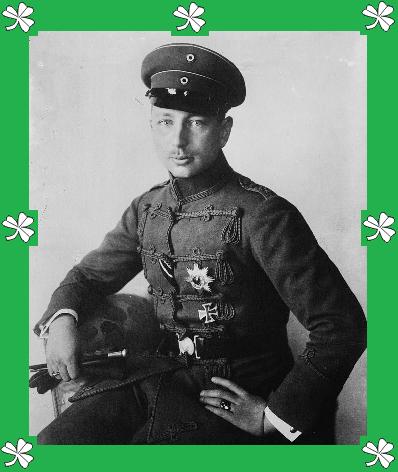
The common knowledge is that Padraig Pearse was named as the President of the provisional government for the newly proclaimed Irish republic, however, oddly enough for a group of Irish republicans mixed with not a few socialists, there was reportedly conversations in favor of a monarchy going on in the rebel headquarters. If success were to be a real possibility much seemed to depend on Germany winning the world war and even if not the possibility that Germany would win anyway (still a real possibility at the time) would have to be taken into account. There was, reportedly, talk then of gaining German favor by restoring the old Kingdom of Ireland with the Irish crown being offered to Prince Joachim of Prussia, son of Kaiser Wilhelm II. More has probably been made of this in the writings of later years than is deserved, but it is somewhat fascinating, and probably more than a little ironic, that serious consideration was given about the possibility of there being a German King Joachim I of Ireland had things gone differently. The Prussian prince, who probably had no idea he was the subject of discussion among Irish rebels, is oddly enough most known among some circles as a potential King of Ireland than for any of his own actual deeds or accomplishments. Hopefully he would have been expected to convert otherwise opponents could have pointed out that by replacing King George V with King Joachim I they were simply replacing one German-blood, Protestant monarch with another. |
|
|
|
 |
|
|
King Joachim I of Ireland? |
|
|
In any event, there was nothing symbolic or hypothetical about the response of the British. By intercepting the German weapons shipment they thought that they had stopped any potential trouble and were quite rattled when the uprising broke out anyway. As their forces gathered strength they cut off all access to Dublin and soon prepared to move in. The government in London, already under a great deal of stress because of the world war, was anxious to crush any and all opposition in Ireland and were not particularly concerned with being too careful about it. Their reaction might be understandable given the current state of affairs, but in the end they did their own cause more harm than good by the brutality of their counter-attack. The Lord Lieutenant of Ireland declared martial law and the Royal Artillery began shelling the city, by land and by sea, aiming for what were thought to be rebel positions but not being too careful about what they destroyed. In the process, far more innocent civilians were killed by the British shelling and onslaught than were actual rebels. This offensive began on April 26 and the Irish troops, though considered amateurs, fought with considerable discipline and tenacity. However, the British by now had both superior numbers and vastly superior firepower on their side and made slow but relentless progress pushing into the city. Some reports indicate that the British troops had been ordered to take no prisoners. Irish citizens were arrested on the street indiscriminately and much of the inner city was leveled by the British artillery. Many British troops also carried out summary executions and all too often the victims were innocent civilians who had nothing to do with the uprising. In the end only a little over 64 Irish rebels were killed compared to a death toll of over 200 Irish civilians. |
|
|
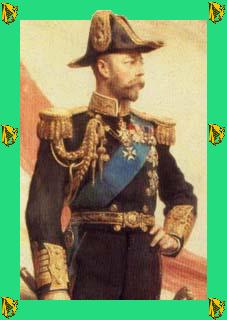
The British were certainly rattled at being caught off guard but even so they should have realized that this uprising did not actually have a great deal of popular support behind it. The countryside did not rise up against British rule and most Irish in Dublin met the rising with little more than bemused interest as a sort of defiant gesture. By coming down on the public in such an iron fisted way the British only forced public opinion into the republican camp. Slowly, one by one, the rebel positions folded and finally Padraig Pearse was forced to accept the British demand for an unconditional surrender. He ordered his forces to lay down their arms and went peacefully into British custody. The uprising ended formally on April 30, 1916 but the bloodshed, unfortunately, did not. The British were embarrassed by the whole affair and responded with swift and brutal force. Although it was not known at the time, King George V actually spoke up in defense of his unwilling Irish subjects and wisely urged moderation and forgiveness. He could see that violent retaliation would only breed further unrest and His Majesty was to be proven all too correct. Unfortunately for all concerned, the government took no heed of the advice of their monarch. |
|
|
|
 |
|
|
King George V |
|
|
|
Padraig Pearse, usually considered the President of the Republic of Ireland that was declared during the uprising, was the first of fifteen Irish leaders to be singled out for execution. His death was the first of many, but with Pearse the Irish Catholics gained their first political martyr and the image and words of this proud, young, eloquent patriot would inspire other Irish to resistance for generations to come. Oddly enough the British also, from the outset, placed blame for the uprising on Sinn Fein which was, at that time, not militant, radical or even republican. Yet, Britain made Sinn Fein, overnight, the most popular party in Ireland by blaming them almost entirely for the uprising which they had virtually nothing to do with. This is an important point however, because it shows the extent to which it was originally the British who made the Easter Uprising such a pivotal moment in Irish history. |
|
|
|
It is a simple fact that most people are apathetic and simply wish to live their lives in peace and will go along to get along. Most had been happy with home rule and many were upset to see it repealed but it did not lead to massive unrest. The rebellion across the island that was hoped for did not break out remember. Some of the Irish people in Dublin looked at the uprising as a dramatic, heroic gesture but nothing serious while others looked at it as a bunch of silly theatrics and others looked at it very negatively as a disturbance to their peaceful lives. No matter how bad things were, this last group saw the uprising as something that would only make things worse. Also keep in mind that virtually no one was hurt when the republicans took over these buildings and read out their declarations and if the British had moved in carefully and with restraint, simply arresting the ringleaders and taking them off to jail they may well have been seen derisively as a group of failed would-be revolutionaries with more drama than common sense. However, the British retaliation made everyone hate the British government all the more and by executing the 15 men the British Prime Minister turned a group of failed rebels into a group of Irish republican martyrs. Likewise, after all of this, by blaming Sinn Fein the British turned that party into the primary voice of Irish nationalist opposition to British rule and set the ball rolling for Sinn Fein to go from being a moderate (even monarchist) party to a radical republican party. |
|
|
Because of all of this the Easter Uprising, which was honestly a rather wild scheme that failed in its stated goals, became an honored memory and a rallying cry for all Irish afterwards to push for an independent Ireland and eventually a Republic of Ireland. In the end, it worked out to be just the sort of blood sacrifice that Pearse had spoken of. It was a disaster for the British in terms of world opinion and the 15 executed men were immortalized in poems for years to come. The same Irish public that had not supported the uprising embraced the cause and was determined to see that the leaders of it would not have died in vain. The guerilla war for independence that followed, the civil war and even the ongoing struggles to make Ireland a whole country all sprang, in some form or another, from the seed that was planted by the men of the Easter Rising of 1916 who, with little more than a dream and prayer, dared to challenge the mightiest empire on earth for the cause of Irish freedom. |
|
|
|
|
|