 |
|
|
|
|
|
|
|
|
|
|
|
|
|
|
|
|
|
|
|
|
|
|
|
|
|
|
|
|
General Patrick Cleburne |
|
|
|
The Stonewall of the West |
|
|
 |
|
|
|
 |
|
|
 |
|
|
|
|
|
|
|
|
|
 |
|
|
|
|
|
|
|
|
|
|
|
|
|
 |
|
|
|
|
|
 |
|
|
|
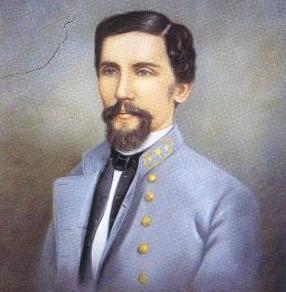
One of the most celebrated commanders of the War for Southern Independence, indeed one often acclaimed as the finest divisional commander of that war, was an Irish born veteran of the British army General Patrick Cleburne. He was easily the most famous Irish general on the Confederate side and possibly the most famous Irish general of the entire war and he almost certainly has enjoyed a greater reputation that some of his Irish brothers who fought for the north because of his great military skill. The Irish may have been more numerous in the north and the Irish Brigade of New York more famous, but there were plenty of Irish in the Confederate service including such units as the Tenth Tennessee, the Twenty-fourth Georgia and the Emerald Guards. They also had their own heroes and Cleburne was at the top of that list. Patrick Ronayne Cleburne was born, appropriately enough, on the feast of St Patrick in Ovens, County Cork, Ireland to the Anglo-Irish family of Dr. Joseph Cleburne. His mother died when he was only 18 months old and his father died and left him an orphan when he was only 15. He first started to follow in the footsteps of his father by studying medicine but failed his language requirement on the entrance exam to Trinity College of Medicine in 1846 and so decided instead to join the British army and enlisted in the Forty-first Regiment of Foot in which he eventually became a corporal. |
|
|
After three years of service for Queen Victoria he purchased a discharge and emigrated to America with his sister and two brothers, eventually settling in Helena, Arkansas. When he first landed in New Orleans, Louisiana he had nothing but fifteen dollars in his pocket and his Irish determination to succeed and make something of himself and this he did. He set himself up as a druggist and later became a land attorney and soon became a respected figure in local society. However, this was also a time of difficulty for immigrants and Cleburne himself was severely wounded in 1856 by a member of the Know Nothing Party which opposed immigrants and which was violently anti-Catholic (though Cleburne was a Protestant). By 1860 he was a naturalized US citizen, a local success story and good friends with Thomas C. Hindman, also of Helena, Arkansas, who would also become a general in the Confederate army but who was, at that point, a local Democrat politician. As the division between the north and south deepened there was no doubt where the sympathies of Patrick R. Cleburne lay. He was an ardent southern patriot and, like a number of other famous Confederate generals, he was opposed to slavery. Cleburne was adamant that slavery had nothing to do with the war for southerners, most of whom were far too poor to own slaves and certainly would not risk their lives so that the wealthy few could keep their own. |
|
|
When the war broke out and Cleburne cast his lot with the Confederacy he compared the situation in the American south to that in Ireland as an agrarian, less industrialized, less wealthy land of independent-minded people fighting for their rights against the British government that ruled them. The same could be said in description of the Confederacy against the Union. Cleburne enlisted in the Confederate army, first in the Yell Rifles, a local militia company, as a private. In keeping with the militia tradition, the Confederate army was democratic and Cleburne was quickly elected captain of the company. In January of 1861 Captain Cleburne led his men in the seizure of the US Army arsenal at Little Rock, Arkansas and following the secession of Arkansas and her joining of the Confederacy the Yell Rifles became part of the Confederate First Arkansas Infantry (later the Fifteenth) and Cleburne was quickly elected colonel of the new regiment. Within a short time he was a brigade commander and on March 4, 1862 was promoted to the rank of brigadier general. |
|
|
General Cleburne saw action in almost all of the major battles of the western theatre of the war. He served with distinction at the bloody battle of Shiloh where he was praised by his superior General William J. Hardee for his courage on the attack in taking his brigade to within 400 yards of the key Union position at Pittsburg Landing and where his men fought tenaciously and sustained forty percent losses. It was quite an exemplary performance for Cleburne who, though he was a veteran of the British army, had never been in battle before Shiloh. Following this experience Cleburne was wounded in the face (a bullet passed through his mouth and out his cheek) at the battle of Richmond, Kentucky during the offensive into that commonwealth in which the troops of Cleburne, now commanding a division, led the way and which was a key part of what many consider one of the most total Confederate victories of the entire war. After two months of recovery General Cleburne returned to service in time for the pivotal battle of Perryville in which the commanding Confederate General Bragg reduced Cleburne back to commanding a brigade and in which he displayed his tendency to snatch defeat from the jaws of victory. Nevertheless, Cleburne and his brigade succeeded in capturing a very well defended Union position and he also gave invaluable service in covering the withdrawal of the Army of Tennessee afterwards and saving a huge amount of badly needed Confederate supplies from being taken by the enemy. |
|
|
The Army of Tennessee under Bragg retreated from Kentucky to Tennessee and Cleburne again fought admirably at the battle of Stones River where he and his men drove the Union forces back three miles and routed the Union right flank and forced them to fall back to the Nashville Pike. In recognition of all of this service, on December 13 Patrick Cleburne was promoted to major general and by that time had started to be known by his famous nickname; the Stonewall of the West in reference to the legendary General Stonewall Jackson in the Army of Northern Virginia. He was well on his way to becoming known as the finest divisional commander of the war, north or south. At the bloody battle of Chickamauga in Georgia in 1863 General Cleburne led a rare night attack at the outset of what proved a stunning Confederate victory. In the ensuing disaster at Chattanooga it was again the Stonewall of the West, General Cleburne, who lived up to his name by holding the northern end of Missionary Ridge against vastly superior Union forces and afterwards, at the battle of Ringgold Gap he saved the Confederate army from total destruction by fighting a heroic rear-guard action before falling back to Tunnel Hill. The conduct of General Cleburne and his men were so impressive that they were voted the official thanks of the Confederate Congress in Richmond. |
|
|
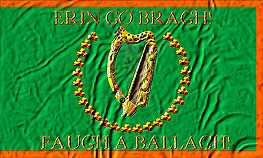
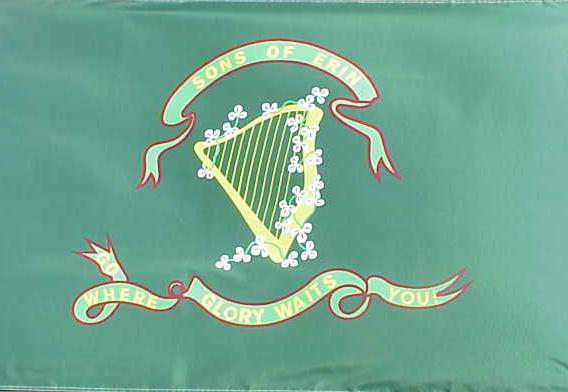
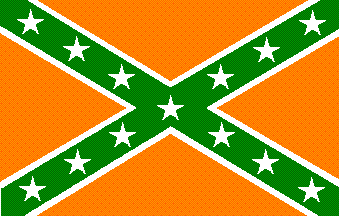
By this time Cleburne had become almost as equally well known among the ranks of his enemies who dreaded to see the distinctive blue flags of his division coming on to the field. It was, perhaps, a fitting counterpart to how the Confederates in Virginia dreaded seeing the green flags of the famous Irish Brigade of New York. Cleburne was known for his courage and clear head under fire, his tactical skill and steadfastness on the defense. Given his recognized talent one might wonder why he never advanced to a corps command and the answer to that lies in the realm of politics rather than warfare. Although Cleburne was friends with Confederate President Jefferson Davis (which certainly was helpful) he ran afoul of others in the Confederate government because of his opposition to slavery. The more the Union made the abolition of slavery a major war aim the Confederates became even more adamant in preserving it and not only was Cleburne not a supporter of slavery he was also one of those who favored enlisting Blacks into the Confederate army in return for their freedom. |
|
|
In the Winter of 1863/64 General Cleburne was bold enough to write a letter to the Confederate government urging them, for the sake of the survival of the nation, to abolish slavery and enlist the former slaves into the Confederate army to fight for their freedom at the end of the war. This earned Cleburne enough enemies that despite having friends in high places it probably killed his chances of advancing any farther in rank. However, it should be pointed out that in 1865 the Confederate Congress did finally agree to allowing Blacks to enlist in the army (with the support of General Robert E. Lee) but of course by then it was too little, too late. It also did not help Cleburne that he was an Irishmen and not a West Point graduate which worked against him as well to some extent. He was, however, quite farsighted in predicting that slavery would haunt the south and taint their struggle if they would be defeated as it would be the north that would write the history and portray the southerners in the darkest way possible. |
|
|
|
Nonetheless, Cleburne fought on with his usual skill and heroism in the battles throughout Georgia and also found a little time for potential private happiness when he became engaged to Susan Tarleton of Mobile, Alabama though, alas, the two were never to be married as Cleburne was not to survive the upcoming 1864 campaign into Tennessee under the command of General John B. Hood. His end came at the gloriously bloody battle of Franklin in which General Hood ordered a massive frontal assault on the Union fortifications. It was quite a sight to see, dwarfing even the grand charge of General Pickett at Gettysburg as the bulk of the Confederate army moved out in parade perfection with lines dressed, flags waving and drums beating to assault the federal lines on November 30, 1864. General Cleburne had his horse shot out from under him and he was last seen on foot waving his sword over his head as he led his men toward the Union lines before being cut down. More Confederate generals lost their lives at Franklin than in any other battle (six in total) and the body of General Cleburne was found, shot through the heart, just inside the Union lines, and was taken to a small field hospital on the Columbia Turnpike. Sadly the Yankees had looted his body and his boots, sword and watch were all missing. |
|
|
|
General Patrick R. Cleburne was first laid to rest near Mount Pleasant, Tennessee but six years later in 1870 was moved to his adopted hometown of Helena, Arkansas where he was ceremoniously buried in Maple Hill Cemetery on the Mississippi River. His old superior officer, Lieutenant General William J. Hardee said of him,"Where this division defended, no odds broke its line; where it attacked, no numbers resisted its onslaught, save only once; and there is the grave of Cleburne". In the years following his death counties in Alabama and Arkansas were named in his honor as were a town and a lake in Texas. The south mourned for him as it did few others and the Irish community in particular who saw him as their champion. In 1865 when the Confederacy fell conquered and General Lee was forced to surrender his army a Confederate soldier explained to one of his northern enemies that, "the only reason you won is that you had more Irish than we did". |
|
|
|
|
|
|
|
 |
|
|
|
 |
|
|
|