

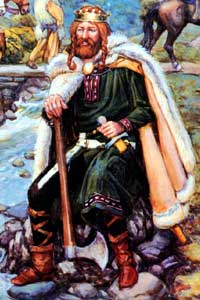

Brian's courage and endurance of many hardships won more and more Irishmen to his cause, and eventually the shame of watching his younger brother's patriotic heroism caused King Mahon to renew the war against the Danes as well. Alliances were made and Brian won a series of battles against the Vikings and rival Irish states. He adopted the weapons of the Danes, such as the battleaxe, to use against them to thwart their armor advantage. Brian made sure his army was well-disciplined, trained and cared for and in 977 he defeated the Munster Danes, killing their leader, Ivar of Limerick.
Brian Boru then turned against the Irish states that had allied against them and defeated each in turn. Others, still undefeated, pledged allegiance to him out of a sense of healthy self-interest. In 1000 Brian won another spectacular victory over the Danish Vikings at Glenmama valley, using the terrain to his advantage against the Danish cavalry in a brilliant strategic maneuver. Only two years later Brian Boru was crowned High King, a title used in the past in an "on again, off again" way for great Irish leaders and dynasties. In 1003 the states of Ulster and Connaught pledged their loyalty to High King Brian, officially making him the first leader of a united Ireland.
For 10 years there was peace in the united Kingdom of Ireland, until a rebellion was hatched by Maelmorra, the King of Leinster. He incited the Danes against Brian Boru and secured treaties with Viking leaders in Norway, England and Denmark. High King Brian called upon his loyal forces from across the island, assembling some 20,000 men. In 1014, on Palm Sunday, DublinBay filled with Viking long ships and on Good Friday, the Danes moved ashore to attack. By this time, the High King was 73-years-old and was persuaded to turn field command over to his son. Before departing for battle, High King Brian gave his men some parting words of courage, sitting on his horse, holding a sword in one hand and a crucifix in the other. While the Irishmen fought through the day Brian Boru prayed earnestly in his tent for the victory of his country. As the day drew to a close, the tide swept the Viking ships out to sea and the Irish forces cut off the Danish retreat, inflicting a stunning defeat and seeing the death of Maelmorra. However, in the heat of battle, High King Brian's son was killed by a Norwegian chieftain.
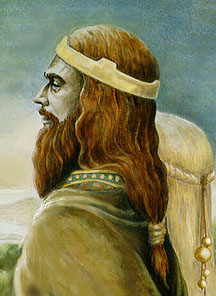
The battle had cost Ireland the life of High King Brian Boru and his son, a fact which ensured that the unity of an independent Ireland would not last long. However, because of this battle, and the Irish victory, as well as the heroism of Brian Boru in bringing his country to such a point, saved Ireland from Danish occupation and secured the safety of the Catholic Faith. He also proved that it was possible for Ireland to be free and united, which provided a lasting legacy of heroism and inspiration for countless future generations.