 |
|
|
|
|
|
|
|
|
|
|
|
|
|
|
|
|
|
|
|
|
|
|
|
|
|
|
 |
The Battle of the Boyne |
|
 |
|
|
The War of the Two Kings |
|
|
|
|
|
|
|
|
|
 |
|
|
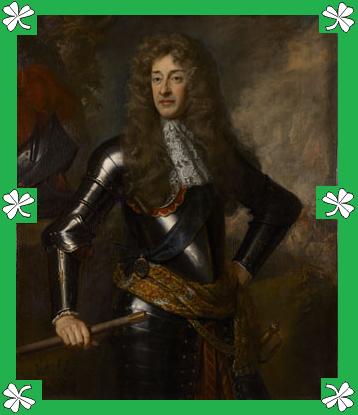
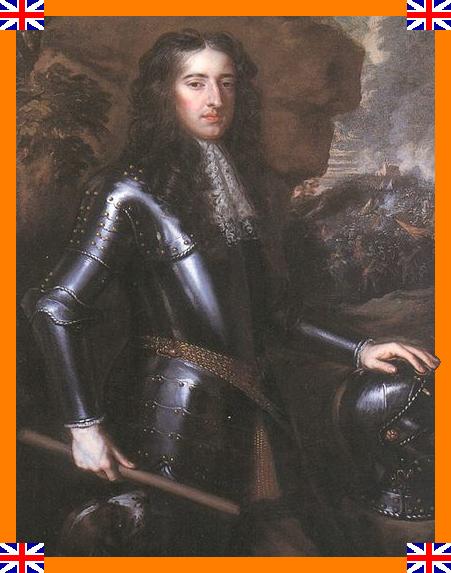
| The battle of the Boyne is one of the most significant battles in Irish history and it is commemorated every year, mostly by the victors, but despite its prominence the details of the battle are not as well known as one might think. The battle of the Boyne was the culmination of a war over the royal succession in the British Isles which started with the so-called Glorious Revolution of 1688 in which the lawful monarch, the Catholic King James II, was overthrown by his son-in-law the Protestant Dutch Prince William of Orange. However, this was a conflict with very deep roots that reached back at least as far as the English civil wars and the contemporary struggles in Ireland which ended with the conquest of Confederate Ireland by the Protestant dictator Oliver Cromwell. Mutual interest had caused Ireland to join the royalist camp in support of King Charles I who eventually lost his struggle and was executed by Cromwell who then led a campaign into Ireland so devastating that some have described it as a genocide. |
|
| Terrible laws persecuting and oppressing Irish Catholics were enforced and these lessened at least somewhat with the restoration of the monarchy under King Charles II though they did not go away. When Charles II died he was succeeded by his younger brother King James II who was a Catholic. The native Irish hoped that James, a fellow son of the Church of Rome, would repeal the oppressive laws and liberate the country. Indeed, King James II did try to institute religious tolerance (not just for Catholics like himself but for all Christians) but he was opposed by the fanatical Protestant elites who dominated Parliament. When King James II and his second wife Queen Mary of Modena had a son and heir the Protestant elites plotted with the Prince of Orange (who had married Princess Mary, daughter of James II by his first wife and a Protestant) to invade England with a Dutch army and overthrow his father-in-law, the legitimate monarch, and take the throne for himself as a pliant figurehead for the Protestant elites. When his most trusted officials and generals betrayed him King James II was forced into exile in France but he was determined to return and regain his throne. The first step in this grand campaign would be the island of Ireland where he trusted on the support of his Irish fellow Catholics who had fought for the Stuart throne in the Wars of the Three Kingdoms as well as the backing of his cousin King Louis XIV of France. |
|
| Although most attention has always focused on the King, the fighting in Ireland broke out before he arrived and would continue for some time after he had gone. A good reason for this is that, the Irish Catholics especially among all the Jacobites (loyalists of James) of the British Isles, were fighting for a principle more than a man. They had long been suffering under the tyrannical rule of the Protestant elites who had come over to Ireland, taken their land, driven them into the wilds of the country to starve and had kept them trampled under foot in every way. The Irish would fight for King James II because he offered relief and a better future, but with or without him they would fight for their own survival as a people as long as possible. As soon as things began to look shaky across the sea in Britain the Catholic Jacobites in Ireland began taking precautions to try to protect their cause and garrison important fortified cities with Catholic troops. Most of the English and Scottish settlers in Ireland were concentrated in Ulster and the first clashes began there, particularly the start of the siege of Derry on December 7, 1688 by Jacobite troops under the Earl of Tyrconnell. Later, on March 14, 1689 the Jacobites won a swift victory over the Williamites (supporters of William of Orange) in County Down at the Break of Dromore; so called because the Orange forces fled so quickly. |
|
|
|
 |
|
 |
|
|
|
|
| The Prince of Orange, who was declared King William III by his Parliamentary supporters, quickly sent troops to Ireland to enforce his rule. King James II finally came himself, arriving on March 12, 1689 during an inconclusive year of fighting between Protestant government forces and Irish Catholic guerillas. King James II repealed the harsh laws previously passed by the Protestant government and restored the lands and rights of the Irish Catholics. With the Jacobites seen as gaining the upper hand William of Orange finally came to take personal command of his forces in Ireland, arriving on June 14, 1690. Although the battle was, and is, generally considered one of Catholics against Protestants the actual situation was much more complicated. As a political matter at the time the Pope was opposed to King Louis XIV of France and by extension his ally King James II. Some of the Jacobite forces were Protestant English royalists and, on the other side, the best unit among the Orange forces was the Blue Guards made up largely of Dutch Catholics. Some fought for religious reasons, others for political reasons and still others simply for self interest. In any event, the struggle would go down in popular memory as one of Catholic versus Protestant; green versus orange. This was at least more true among the native Irish who were fighting for their freedom, their religion and rights to their lands which had been taken by the Protestants. |
|
| The two royals and their armies came together on the Boyne River in the east of Ireland near the town of Drogheda, the site of a terrible massacre by Protestant forces under Oliver Cromwell during the Confederate War. William of Orange had landed his forces at Carrickfergus and was marching on Dublin. The Jacobites fought a delaying action while James II prepared a defensive line at the Boyne River. The Orange forces numbered about 36,000 while the largely Irish Catholic army of Jacobites numbered about 25,000. The Irish were at a greater disadvantage though because of their lack of formal military experience in most cases and their lack of modern weapons. Many had no firearms at all and those who did, in many cases, were armed with antiquated matchlock muskets while the Orange troops had newer, more reliable flintlocks. William of Orange reached the Boyne on June 29 and was almost killed by Irish artillery while scouting the river for fords to cross his troops. The battle fought on July 1 (old calendar) centered around the control of one of these fords at Oldbridge. |
|
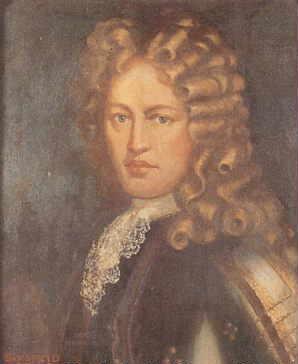
| At the outset, William of Orange attempted a flanking move by sending Meinhardt Schomberg (son of his second-in-command) with about a quarter of his forces (about 10,000 men) to another ford, Roughgrange, some six miles away. These troops pushed past the Irish dragoons under Sir Neil O'Neill after half an hour of heavy fighting which caused King James, fearing he would be outflanked, to rush half his troops (about 17,000 men) and most of his artillery to stop the Williamites. However, unknown to either commander, the area around the ford was dominated by an almost impassible ravine that prevented either side from getting at the other and meant that a large part of both armies would sit out the battle in useless inactivity. Meanwhile, with his Blue Guards in the lead, William attempted to blast his way across the Boyne at Oldbridge. His veteran troops with their superior weapons were able to push through the more lightly armed Irish infantry who nonetheless put up a tenacious fight. It was remarkable considering that, after the initial movement of troops, there were only 6,000 Irish Jacobites to defend against 26,000 Williamites. They eventually captured the village of Oldbridge itself but were halted when James II sent his cavalry charging in to pin them down. Some of the Orange forces were driven back into the river by the hard hitting Irish cavalry but others held firm and poured volley after volley into the Irish ranks, inflicting terrible losses. It was during this fierce fighting that the Duke of Schomberg (deputy commander of the Orange forces) and George Walker, an Anglican priest and leading Protestant, were both killed. |
|
|
 |
|
|
 |
|
|
|
Sir Neil O'Neill |
|
|
|
|
|
|
Patrick Sarsfield, Earl of Lucan |
|
|
|
|
| As the battle stalled things did not look good for William of Orange. His forces were holding their own but were being chewed up by the Irish horsemen while his own cavalry took losses trying to cross the river and come to the aid of the embattled infantry as the Irish put down a heavy fire from behind hedges and houses on the shore. Many troops were massed together in the river, up to their armpits in water, fighting for their lives. However, when the Orange cavalry arrived they were able to push the Irish back though the Jacobites gave ground grudgingly as they fell back to Donore to regroup. At midday William of Orange crossed the Boyne downstream at Drybridge from his infantry with about 3,500 cavalry. The Irish tried to make a stand at Donore where, at the local church, King James II originally had his headquarters. As the Orange forces moved against the heights at Donore the remaining Irish troops at Oldbridge were forced to fall back to Donore to aid in the fight and avoid being cut off . |
|
| For about half an hour the Irish Jacobites were able to hold off the Orange cavalry before being forced to fall back again to Duleek which they did with good order and discipline. During the heavy fighting there William of Orange was almost killed by one of his own men, which is not surprising given that about the only means of identifying the opposing forces was the sprig of green the Orange forces wore on their hats as opposed to the pieces of white paper worn by the Irish Jacobites. The Jacobite army converged on Duleek to avoid being crushed by the two wings of the Williamite army. The Irish and their allied forces again acquitted themselves quite well with the French infantry brigade fighting to cover the retreat and gaining considerable admiration. This allowed the Jacobites to retreat without taking very heavy losses. |
|
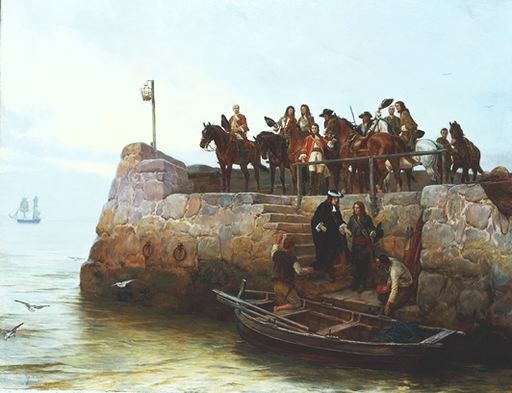
| By that time, King James II had decided to throw in the towel and ordered a retreat. As the Irish infantry fell back they were covered by their cavalry as the Jacobites withdrew behind the Shannon River to Limerick. The Orange forces soon besieged them there but by that time James II had left Ireland and William of Orange had marched triumphantly through Dublin. James II and his escort rode to Duncannon and from there he returned to exile in France leaving the resistance to go on under his most able Irish commander General Patrick Sarsfield. In all the years since the decision of James II to give up and return to France has been the subject of a great deal of controversy and criticism. To some extent it was a mistake and James II seems to have given up prematurely. After all, in spite of what the Orange side likes to portray, the battle was not a stunning victory or a crushing defeat and total losses for both sides were only about 1,500 to 2,000. The Irish had put up a ferocious fight and had fallen back in good order. They were still a potent fighting force. James II could also be criticized for not giving more responsibility to his most gifted commanders, especially General Sarsfield who carried on the fight after his departure. However, historians and others should be fair and any treatment of King James II is often very biased and unfair. Overall, the war was not going well for the Irish. The siege at Derry was not successful, Enniskillen could not be taken, the battle of Newtownbutler was a terrible loss and most of Ulster was firmly in Orange hands who had vastly superior forces than his own. The loss at the Boyne also caused many Scottish Jacobites to give up the cause of a Stuart restoration; at least this time. As with his elder brother Charles II the tragic fate of his executed father had to have been constantly in the mind of James II in all of his political troubles. |
|
|
|
 |
|
|
"Lost Cause" King James II leaving Ireland to return to exile in France |
|
| So, unfortunately, though he had once been their champion, James II is probably no more popular in Ireland than he is in Britain aside from perhaps a few diehard Catholics. He did, however, represent hope and brought at least temporary relief to the oppression that Catholic Ireland was suffering. The loss of the Boyne is generally one most Irish would rather forget but the Protestants and Unionists will not allow it and it is they, particularly the Orange Order, which have made the anniversary of the battle of the Boyne a major holiday in Ireland which they commemorate with numerous marches and parades. Today they claim to be celebrating it simply as a matter of history and tradition, however, it is hard to make it appear very noble to the Irish Catholics who see it as an effort to rub their past defeat and British, Protestant domination in their faces. It is made all the worse by the fact that Orange Order members often insist on marching through Catholic areas where such a celebration of Protestant Unionist victory is neither wanted nor welcome. In the past a great deal of tension and even violence has gone along with the marches commemorating the victory of William of Orange at the Boyne and until recent years the British army had to provide security for the marches. These days all is mostly peaceful but some level of controversy is always likely to remain because, what the battle of the Boyne represented is much more than a parade just as it was more than a choice between a king named James or one named William. |
|
| After a time peace was restored to Ireland by the Treaty of Limerick which the Protestants notoriously betrayed and as a result conditions for the Irish Catholics became worse than they had ever been. King James II lived out the rest of his life in exile in France, praying for the forgiveness of his sins and preparing his son to carry on the struggle of the Stuarts to regain the Crown from the usurpers. He died on September 16, 1701 and his remains were later destroyed by mob desecration during the French Revolution. William of Orange went on being king, left power in the hands of the Protestant elites in Parliament while he continued to focus on Holland and fighting the French. When his horse stumbled over a mole hill William was thrown and broke his collar bone which eventually led to his death from pneumonia in 1702. For a long time afterwards Jacobites across Britain and Ireland would toast "the little gentleman in the black velvet waistcoat" referring to the mole. |
|
|
|
|
|