 |
|
|
|
|
|
|
|
|
|
|
|
|
|
|
|
|
|
|
|
|
|
|
 |
|
 |
|
 |
|
|
|
|
|
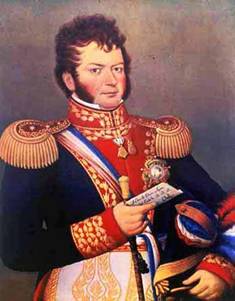
Bernardo O'Higgins |
|
|
|
|
|
|
|
|
|
|
|
|
|
|
|
The Liberator of Chile |
|
|
|
|
|
|
|
|
 |
|
|
| ��������������� Throughout the many periods of Irish history in which the native, Catholic population was suppressed and persecuted one of the common destinations for exile was the Kingdom of Spain. As a fellow Catholic nation often at enmity with England the Spanish were seen as natural allies and indeed at times even gave military support to Irish liberation efforts. Accordingly, there arose in Latin America a very noticeable Irish presence as the Spanish colonies in America offered a fresh start and new opportunities for exiled Irish Catholics. Irish settlers, priests and even military officers and high government officials could be found throughout Spanish America from the far north to the far south, from Texas to Chile. The last Viceroy of New Spain (Mexico) was an Irish Spaniard named Juan O'Donoju. One of the many heroes of the War for Texas Independence was Father Michael Muldoon, an Irish Spanish priest. One of the right hand men of the famous Simon Bolivar was the Irish general Daniel O'Leary. The Irish Spaniard Juan Galindo conquered the last Spanish fortress in Central America during the independence war there. �In Chile, the founder of the corps of engineers was an Irishman named Brigadier General Juan Mackenna. He was a long time ally of the first leader of an independent Chile, Bernardo O'Higgins. |
|
| ��������������� Bernardo O?Higgins Riquelme was born on August 20, 1778, the illegitimate son of Isabel Riquelme y Meza, a Chilean noblewoman, and an Irish immigrant from County Sligo Ambrosio O'Higgins. His father rose from being a traveling salesman to become the Captain-General of Chile and Marquis of Osorno in 1792. Spanish law forbid Spanish officials from marrying natives of the countries they served in so young Bernardo was never openly acknowledged by his father as his son, however, he did not totally neglect him either. Bernardo lived with his mother as a youth but when his father became Viceroy of Peru (which included all of southern Spanish America) he had the means to send Bernardo to school, first in Lima, then Spain and later in London. It was in London that Bernardo became acquainted with the revolutionary leader Francisco de Miranda of Venezuela. Bernardo immersed himself in the movement for South American independence and joined a Masonic lodge established to foster that specific goal (despite being officially Catholic, huge numbers of high Spanish officials in Europe and America were Masons). His life in London left him rebellious, penniless and living with friends. |
|
|
| ��������������� When Ambrose O'Higgins learned of the activities of his son he stopped his financial support but still left him an inheritance when he died in 1801. Barnardo went to Spain and attempted to return to Chile but, with the Napoleonic wars raging, his ship was intercepted by the British and for a time he was imprisoned in Gibraltar. When Bernardo finally returned to Chile he served briefly in the Congress called by the junta to rule in place of the Spanish King Ferdinand VII who had been deposed by the French. This vacuum was seized upon by independence advocates as a golden opportunity and in 1810 Bernardo joined the Chilean Nationalist Army with troops from his estate. Infighting and ill health kept him on the sidelines for a time but eventually O'Higgins became the commander in chief of the army. However, in 1814 he was defeated by the Spanish Viceroy of Peru at the battle of Rancagua and was forced to retreat into the Andes. The revolutionary government was broken up and O'Higgins was finally forced to go into exile. |
|
|
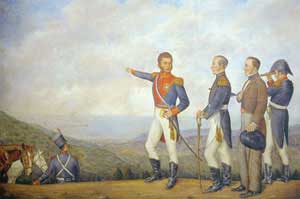
| ��������������� A common problem for the Latin American revolutionaries was that whenever they defeated Spanish forces in a particular area there were always additional Spanish forces in neighboring territories that could move against them. Jose de San Martin had had similar problems in Argentina and soon he and his old friend Bernardo O'Higgins became allies in a grand campaign to liberate all of southern Latin America. A plan was developed to expand the war in Argentina to Chile and then march north to Peru and eventually join forces with the revolutionary leader Simon Bolivar. Spanish forces in Chile were the greatest threat to San Martin and his rebellion in Argentina so cooperation was essential. In Argentina they built up a well trained, supplied and disciplined army in secret before launching the invasion of Chile in 1817. San Martin befuddled the Spanish, slipped through the mountains undetected and attacked the Spanish at the battle of Chacabuco. The Spanish were greatly outnumbered but reinforcements were on the way and an immediate attack was imperative. �In command of his cavalry and the first half of the army was Don Bernardo O'Higgins. He was supposed to hold the enemy front while the second half of the army flanked their position but this attack was poorly coordinated and O'Higgins found himself confronting virtually the entire Spanish army. Disobeying orders and acting on his own initiative O'Higgins ordered an attack along the line which managed to punch enough of a hole for his cavalry to charge through and thoroughly defeat the Spanish. |
|
|
|
 |
|
|
| ��������������� The following year the Spanish surprised and defeated San Martin at Cancha Rayada but at the battle of Maipo in 1818 the Spanish were thoroughly defeated in an evenly matched and hard fought battle which ended Spanish rule in Chile. By this time though, O'Higgins had taken on a more political role. The grateful Chilean revolutionaries had offered San Martin power but he declined to continue northward with his conquest of Peru. San Martin deferred to O'Higgins who was named Supreme Director of Chile on February 16, 1817 with dictatorial powers. However, he still had military affairs to attend to dealing with Spanish remnants and Mapuche Indians who had allied with the Spanish Crown. He also set up a new government and the first independent system of laws and national organization Chile ever had. He organized a competent navy with the help of the adventurous British naval officer Thomas Cochrane (later Lord Cochrane Earl of DunDonald) which took part in the liberation of Peru. An affair with a married woman gave him a son named Demetrius but like his father he never married. |
|
|
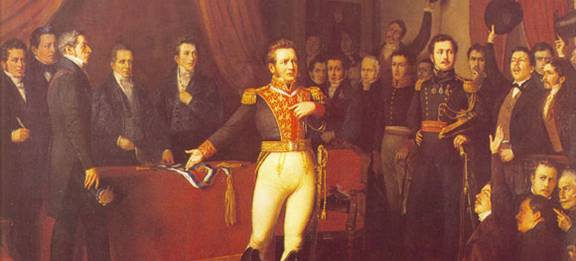
| ��������������� As ruler of Chile O'Higgins issued many sweeping social reforms including setting up many colleges, hospitals, libraries and courts of law. Modernization was pushed quickly and though he was always known as an honest and upright man angered many of the elites as well as conservative land owners and the Church who felt he was going too far too fast. His association with foreign militaries and grand, commanding nature led to rumblings that he was becoming monarchial. Big business turned against him and he was continuously frustrated that his well meaning reforms were being resisted by so many. Likewise, as a military man, he never organized a formal political party and so had no real power base even though he was widely revered by many across the country for his heroism in the war for independence. He became disgusted with politics and when agitators began to foment armed resistance he agreed to resign from office in 1823; an event known as the abdication. O'Higgins took his mother, sister and son and moved to Lima, Peru where he concentrated on his own estate as well as working with other independence movements and tried to foster a coalition of South American republics. |
|
| ��������������� In time, his health began to fail though until the end he remained concerned about events in his country and advocated expansion southward and for colonization of the Straits of Magellan. He was finally allowed to return to Chile but a heart attack prevented him from doing so. Don Bernardo O'Higgins, the Liberator of Chile, died in Lima on October 24, 1842 calling out the named Magellan. The Peruvians gave him a grand funeral and in 1866 his remains were returned to Chile and he was buried in Santiago with all of the honor of a hero of independence and founding father of the Republic of Chile. All in all, anyone would have to say that the life and career of Bernardo O'Higgins was remarkable and certainly he was one of the most outwardly successful Irishmen in the New World. I personally do not think the total destruction of the Spanish empire was a good thing, independence within a confederation of Latin nations united by the Crown of Spain would have been better in my opinion, but then there was talk that O'Higgins might have been leaning more traditional himself during his time in power. Jose de San Martin, for example, favored a constitutional monarchy with an Inca royal on the throne. He had his scandals, failings and shortcomings but he does deserve the credit for creating modern Chile which has been one of the most stable countries (comparatively) in Latin America. |
|
|
 |
|
|
|
The abdication of Bernardo O'Higgins as Supreme Director |
|