 |
|
|
|
|
|
|
|
|
|
|
|
|
|
|
|
|
|
|
|
|
|
|
|
|
|
|
|
|
|
|
|
|
|
|
 |
|
The Uprising of 1798 |
|
|
|
|
 |
|
|
|
|
|
 |
|
|
|
|
|
|
The Battle of Vinegar Hill |
|
|
|
 |
|
|
|
The Irish Uprising of 1798 is one of the pivotal events in Irish history and stands amongst a tragic list of military failures that inspired further patriotism and the spirit of resistance in Irish men and women throughout all the years since. The 1798 Rebellion was also significant as being one of the first Irish uprisings which saw a union between Catholic and Protestant (Presbyterian) Irish nationalists. The Catholics had always been treated worse since Protestantism became dominant in the British Iles and in 1798 Catholics were singled out as being banned from holding public office, bearing arms or even, since 1727, having the right to vote. However, the Penal Laws also excluded Presbyterians from power. The Presbyterians had built up a place of prominence for themselves in Ulster especially compared to the condition of the impoverished Catholic peasantry but they also felt the pinch when the Irish parliament, dominated by Anglicans, began increasing Anglican power and dominance across the country. |
|
|
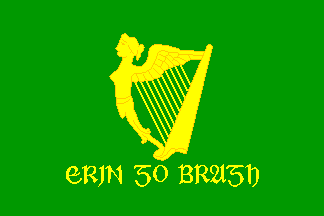
Ireland was also being influenced by political upheavals abroad such as the American Revolution, which gave hope that the British Empire was not invincible, and more recently the outbreak of the French Revolution. Even the wealthier Presbyterians were unhappy with having to pay tithes to the Anglican church and there were even some Anglican aristocrats who were unhappy with having to sacrifice their own wealth to the imperial ambitions of Britain, symbolized by the fact that wool could only be exported to Britain for one example. In 1791 a group of liberal Protestants formed the Society of United Irishmen which aimed at forming a coalition of Irish Catholics, Presbyterians, Methodists and others to push for democratic reforms, greater autonomy and Catholic emancipation. When Britain went to war with revolutionary France the Society was forced underground and made their new ultimate political goal independence from Great Britain. The movement proved popular and by 1797 there were around 100,000 United Irishmen across the country. It was enough to alarm the British who began taking the Society more seriously as they grew in numbers. |
|
|
As had been done many times in the past and would be done again in the future the Irish rebels turned for help to the enemies of Britain on the continent and decided to put off a general uprising until French troops could be sent to help. The famous Irish rebel (and Protestant) Theobald Wolfe Tone traveled throughout France and the United States to enlist support for the United Irishmen and their planned rebellion. This was a strategy that seemed to be working as, in December of 1796, Tone returned to Ireland with a French expeditionary fleet and 15,000 French troops under General Lazare Hoche. The ships managed to avoid the Royal Navy and reached Bantry Bay but bad weather prevented the troops from landing. Some ships were sunk in the storms, others damaged and forced to return home and some so badly damaged that they had to be scuttled by their own sailors before the expedition was called off and returned to France. A despairing Wolfe Tone compared it to the loss of the Spanish Armada. |
|
|
|
|
|
|
The British responded to these events with a vicious crackdown in Ireland. Homes were burned, people were tortured and even executed on the slightest suspicion of nationalist sentiments. The violence was especially strong in Ulster where the union of Catholic and Protestant forces was most feared. Troops were ordered to disarm the Presbyterians and the newspaper operated by the United Irishmen was shut down. The government also sought to quell the unrest by playing on religious animosities and supported the Protestant Orange Order, formed in 1795, to encourage Protestant loyalty to Great Britain and spread fear and hatred of Roman Catholics. A British general even wrote that their hold on Ulster depended on increasing the animosity between Protestants and Catholics. Given the history of Ulster since then, it would seem the British general was absolutely accurate in his thinking. The Orange Order helped to rally and organize loyalists and played a key part in the propaganda battle by associating Protestantism with loyalty to Britain and associating Catholicism with treason and playing up the old hatred and suspicions of Catholics as villainous slaves loyal to the Pope. |
|
|
|
|
 |
|
|
|
|
What is ironic, given all of that, is that the Catholic leadership in Ireland was mostly opposed to any rebellion. This is often associated with the establishment of Maynooth College, however, the opposition of the Church was much deeper than that even though there were plenty of Catholics and Catholic clergymen who were ardent Irish patriots. The Church was greatly disturbed by the inspiration many in the U.I. were taking from the French revolutionaries who were violently anti-Catholic and butchered thousands of peasant Catholics in France. The Church also, in keeping with the Bible and Christian tradition, tends to be against rebellion or revolution on principle so long as the free exercise of the faith is not threatened. The Church is also, on principle, against war and one of the key deciding factors on judging whether or not a cause for just war exists is whether or not there is a reasonable chance of success and, obviously, a peasant rebellion in Ireland against the British Empire must have looked to many to be quite possibly a futile sacrifice of lives. With the French revolutionaries also at war or threatening war with Catholic Austria and Italy and eventually Spain, that was also a factor. Over the years the Catholic Church leadership would officially oppose Catholic rebellions against non-Catholic governments in places as far from Ireland as Poland. Again, however, there were plenty of Catholics and even some Catholic clergy who supported the uprising such as Father Mogue Kearns, Father John Murphy, Father Michael Murphy and Father Philip Roche. |
|
|
 |
|
|
|
 |
|
|
|
|
|
With the French expeditionary force turned back things were a little disheveled in the leadership of the United Irishmen and things only got worse in March of 1798 when British intelligence efforts were successful in providing information that allowed the British to wipe out many of the U.I. leadership in Dublin. This was to be a recurring theme throughout the history of Irish rebellions as the British, whether in 1798 or in the Fenian rebellion or even the Easter Rebellion, proved to be quite adept at infiltration and intelligence gathering which allowed them to crush potential rebellions before they got off the ground. In response to these raids a minor rebellion broke out immediately in Cahir but was put down with merciless efficiency by Colonel Thomas Judkin-Fitzgerald, Sherrif of County Tipperary. Martial law was imposed and the British crackdown became more ferocious than ever and the leadership of the United Irishmen was being decimated. In desperation, facing total annihilation, the remainder decided to launch the rebellion on May 23 with or without French assistance. Nonetheless, many intended targets had to be abandoned due to the increasing guard of British troops and many would be rebels gave up and abandoned their weapons before the rebellion even started. |
|
|
Because of all of this, in many ways the 1798 Rebellion failed before it even started. Nonetheless, on May 23, 1798 the remainder of die hard nationalists rose up in the counties around Dublin as planned. Part of this was encouraged by the government disarming the Presbyterians which many Irish believed to be a prelude to a massacre of Catholics. The fighting really got underway early in the morning of May 24 but in most cases the Irish rebels were bloodily repelled by the British troops. Kildare was occupied by Irish rebel forces but only after the British withdrew for fear of being surrounded. When word spread of the uprising many Catholics being held prisoner were massacred in Dunlavin Green and Carnew. Fierce guerilla fighting broke out in Wicklow where General Joseph Holt, a Protestant, led about a thousand men in the Wicklow Hills against the British, fighting on in the hope of aid of France. In Ulster the rebel forces were mostly Presbyterians and Henry Joy McCracken briefly took control of County Antrim but were defeated the next day by British troops from Belfast. In County Down Irish rebels under Henry Munro had some initial success but were defeated at the battle of Ballynahinch. |
|
|
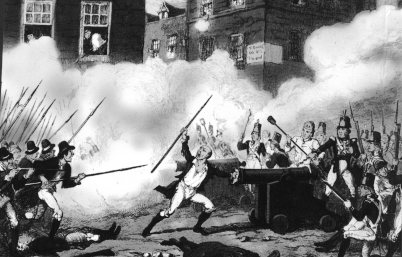
The most success the United Irishmen had was in the south, specifically County Wexford, which they were able to control for a time. The British had already arrested rebel leaders in the area and had done their best to disarm the populace. A key leader to emerge was Father John Murphy who, like others in the clergy, had been against the rebellion. Indeed, Father Murphy had urged his congregation to disarm and be loyal to the King, quoting the Biblical command to submit not only to the good and the gentle but also the harsh. However, things changed when word arrived of the massacre of Catholics at Dunlavin and the increased oppression of his own people. It seemed that their peacefulness and cooperation was not enough to save them from persecution and so, righteous indignation boiled over as even Father Murphy admitted that it was better to die fighting if they were to be killed anyway simply for the crime of being Irish Catholics. Armed with little more than pikes, the Irish formed up under the leadership of Father Murphy and defeated a militia company sent after them at the battle of Oulart Hill. As the Irish rebels marched on their numbers swelled and after a few more victories their ranks had grown to some 10,000 poorly armed but highly motivated volunteers. |
|
|
 |
|
|
|
|
|
|
|
|
|
|
|
|
The Battle of New Ross |
|
|
|
The Irish insurgents set up a republican government and dispatched forces toward Dublin and New Ross. Unfortunately, the one column met a disastrous defeat at the battle of New Ross on June 5, 1798 which was followed by a horrific massacre of prisoners, wounded men and civilians alike. The column meant to threaten Dublin, and which included Father Michael Murphy, met the British and the battle of Arklow on June 9, 1798 where British muskets and artillery took a terrible toll on the rebel Irish pikemen. Father Michael Murphy was himself killed leading a charge against a British gun position. The rebels slipped away under cover of darkness. The British were glad to let them go as they were almost completely out of ammunition and would likely have crumbled in the face of one more major attack. Nonetheless, all of this had a profound effect on the British who were amazed at the fight and tenacity of the Irish in spite of having almost no modern weapons and their leadership either dead, imprisoned or in disarray and massive forces were dispatched to crush the rebellion once and for all. |
|
|
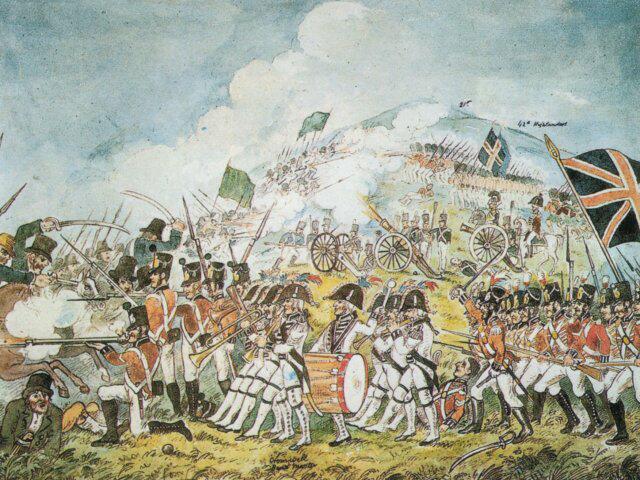
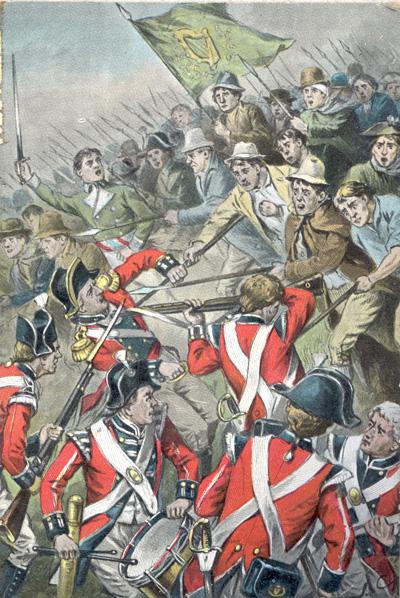
The climactic fight of the uprising came at the battle of Vinegar Hill on June 21, 1798. The British were led by General Lord Gerard Lake with about 20,000 well armed men. On the Irish side, Anthony Perry, Myles Byrne, Father John Murphy and William Barker led about an equal number of rebel troops, the majority of them without firearms. The Royal Artillery decimated the Irish lines who mounted several gallant but bloody counter attacks which only brought temporary relief. With Irish casualties mounting the British launched a massive attack on the hill and drove the Irish remnants back who were only able to escape thanks to the delay of the British forces under General Francis Needham. It was not the final battle that General Lake had wished it to be but it had broken the back of the Irish resistance. Also, once again, many atrocities were committed as the British cavalry swept down on the stragglers of the Irish camp, mostly women and children, who were brutally butchered. Subsequent Irish defeats at Knightstown Bog and Ballyboughal effectively brought the uprising to a bloody end. |
|
|
However, peace was not to come yet as in August a French force of about a thousand men under General Jean Humbert landed in County Mayo and was soon joined by about 5,000 Irish rebels. Showing what might have been General Humbert met the British at the battle of Castlebar and, despite being outnumbered three to one, earned a smashing victory that later became known as the Castlebar races because of the flight of the British troops who abandoned many of their weapons in their haste to flee the battlefield. In the aftermath Humbert declared the Republic of Connaught but on September 8 was defeated at the battle of Ballinamuck in which General Humbert was captured. The war was effectively over though some Irish guerillas fought on for a number of years afterward not ending until the defeat and capture of Robert Emmet in 1803. For the defeated leaders of the uprising the British government showed no mercy. |
 |
|
|
Wolfe Tone, most famous of the rebel leaders, was convicted of treason and hanged on November 19, 1798 after a failed suicide attempt. Henry Joy McCracken was also hanged after spurning an offer of pardon if he revealed the names of his fellow United Irishmen. Lord Edward Fitzgerald, who had actually fought with the British in the American Revolution, died of his wounds after being captured and denied proper medical care by the British. None, however, probably had a worse end than the most reluctant revolutionary of them all; the noble priest Father John Murphy. He was captured, convicted of treason and tortured. He was then stripped naked, flogged and hanged after which he was decapitated and his body mutilated in the most brutal and disgusting way, his body stuffed into a barrel of tar and burnt. His severed head was put on display in view of the Catholic church across from the Sessions House in Tullow as a warning to all other Irish Catholics who might dare challenge Protestant rule. |
|
|
|
|
Things were no better for the ordinary folk in Ireland. The British, for their part, had few qualms about it as the Irish had once again shown their readiness to make common cause with their enemies and strike against them during a time of war. The British brought down an iron fist on Ireland and Irish Catholics especially and stepped up their efforts to encourage sectarian hatred with their support of the Orange Order and other bigoted loyalist groups. In 1800 the Act of Union was passed which ended what little Irish autonomy there had been and which would last for over a hundred years to come. However, the immense bloodshed, the heroism and the atrocities and oppression brought on by the 1798 Rebellion lingered on in the hearts and minds of Irish Catholics and some Protestants as well for generations to come. The names of Wolfe Tone, Henry McCracken, Edward Fitzgerald, Father Murphy, Robert Emmet and Joseph Holt would live on and are still celebrated by Irish nationalists to this day. |
|
|
|
|
|