

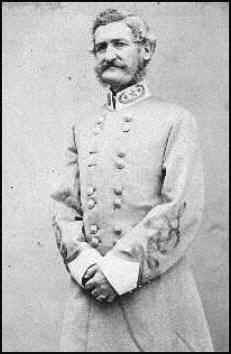
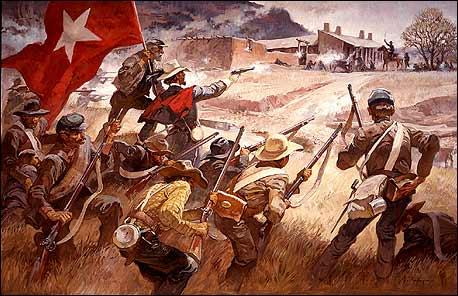

General Sibley had also fallen considerably in the estimation of his men after all of the praise and high hopes he had garnered in San Antonio. General Sibley had been ailing much of the time and had to leave the fighting at Valverde in the hands of Colonel Green. Rumors began to spread that Sibley was drunk, in fact he actually was quite ill but this drove him to drink and alcoholism would become a serious problem for him. The fact that he retired from the battle also caused many of the hard-fighting Texans to accuse Sibley of being a coward. Nonetheless, Sibley continued his advance north though his hoped for partnership with Governor Baylor proved impossible and he concentrated his small forces further west and was eventually removed by President Davis for his brutality toward the Apache Indians.
Leaving Ft Craig in his rear was a dangerous move, but an unavoidable one as Sibley simply did not have the manpower to storm the place. Instead, he moved north toward Albuquerque and Santa Fe with the next major obstacle being Ft Union. A small force of Union militia attempted to hold Sibley off at Socorro but most of the Union troops fled at the first canon shot and the local public refused to cooperate saying that the Union presence had been a curse to the territory and Texan rule could only be an improvement. Finally, the Yankees evacuated the town and Colonel Henry McNeill occupied it without opposition. Sibley ordered a hospital established at the town, but the Confederate supply situation was already becoming critical. General Sibley had counted on capturing federal supplies at Albuquerque but when the Confederate Army of New Mexico occupied the city on March 2, 1862 they found that the retreating Union forces had destroyed everything that could not be evacuated. The extent of Sibley's overconfidence had become very clear.
As part of the effort to take out the garrison of Ft Union, Sibley sent troops north to Santa Fe which was occupied on March 10, 1862 where again, no considerable stores of supplies could be found. Still at his headquarters in Albuquerque Sibley had to disperse some of his meager forces to collect fodder and provisions from the surrounding countryside. Cold weather was also a burden with heavy snowfall in early march which took the lives of several soldiers. As a prelude to taking control of the Santa Fe trail, Sibley sent Colonel William R. Scurry to secure Glorieta Pass. Again, Sibley was criticized for his absence, remaining 60 miles away in Albuquerque. In the ensuing battle, known as the "Gettysburg of the West" the Texans succeeded in driving off the Union forces, but returned to camp to find that their supply train had been destroyed by a federal raiding party. With his army starving and freezing to death, Sibley was forced to abandon the campaign and return to Texas. The horrific march, compared by the Texans to the retreat from Moscow, cost more lives than all the battles fought by the Army of New Mexico. Once again in his career there were calls for a court-martial against General Sibley.
Due to his friendship with Davis and others in Richmond, Sibley survived his legal troubles and his brigade fought at the victory in Galveston, Texas on January 1, 1863 before being sent to Louisiana to join the forces under Lt. General Richard Taylor. Here again Sibley was severely criticized for incompetence and accused of being drunk. His good luck at surviving might have come to an end were it not for the surrender of the Confederate forces before he could rejoin his command after a pointless trip to Richmond. Sibley was paroled and went to New York to be with his Unionist wife, leaving behind his ruined plantation in Louisiana. It was while in New York that Sibley was suggested by none other than Union General William T. Sherman to the representatives of the Khedive of Egypt who was looking to recruit veteran American officers for the Egyptian army.
Once again, Sibley's hopes soared and soon he was on duty with a few other Americans in the deserts of North Africa, commanding the Egyptian artillery. However, the career of Pasha Sibley was to be no more successful than that of General Sibley. His drunkeness was even more of an embarassment in an Islamic society and soon he was dismissed and sent back to the States where he died in poverty on August 23, 1886.
Sibley is a hard man to judge. He was thoughtful and inventive, but also displayed gross neglect of duty on several occasions. He could be argumentative and difficult, but also compassionate, taking the time to write letters to the families of the men killed in battle. On the whole, it is safest to say that he was a man of great ambition and glorious dreams, but who simply lacked the qualities necessary to see them become reality. His problems began in the U.S. Army, but he was persuasive enough to win a generaliship and his own command for an extremely important campaign. Here, his greatest mistakes were overconfidence; thinking the enemy too weak, the local populace too supportive and thinking he could supply himself almost totally off of captured stores. His absence from the battlefield and frequent illness hurt his reputation, and in his subsequent career it seems that alcaholism did become a serious problem for him. Yet, for those early months of 1862 it was General Sibley who gave the south hope in the conquest of the southwest and a "gateway to the Pacific".