 |
|
|
|
|
|
|
|
|
|
|
|
|
|
|
|
|
|
|
|
|
|
|
|
|
The Battle of Pea Ridge |
|
|
War in the Trans-Mississippi |
|
|
 |
|
|
|
 |
|
|
|
|
|
|
|
|
|
|
|
|
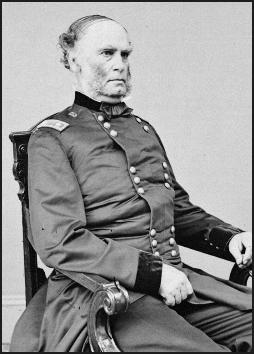
General Samuel R. Curtis USA |
|
|
| The War Between the States had been raging west of the Mississippi long before it exploded in the east. Kansas had been a battleground for northern and southern sympathizers long before the first official battle at Ft Sumter, and it was less than a month later that Union troops in Missouri carried out the St Louis massacre. War soon came to the Trans-Mississippi and control of Missouri was the first prize. Outrage over the massacre at St Louis increased sympathy for the south and opposition to the Union. The Missouri Guard under General Sterling Price and Confederate forces under Texas Ranger General Ben McCulloch defeated Union troops at Wilson's Creek and Lexington before the arrival of massive Union forces allowed them to take control of much of Missouri in late 1861 and early 1862. However, Confederate harassment persisted and the Union undertook a campaign to eradicate all Confederate opposition in Missouri and push the southerners back into Arkansas. US Brigadier General Samuel R. Curtis and his Army of the Southwest was dispatched for this purpose with 10,250 soldiers and an arsenal of 50 canon. |
|
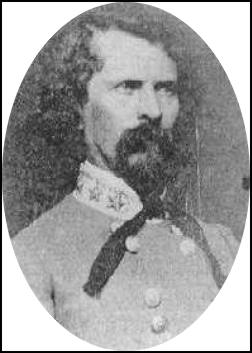
| General Curtis moved his men into Benton County, Arkansas and laid them out in a fortified line along the north bank of Sugar Creek. Ironically, for the side that was preaching about the indissoluble Union and American nationalism, more than half of the Union forces present were newly arrived German immigrants. They prepared for a Confederate attack and the southern forces did not make them wait long. The Confederates coming to oppose them were the Army of the West under the command of General Earl Van Dorn who had been put in command of the Trans-Mississippi Department following disagreement between McCulloch and Price. His command numbered roughly 16,000 men and included the Missouri Guards, some rough riding Texas Rangers, 800 Cherokee Indians and troops from Arkansas and Louisiana. The goal of General Van Dorn was to destroy Curtis and his army and begin a counteroffensive that would regain Missouri for the Confederacy. |
|
|
 |
|
|
General Earl Van Dorn CSA |
|
| Seeing the entrenched position and good fields of fire Curtis had on Sugar Creek, Van Dorn knew better than to try to attack him head on. Instead, he sent his troops in Fayetteville under his subordinates Price and McCulloch, northward on the Bentonville Detour in an effort to flank the Union line. Wishing to be unencumbered and move swiftly, Van Dorn left his supply and baggage train behind, but nonetheless, the maneuver took three days of forced marching through freezing, snowy weather. It was made all the worse by the fact that, as with most of the Confederate troops throughout the war, the Army of the West was poorly equipped with many men lacking proper winter clothing and even shoes. The ragged and hungry but determined southerners left a red trail in the snows north of Fayetteville with their freezing, bloody, barefoot feet. |
|
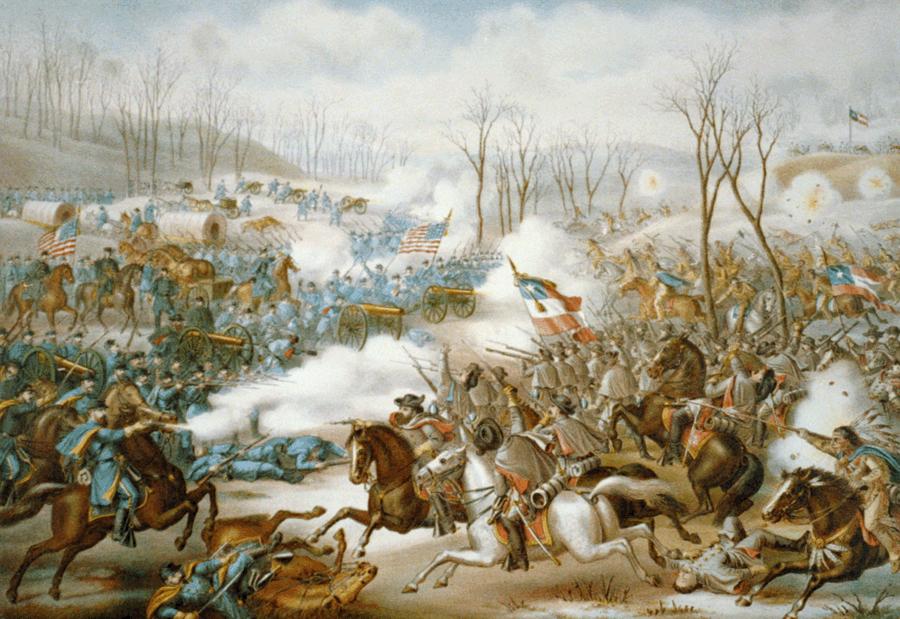
| General McCulloch was behind schedule and Van Dorn ordered him to move west around Pea Ridge and join Sterling Price at Elkhorn Tavern. McCulloch would be moving along the south face of Pea Ridge while Price and Van Dorn would move around the north face and have Elkhorn secured before McCulloch arrived. However, Union General Curtis got wind of these movements and because it was impossible for the Confederates to move so far in such weather very rapidly he was able to move his army around to face the onslaught and intervene his troops before McCulloch and Price could join forces. The battle of Pea Ridge opened on March 7, 1862 when McCulloch, whose command included Confederate troops under General James McIntosh and Indians under General Albert Pike, ran headlong into Union forces at Leetown. The fighting was fierce and the Confederate high command was decimated as General McCulloch and General McIntosh were killed and Colonel Louis Hebert was captured. This left the Confederates in disarray with their top commanders killed and their assault soon fell apart. |
|
| General Van Dorn and Sterling Price did not reach their destination either as while McCulloch and his command was being torn to pieces on the other side of Pea Ridge, Van Dorn and Price met Union troops on their way to Elkhorn Tavern. Despite their beleaguered condition, the feisty Van Dorn ordered an immediate assault and the Confederate troops soon drove the northern forces back, reached Elkhorn Tavern where they joined up with the remnants of McCulloch's men and cut the lines of supply and communication to General Curtis. |
|
| The following morning, on March 8, General Curtis moved on Elkhorn Tavern where he concentrated his artillery to smash the Confederates and take back what had been lost the night before. Commanding the Union attack was General Franz Sigel, Curtis' deputy commander and a German immigrant who won rapid promotion in the hope of encouraging German enlistments but who proved to be an ineffective commander throughout the war. The Confederate lines were shelled heavily, then hit with massive infantry and cavalry attacks which the Confederates fought off desperately all morning, giving ground grudgingly. Under ordinary circumstances, it might have been possible for Van Dorn to take the losses sustained thus far and still manage to snatch victory from the jaws of defeat. However, these were not ordinary circumstances. Having left his supply train behind, the Confederates were rapidly running out of ammunition with no hope of refreshment in time to make a difference. By mid-day General Van Dorn realized that there was no hope for victory, he grudgingly ordered a retreat down the Huntsville Road. |
|
|
|
 |
|
|
The battle of Pea Ridge |
|
|
| The battle of Pea Ridge Arkansas proved to be a critical engagement and a hard defeat for the Confederate forces. While roughly 4,600 southerners of the Army of the West had been lost, Union casualties amounted to only around 1,400. Although not immediately realized, Pea Ridge meant the Confederates would never be able to retake Missouri, although the fighting would remain fierce due to future efforts and numerous cavalry raids and guerilla warfare by the numerous partisan units operating in the area. Not long after, with Confederate forces massing for the upcoming battle of Shiloh, General Earl Van Dorn and his Army of the West was transferred to the Army of the Mississippi under General Albert Sidney Johnston, the supreme commander in the western theatre. Although necessary, this left Arkansas exposed and General Curtis was quick to renew his offensive with a drive on the capitol of Little Rock. |
|
| General Samuel Curtis was later made Union commander of the Missouri district, but was reassigned when his abolitionist opinions endangered the popularity of the Lincoln administration in slave holding Missouri, however, he later came back to face his old nemesis Sterling Price again in 1864. He spent the rest of the war in the northwest and worked in the railroad business until his death in 1866. Union General Franz Sigel was promoted and given a major command in the east where he was humiliatingly defeated by Confederate General Stonewall Jackson until he was finally relieved of command. Reappointed later to serve in West Virginia he was soundly thrashed by General Jubal Early and was fired again. He became a newspaperman after the war and died in New York in 1902. |
|
|
| Confederate General Earl Van Dorn failed his cause at Corinth, Mississippi but recovered his reputation with several cavalry victories in Mississippi and Tennessee. A notorious womanizer, Earl Van Dorn was shot in 1863 by a doctor who claimed the general was having an affair with his wife. General Albert Pike was accused of cruelty and appropriating Confederate funds and fled to the Arkansas hills and offered his resignation when General Thomas Hindman ordered his arrest. He was eventually found and arrested on charges of treason and insubordination but was allowed to resign and leave the army. After the war he lived in New York and Canada. He died in Washington DC and is now buried in the House of the Temple of the Masonic order of which he was a leading figure. General Sterling Price continued to fight for the liberation of his home state in battles throughout Arkansas and Missouri for the rest of the war. His most famous expedition was a cavalry raid that rode all around Missouri in 1864 but the results were mixed. At the end of the war, rather than surrender, he took his remaining forces to Mexico and allied with the embattled Emperor Maximilian. In Veracruz he established a colony for former Confederates named Carlota in honor of Mexico's Belgian Empress. When the Mexican Empire began to collapse he returned home and died in St Louis in 1867. |
|