

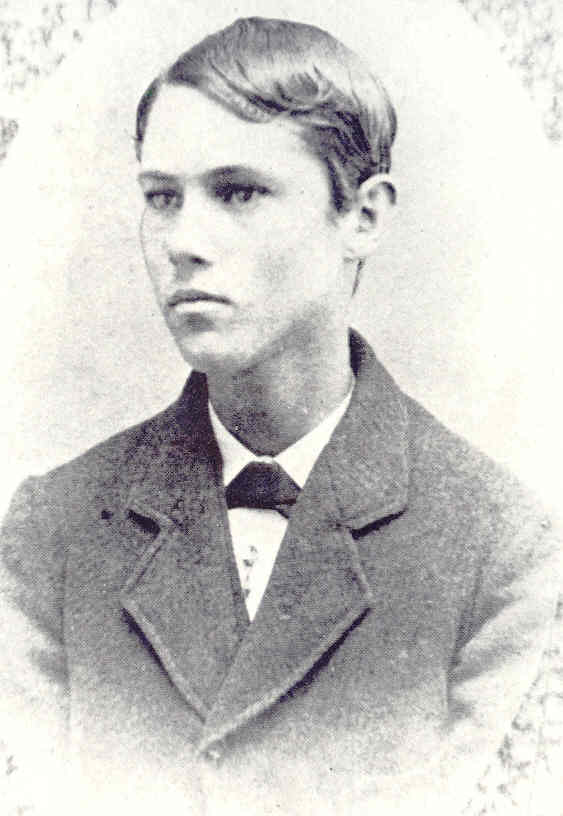

At the end of the war, after more than doing his duty, Jesse was shot in the chest as he tried to surrender in Lexington. He came home to find Union forces riding rough shod over the local populace and northern carpetbaggers coming south to enrich themselves on the Confederates' misfortune. From then on, Jesse took it upon himself to become the outlaw-hero of the defeated Confederates of Missouri. No less a figure than President Teddy Roosevelt described him as "America's Robin Hood". To strike back at those who had persecuted his family and who were taking advantage of the war ravaged south, in 1866 Jesse formed an outlaw gang including his brother Frank and cousins Cole and Jim Younger all of whom were former members of Quantrill's raiders. In Liberty, Missouri Jesse carried out the first bank hold-up in peacetime in American history (the only previous daylight bank robbery had been carried out in 1864 in St Albans, Vermont by Confederate troops operating out of Canada). Jesse and his gang made off with over $62,000.
Jesse James and his followers launched a campaign of armed robbery ranging from Missouri to Texas to Iowa holding up stage coaches, banks and for the first time in history: trains. It was in Iowa in 1873 that the James gang conducted the first American train robbery, making off with $3,000. All efforts to captured Jesse and his gang proved futile, even when the elite Pinkerton National Detective Agency was on their trail. This was due mostly to the fact that Jesse was a hometown hero and no one would betray him. The money that was so readily available was due largely to the exploitation of the south by northern carpetbaggers and the local public saw Jesse and his men as heroes, robbing from the rich to give to the poor in time honored fashion. The Pinkerton's themselves also did not help their cause through their brutal tactics. At one point they threw a bomb into Jesse's home blowing the arm off of his mother and killing a 9-year-old half brother. Jesse was outraged and anyone who was undecided before became James gang sympathizers after that dastardly deed.
The begining of the end for the James gang came in Northfield, Minnesota in 1876 with a bank heist that went bad. A massive shootout with the local populace ensued and Frank and Jesse James were the only two to successfully escape. Jesse finally settled down somewhat after marrying his first cousin Zerelda Mims and having four children. Jesse had a $10,000 bounty on his head and the family moved to St Joseph, Missouri where they could find some relative security. However, Jesse could not resist going for that "one more" job and recruited some new men, including Robert and Charles Ford, to help him rob the Platte City bank in 1882. Jesse had the men in his house, trusted them and considered them friends, and so it was that what came next has gone down in history as one of the most disgusting acts of betrayal and cowardice in the Old West. On April 3, while Jesse stood on a chair adjusting a picture on the wall of his home, Robert Ford pulled his gun and shot Jesse in the back of the head, hoping to claim the $10,000 reward.
Fortunately, Robert Ford never got the full $10,000. His brother later committed suicide and he was ultimately gunned down himself in Colorado in 1892 (his killer recieved only a 2-year sentance). Since that time, Jesse James has been honored as a folk hero and romantic outlaw, while all those who remember Robert Ford remember him only as the lowest form of traitor. The end of the story was summed up in a popular folk ballad which said, "But that dirty little coward, That shot Mr. Howard, Has laid poor Jesse in his grave". Nonetheless, Jesse James has become one of the most celebrated bandits in American history, an Old West legend and most importantly, remembered as a rebel with a good cause, not simply a criminal. Numerous books, songs and movies have been made in his honor and we can be sure that many more will come in the future as well.