
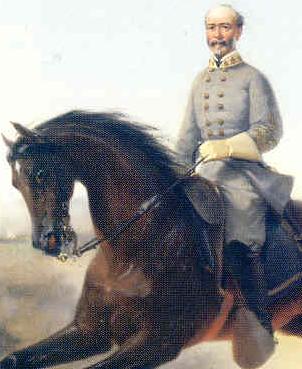
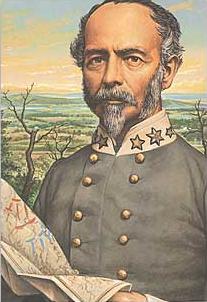

When Virginia seceded, Johnston resigned and was commissioned as a major general in the Virginia militia, taking over from General Thomas J. Jackson at Harper's Ferry (in modern West Virginia) and forming the Army of the Shenandoah. Working in conjunction with General Pierre G.T. Beauregard, General Johnston's timely arrival ensured a stunning Confederate victory at the 1st Battle of Manassas Jct. Later he was promoted to full general by President Jefferson Davis, however, the two always had a very stormy relationship. Their rivalry went all the way back to a feud over a girl at West Point and like all southern gentlemen with enlarged senses of honor and pride they never got over it. Johnston was offended at his promotion that he was ranked behind full generals Samuel Cooper, Albert Sidney Johnston and Robert E. Lee in spite of the fact that he had outranked all of these men in the pre-war army. Davis retorted that Johnston's post had only been a "desk" command, but the same could be said for General Cooper and it does seem rather suspect that the 3 men given top seniority (Cooper, Sidney Johnston & Lee) were all friends of Davis while the two generals who had won the south's only victories thus far, Joe Johnston and Beauregard, were ranked last and also did not get along well with President Davis.
Nevertheless, Johnston was given command of the Confederate Army of the Potomac and charged with defending the capital of Richmond. In early 1862 a massive Union army began advancing up the peninsula which Johnston countered with a delaying action back to the Chickahominy River. Then, on May 31, 1862 he attacked the Union army at Seven Pines. The battle was a stalemate, but Johnston was wounded and replaced with Lee whose career so far in Confederate service had not been inspiring. When someone suggested to Johnston that his wound spelled certain doom for the south, Johnston disagreed, saying it was the best thing that could have happened because Lee and Davis could work well together as he had been unable to. After recovering Davis gave Johnston the thankless job of supreme commander of the Western Department, which consisted mainly of Braxton Bragg's Army of Tennessee and John C. Pemberton's Army of the Mississippi. Johnston was expected to lift the siege at Vicksburg but the manpower simply didn't exist to carry out such an operation.
Following the infuriating defeat at Chattanooga Davis finally removed his friend General Bragg and put Johnston in command of the Army of Tennessee, now operating in northwestern Georgia. Johnston greatly improved the morale of his army, got them the supplies they needed and prepared to face down one of the north's most brutal and dangerous commanders; William T. Sherman. Johnston, during this campaign, proved his strategic ability and talents as a defensive commander. However, Sherman repeatedly refused to fight him. Johnston would occupy an unassailable position, Sherman would not dare attack him and start moving around Johnston's flank. Johnston would then pull back to a new defensive line and the situation would repeat. Sherman was infuriated by these tactics and when rain clogged roads cut off any way around he finally made one assault at the battle of Kennesaw Mountain. It was a stunning defeat for Sherman and cost him 3,000 men. After this, he again stopped trying to fight Johnston head on and reverted to his flanking tactics but, though he inched ever closer to Atlanta, he could never catch Johnston in a vulnerable position.
General Johnston, however, also angered Davis for his use of defensive tactics. The President wanted an aggressive blow and on July 17, 1864 he removed Johnston from command and replaced him with the fiery General Hood. Ultimately, Atlanta fell and as Sherman began his destructive march to the sea there were almost no Confederate forces to oppose him. In 1865 President Davis dissolved his own military staff and appointed Robert E. Lee commander-in-chief of all Confederate armies. One of Lee's first actions was to put General Joseph E. Johnston back in command of the forces opposing Sherman in the Carolinas. Some sharp and hair - raising battles were fought, but the Confederates were hopeless outnumbered, as Johnston confessed to President Davis of General Sherman, "I can do no more than annoy him". This Johnston did, teamed up again with his partner from First Manassas, General Beauregard, until after the fall of Richmond and the surrender of General Lee. On April 26, 1865 General Johnston surrendered to Sherman.
After the war, General Johnston continued to be a leader for the south in politics. His fellow Virginians elected him to Congress and served as railroad commissioner in President Cleveland's government. He died after catching cold at the funeral of his old adversary where he served as a pallbearer and refused to put on his hat in the cold rain. He died on March 21, 1891. There can be no doubt that Johnston was a formidable commander, particularly in the defensive role General Sherman found him to be his most infuriatingly skillful enemy. Yet, personal rivalries and an inability to risk his great reputation with swift attacks meant that Joseph Johnston's legacy was to be known as the Confederate commander who never lost a single major battle, yet also never won one either.