
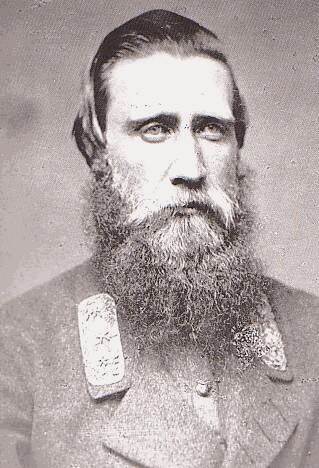
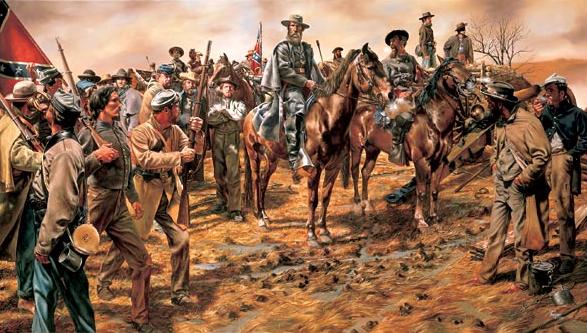

Back on the battlefield, after the disasterous siege of Chattanooga President Davis finally replaced his friend Braxton Bragg with General Joseph E. Johnston in command of the Army of Tennessee, now recovering in Georgia. Davis did not get along with Johnston and accused him of being timid and cautious, so it only seemed natural for Davis to put his new friend and boldly aggressive lieutenant general John Bell Hood in charge of a corps in Johnston's Army of Tennessee. Johnston fought a defensive campaign against General Sherman who was leading the Union forces toward Atlanta, tactics which frustrated Sherman but also his young and combative subordinate Hood who was anxious to take the offensive. It was also during this time that Hood found religion and he was baptized in the field by his fellow lieutenant general Leonidas Polk who was also an Episcopal bishop. As Sherman creeped ever closer to Atlanta Davis finally dismissed Johnston just prior to the battle of Peachtree Creek and replaced him with Hood who, at age 33, became the youngest full general of the war.
Immediately after taking command Hood launched a furious attack against Sherman, but his attacks were poorly coordinated. Some of Hood's more experienced lieutenants, like General William J. Hardee, were slow to move and resentful that such a younger man like Hood was promoted above them. However, Hood had been given command because of his reckless ferocity and he surely did not disappoint attacking Sherman again and again as he pressed against Atlanta. These series of attacks always came very close to success, but were never decisive, usually because someone did not move fast enough or maintain proper coordination with the rest of the army. Losses were heavy and at this point the Confederacy had virtually nothing left to replace them. Finally, on September 2, 1864 Hood was forced to abandon Atlanta. Frustrated in Georgia, Hood decided on a bold offensive. Rather than chasing after Sherman he would march north, invade Tennessee, tearing up Sherman's line of supply and linking up with Nathan Bedford Forrest's cavalry to threaten the northern states. It was a very audacious move. Some claimed that the pain killers Hood was taking for his many wounds were clouding his judgment, while others have proposed that he decided to invade Tennessee to impress Sally Preston and finally win the affection of the love of his life.
Problems came immediately though. Sherman's forces were so massive that he had more than enough troops to continue his destructive "march to the sea" through the deep south and still dispatch enough forces to face Hood and still have a considerable numerical superiority. Also, since Sherman was sustaining himself by the widespread rape of the southern countryside Hood's disruption of his supply lines had no real effect on his army. Hood has been forced to shoulder the blame for this campaign, but it should be remembered that both President Davis and Western Theater commander General Beauregard approved of the operation. There was a great opportunity for Hood to destroy a large part of the federal forces before they could unite against him at the battle of Spring Hill on November 29, 1864. However, once again, the slowness of generals Cheatham and Stewart caused the opportunity to be lost and the Confederate attacks brought few results.
Union forces reached Franklin, Tennessee where they dug in with the river at their back. It seemed to many that the Confederates no longer had the strength for offensive operations, but Hood feared that a retreat would destroy the morale of his men and lead to a slow retreat and ultimate defeat. Always reckless, Hood decided to roll the dice and risk all on victory or death. Hood launched a massive frontal assault on the Union lines at Franklin that even dwarfed Pickett's charge at Gettysburg. The Confederates succeeded in breaking through the front line trenches, fighting was brutal and often hand-to-hand, but Union numbers and extreme Confederate losses finally blunted the attack. Afterwards, the Union troops withdrew from Franklin back to Nashville, but Hood's losses had been horrific. The Confederates lost 6,252 men and 15 generals, six of whom were killed in battle -the largest number of any Civil War engagement.
Nevertheless, Hood pushed on and with the skeletal remains of his army besieged the Union forces at Nashville. Hood still hoped he could provoke the Union commander, George H. Thomas, into making a costly attack on his lines, after which he would counter-attack, take Nashville, push north replenishing his numbers in Tennessee and Kentucky and then circle around from the north and relieve Lee at Petersburg. Thomas made his attack on December 5, having the Confederates outnumbered by about 2-to-1. Thomas concentrated his forces and brought crushing force to bear on Hood's weakened army. For the the first and only time of the war the Confederates broke and retreated in confusion. Losses were horrific with the Confederates losing 13,000 to the Union's less than 3,000. A driving rain and the efforts of Confederate cavalry under Nathan Bedford Forrest saved the remnants from total destruction, but the army had been crushed and General Hood with them. He was overcome by the loss and requested to be relieved of command.
At war's end, President Davis hoped to continue the fight from Texas west of the Mississippi and ordered General Hood to Texas to raise a new army, but before he arrived General Edmund Kirby-Smith surrendered the Trans-Mississippi department. Hood gave himself up at Natchez, Mississippi and was paroled a short while later. After the war, Hood moved to Louisiana and went into business as a cotton broker and insurance dealer. Continuosly spurned by his sought-after Sally Preston, in 1868 he married Anna Marie Hennen of New Orleans by whom he fathered 11 children, including three sets of twins over 10 years. However, Hood still had more tragedy to endure. In the winter of 1878/1879 an epidemic of Yellow Fever swept New Orleans that ruined Hood's insurance business and took the lives of his wife and oldest child. Only a few days later, on August 30, 1879 Hood himself was taken by the disease. His remaining ten orphaned children were all adopted by admiring southern families.