 |
|
|
|
|
|
|
|
|
|
|
|
|
|
|
|
|
|
|
|
|
|
 |
|
|
|
|
The Battle of Hampton Roads |
|
|
|
|
|
|
 |
|
|
|
Throughout American history the United States Navy has always enjoyed an illustrious reputation. There were numerous daring naval successes in the War for Independence, the War of 1812, the undeclared war with France, the campaign against the Barbary pirates in the Mediterranean and during the War Between the States. Even greater success was yet to come as the US Navy swept to a stunning victory in the Spanish-American War and finally became the dominant naval power on earth during World War II. The American navy, though crippled in the initial battle of the war for the USA, went on to aid in stopping the German submarine threat in the Atlantic and destroying Japanese naval dominance of the Pacific and inflicting the first defeat on the Imperial Japanese Navy in hundreds of years. The Japanese surprise attack on the US Naval base at Pearl Harbor, Hawaii was a terrible and costly defeat for the American navy in which thousands were killed. More American naval personnel died on December 7, 1941 than any day previously in American naval history. Prior to that Sunday morning in December, however, the costliest day of battle in the history of the United States Navy came on the first of a two day fight in the waterways known as Hampton Roads, Virginia. |
|
|
The battle of Hampton Roads has a special place in the global history of naval warfare. It was the first battle between armored warships and revolutionized combat at sea. For hundreds of years previously the seven seas had been ruled by the massive, powerful ships of the line of the British Royal Navy. However, with the first shots of the battle of Hampton Roads all the wooden navies of the world instantly became obsolete. For the first day of that battle it was, surprisingly enough, the tiny and improvised Confederate States Navy that ruled the waves. For that one short day in 1862 the Confederate Navy was the most powerful on earth. On the second day that advantage was checked by the United States with a very odd looking little ship that revolutionized naval warship design on its own. Yet, for a battle of such great significance, it is usually considered a draw with neither side winning or losing. Furthermore, neither of the two ironclads involved were to long survive afterwards. It also, however, represented a great number of possibilities for what might have happened had things gone differently, particularly for the southern states. |
|
|
The battle of Hampton Roads was a crucial early engagement for the naval front of the War Between the States and went to the heart of the naval strategy of the war as a whole. From the outset the naval aspect of the war was dominated by the effort of the Union to blockade the southern coast, seize control of the major rivers and starve the south into submission. The Confederates, who had to improvise a navy from scratch, were forced into a defensive position. Their goal was to keep the Union from controlling their rivers and, if possible, to lift the Union blockade. The odds were about as heavily stacked against the south as possible. Unlike New England there was little in the way of a naval tradition south of the Mason-Dixon Line and with almost no industrial infrastructure the south was outmatched by the Union in every way and the Union navy had a considerable head start simply by virtue of the fact that when war broke out they had a navy whereas the south had none. The north quickly moved to blockade southern ports and began feverishly expanding their fleet to give that blockade more strength. The Confederate Navy had to come up with innovative ways to even the odds against them. They knew they could never pose a threat to the Union navy in a traditional fight so the southerners looked to new technology to give them an edge. |
|
|
When the Confederates seized control of the old US Navy yard at Gosport, across from Norfolk, Virginia, the Union tried to destroy anything that could have been of value to the southern rebels. One of the nine ships that were scuttled was the frigate USS Merrimack and the Confederates decided that something could be done with the wreck and quickly set to work. They re-floated the hull (which remained intact below the waterline) and began working feverishly and as secretly as possible to convert the old steam frigate into a modern armored warship. The US Navy was furious about losing control of their traditional home port and quickly dispatched a flotilla of Union warships to blockade Hampton Roads where the Elizabeth and James Rivers emptied into Chesapeake Bay. The Confederates hoped that their new ironclad would make short work of these ships and lift the blockade, giving them greater access to the eastern seaboard. So far the small, improvised James River Squadron that defended naval access to Richmond had only been able to hold steady in the state the flotilla was to know for most of its existence: stagnation. |
|
|
The United States was not without her spies in Norfolk and soon learned of the rebel ironclad under construction at Gosport. The northern war department responded quickly and began to review submissions for designs of an ironclad of their own. This was not an entirely new technology but the American armored warships, northern and southern alike, were innovative in many ways. The British had two warships and the French had one which carried armor plating but all were built along traditional lines and were only armored in key areas. The American ironclads were to be completely different and the Union ironclad was especially innovative. The man who submitted the design which the Union navy accepted was the Swedish inventor John Ericsson. He designed a very small craft, with a hull that only barely rose above the waterline and which was dominated by a revolving gun turret that mounted two massive 11 inch Dahlgren guns. Some dismissed the odd design as a cheese box on a raft but it was the revolving turret that was to change the face of naval warfare forever and end the days of warships exchanging broadsides alongside each other. |
|
|
|
 |
|
|
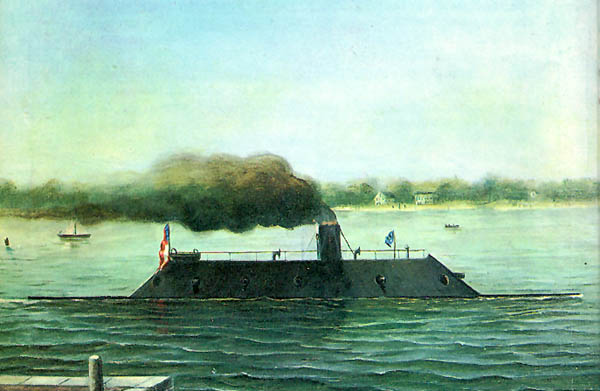
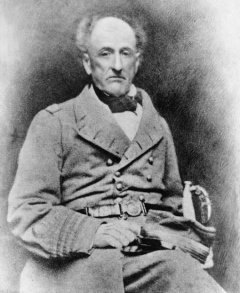
Because of the greater industrial ability of the north and their wealth of resources work on the Union ironclad proceeded much faster than in the south despite the Confederate head start. The Confederates built on the hull of the Merrimack a warship with a massive armored casemate mounting ten guns port and starboard and a massive iron ram at the bow that was intended to make short work of any craft no matter how well protected. She was commissioned on February 17, 1862 as the CSS Virginia and entrusted to the command of a veteran sailor from Maryland, Captain Franklin Buchanan. Because of the urgency involved once the south learned that the Union was constructing an ironclad of their own, the ram had to be rushed into service with workmen still aboard and without a formal shakedown cruise. Nonetheless, it seemed an impressive craft in every way expect for the disabilities the ship inherited. One of these was her deep draft which prevented her from maneuvering in certain areas of the shallow river system at anything but high tide. The most significant, however, was her faulty engines which had not been in great shape even before sitting some months under water. Confederate engineers tinkered with them to get them running but they were still so sluggish when the Virginia got underway that it took the vessel half an hour to turn completely around. |
|
|
After only 120 days of construction the Union ironclad, named USS Monitor, left New York and was rushed to Virginia to confront the Confederate vessel most still referred to as the Merrimack. US President Lincoln and his cabinet were in a state of near panic by the mere presence of the rebel ironclad. The Union army was halted in place and defenses in Washington DC were hurriedly strengthened for fear that the Confederate monster would make short work of their ships, sail up river and shell the capital. Everyone looked nervously at the waters of Virginia; the Confederates with hope and the federals with fear as the Merrimack steamed into Hampton Roads to engage the Union blockaders on March 8, 1862. Captain Franklin Buchanan was assisted by a motley assortment of wooden gunboats, but these mostly hung back as there was no doubt who the belle of the ball was. In the absence of the Monitor, for this one day, the Confederates faced five wooden frigates, particularly the proud vessels Minnesota, and the veteran warships with long records of service Congress and Cumberland which had recently been fitted with the latest rifled cannon. Some officers, representing the pride of the US Navy, were contemptuous of the Confederate ironclad and assured their men that one good, old fashioned broadside would send her to the bottom. |
|
|
As the CSS Virginia steamed into Hampton Roads she was first spotted by the USS Congress under Lieutenant Joseph B. Smith. He and Captain Buchanan on the Virginia both gave their crews a pep talk that echoed the famous words of Lord Nelson at Trafalgar. The Confederacy and the Union would expect every man to do his duty. Both ships beat to quarters and as the rebel ironclad approached Smith ordered the Congress to fire a broadside. The result caused many hearts to sink on the Union frigate. In this first battle test of ironclad technology the federal fusillade had no effect on the Confederate ship as the shots bounced harmlessly off the hull of the Merrimack as the southern sailors cheered in relief. Captain Buchanan, however, made no response and simply ignored the Congress. As she seemed to be no threat to his ship, he decided to take on the Cumberland first as her rifled weaponry were a potential concern. Much later it would be learned how wise Captain Buchanan was in this case as it was the Cumberland which was to inflict more damage on the Confederate ship than any other in the two-day battle. As the CSS Virginia steamed slowly forward the Cumberland began blasting away with everything she had but to little effect. |
|
|
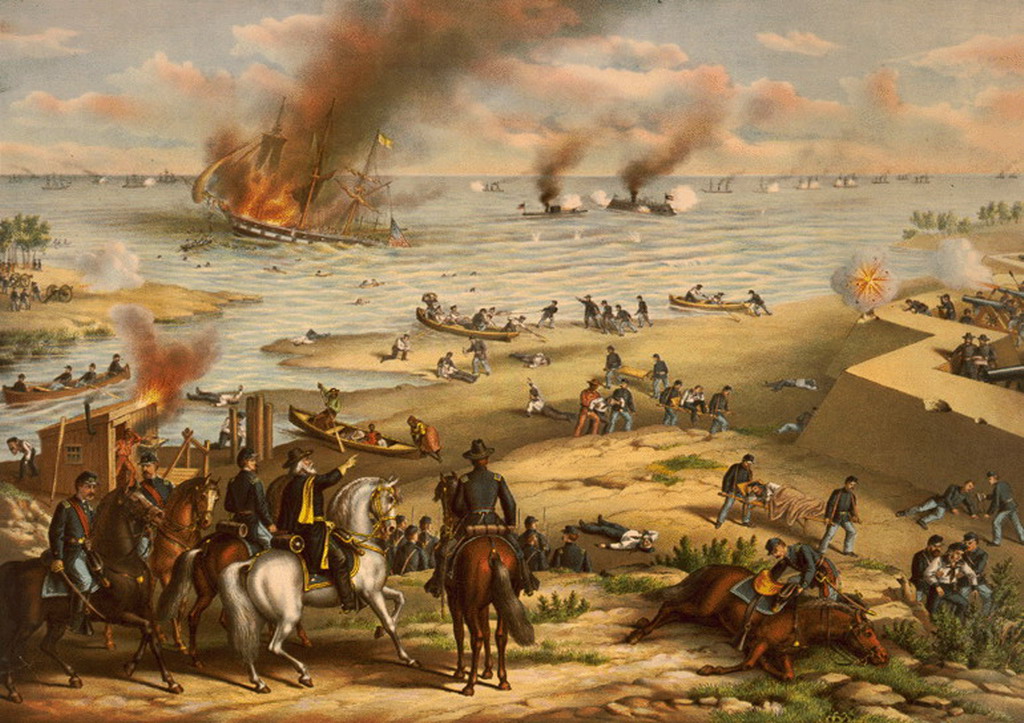
Other vessels and shore batteries joined in the firefight as Captain Buchanan steered his ship to ram the Cumberland. The result was horrific as the Confederate ironclad plowed into the federal frigate with massive force and tore a huge gash in the wooden vessel. At first it was feared that the Virginia would hang but she reversed her engines and soon pulled free. Captain Buchanan praised his enemy for their courage as the Cumberland crew continued to fire away at the rebel ship so long as her guns were above the waterline. The gallant USS Cumberland literally went down with guns blazing. The Confederates had been damaged because of the heroic fight, losing two guns, her ram, taking some internal damage and some slight external damage but she had survived and slowly began coming back around to seek new prey. Buchanan next set his sights on the Congress which was certainly rattled by seeing their own fire have no effect on the southern ship and watching as the Virginia rammed and sank the proud Cumberland, seemingly impervious to enemy fire. Lt. Smith ordered his ship to ground in shallow water which did not put her out of danger. Buchanan moved in and opened fire, the two ships exchanging broadsides and the Confederates were joined by the wooden gunboats of the James River Squadron under Commander John R. Tucker who moved in like a pack of wolves to blast away at the wounded federal ship. |
|
|
After about an hour of getting shot to pieces and taking heavy losses (120 men including the captain, Lt. Smith) the surviving officers of the Congress decided to strike their colors and surrender. As the Stars & Stripes were lowered the southern sailors cheered their victory, however, the celebration was soon interrupted by fire from Union troops on the shore at Newport News Point under General Joe Mansfield while a cease-fire was underway as the Union sailors were evacuating their ship. This was a violation of military protocol given that the Congress had just surrendered and the very honorable Captain Buchanan was outraged. In a typical fit of rage and southern bravado the salty, old Captain Buchanan grabbed a rifle and climbed up on deck and began shooting back at the Union troops despite the pleas of his subordinates. In quick order a Union sharpshooter hit Buchanan in the thigh, shattering his femur. The enraged southern captain passed command to his executive officer, Lieutenant Catesby Jones, but not before ordering him to recommence firing on the Congress. The gunners were to use hot-shot; that is, cannon balls that had been heated to red-hot intensity and Jones was ordered not to stop until the Union ship was burning. Lt. Jones followed orders and soon after the magazine on the Congress was hit and the Union frigate went up in a massive explosion. |
|
|
|
 |
|
|
|
 |
|
|
|
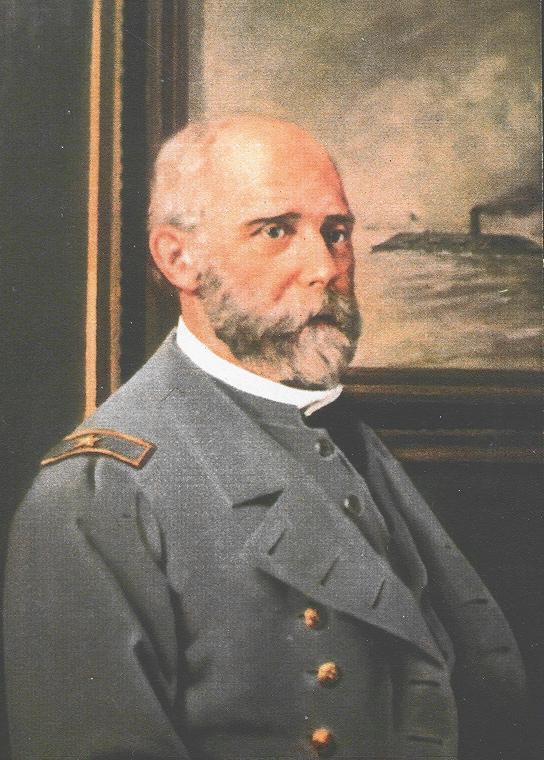
Captain Franklin Buchanan and Lieutenant Catesby Jones, CSN |
|
|
The Merrimack, now under the command of Catesby Jones, would have turned her full attention to the remaining frigate USS Minnesota, however, the Union ship had grounded in shallow water and the Confederate ship could not approach her without running the risk of grounding as well. This was an undesirable side effect of the rebel ship being built on the hull of a frigate which drew just as much water as her ocean going opponents. Lieutenant Jones decided to head back to Confederate waters for the night and return to sink the Minnesota the next morning. In any event, the first day of the battle of Hampton Roads was over and it had been an astounding success for the Confederate Navy. Stephen R. Mallory, Secretary of the Navy, sent a glowing account of the fight to Confederate President Jefferson Davis. However, Confederate dominance of the waves was to last for only one day as during that same night the federal ironclad, USS Monitor, under the command of Lieutenant John L. Worden arrived on the scene at Hampton Roads to defend the helpless Minnesota and stop the Merrimack. All the Union sailors knew that their fate depended on the odd little ironclad under Worden. Despite being more advanced there must have been some fears considering how much smaller the Monitor was compared to the Merrimack and the fact that she mounted only two guns to the ten of her enemy. |
|
|
As the day of March 9, 1862 opened the somewhat repaired Merrimack (officially the CSS Virginia) steamed out toward the Minnesota. There Lt. Jones found the Monitor and the two vessels began circling each other like two boxers about to slug it out. The two ships quickly began blazing away at each other, exchanging shot after shot to little effect. The Monitor was able to swim rings around the large, lumbering Merrimack and thanks to her revolving turret could bring her guns to bear from any direction whereas the Confederates were restricted by their gun ports to firing broadsides when the Monitor was alongside. The Union ship also benefited from having such a low profile with her gun turret being the only major target since the deck was only a mere 14 inches above the waterline. However, the southern gunners blasted away at the small craft as the northern sailors did in return. As the two ships maneuvered around the Virginia ran aground. Stuck in the mud like a sitting duck Jones employed desperate measures to pull his ship free, pushing his beleaguered engines to their breaking point and nearly bursting the boilers before the ship finally pulled free. |
|
|
Shells flew back and forth, making horrendous noise as they glanced off the hulls but doing no critical damage. Seeing the futility of this Lieutenant Jones tried to ram the Monitor but the nimble Union ship was able to turn slightly away at the last moment and only a glancing blow was struck. Hour after hour the two ironclads circled each other exchanging fire that would have sent any other ship in the world swiftly to the bottom. Finally, as the two ships were in very close proximity, the Confederates were able to score a direct hit on the pilot house of the Monitor, blinding her captain, John Worden. Rattled by the loss of her commander the Union ironclad quickly retreated to shallow water where the Merrimack could not follow. Worden passed command to his executive officer Lieutenant Samuel Green who resumed the battle for about an hour before retreating. It was, by then, fairly late in the day and the Confederates thought she had given up the fight. Lt. Jones first thought to return to his original mission and sink the Minnesota which had already been damaged in the heavy firing of the dueling ironclads. However, the tide was running out too fast and the CSS Virginia could not get close to the Minnesota and was forced to return to port while there was still deep enough water for her to do so. When the Monitor later returned to the scene of the battle she found the Merrimack gone and the battle over. |
|
|
 |
|
|
Both sides, naturally, claimed victory but the verdict of history has been that it was a draw. The Confederates had sunk two of the largest ships in the Union navy and badly damaged a third. They had inflicted heavy losses on the Yankees; 261 killed and 108 wounded compared to only 7 killed and 17 wounded of their own. It was the deadliest day in the history of the US Navy until December 7, 1941 and yet, if the battle was a tactical victory for the south (also argued since the Monitor had been the first to withdraw) it did not change the overall strategic situation. The Union squadron still blockaded Hampton Roads and as long as the Monitor was on guard there seemed little hope that this basic fact could be altered. Lieutenant Worden went on to serve with distinction in the remainder of the war, eventually rising to the rank of Captain. Confederate Captain Franklin Buchanan had to have his leg amputated but was later promoted to Rear Admiral and commanded the largest ironclad of the war (his flagship CSS Tennessee) as commander of the Mobile Bay Squadron in another hopeless battle. Both survived the war but the same could not be said for the most famous commands of the two men. When the Confederates were forced to retreat further upriver they could not take the Virginia with them and so scuttled the ship to keep it from falling into Union hands on May 11, 1862. The USS Monitor was sunk in a gale off Cape Hatteras, North Carolina on December 31, 1862 while being towed south. |
|
|
For a battle in which neither side was able to destroy the other the duel between the two ironclads had far-reaching consequences which were felt all around the world and remain with us to this day. The age of tall ships and iron men was gone to be replaced by tall men on iron ships. Soon, all around the world, navies began phasing out their wooden ships and replacing them with armored craft and guns in revolving turrets. This eventually gave birth to the age of the dreadnaught which saw its peak in the big gun battleships of World War I and which was to last until the rise in dominance of the aircraft carrier in World War II. However, at least one battleship remained in service in the US Navy as late as the First Persian Gulf War and that ship, and all others like her, owed something of their existence to the pioneers of the War Between the States and that first clash of armor at sea in the duel of the Monitor and the Merrimack at the battle of Hampton Roads. |
|
|
|
|
|